ISBN:
9780323722490
Copyright:
2023
Publication Date:
01-25-2022
Page Count:
368
Imprint:
Elsevier
List Price:
$60.99

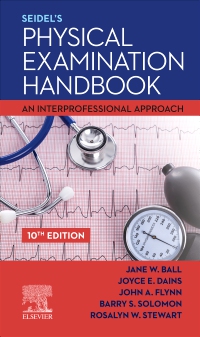
Seidel's Physical Examination Handbook - Elsevier EBook on VitalSource, 10th Edition
by Jane W. Ball, RN? DrPH? CPNP, Joyce E. Dains, DrPH, JD, APRN, FNP-BC, FNAP, FAANP, FAAN, John A. Flynn, MD, MBA, MEd, Barry S. Solomon, MD, MPH and Rosalyn W. Stewart, MD, MS, MBA
Elsevier eBook on VitalSource
ISBN:
9780323722490
Copyright:
2023
Publication Date:
01-25-2022
Page Count:
368
Imprint:
Elsevier
List Price:
$60.99
Was
$60.99
Now $42.69
Or $0.00 with a valid access code
Get a quick reference to the interviewing and physical examination techniques and procedures covered in the Seidel textbook with this handy guide! Seidel's Physical Examination Handbook: An Interprofessional Approach, 10th Edition uses step-by-step guidelines to make exam procedures easier to review and recall. Overviews of the entire health history and physical exam address the full lifespan, from infants, children, and adolescents to older adults. Written by the same interprofessional team of advanced practice nurses and physicians as Seidel's Guide to Physical Examination, chapters in the handbook correspond to the chapters in the textbook. It’s ideal for use in clinicals and in daily practice!
New Edition Expected Availability: 03-19-2026
Seidel's Physical Examination Handbook: An Interprofessional Approach - Elsevier E-Book on VitalSource
Elsevier eBook on VitalSource
ISBN: 9780443409172
-
- NEW! Updated content throughout the book corresponds to the updated clinical content, features, and emphases of Seidel's Guide to Physical Examination, 10th Edition
- NEW chapter on care of transgender and gender-diverse patients provides need-to-know content to help you care for the needs of this underserved patient population
-
- NEW! Nora AI - an AI-powered learning assistant exclusive to Elsevier ebooks on VitalSource's Bookshelf® platform - offers built-in AI learning support that provides personalized answers based on content from the Elsevier ebook
- Two-column Examination sections provide a quick, reliable reference to key exam steps, along with expected and unexpected findings
- Aids to Differential Diagnosis tables summarize distinguishing characteristics of abnormalities, furnishing you with clues for identifying symptoms and diagnosing patient problems
- Color-coded Pediatric Variations tables provide a convenient resource on differences in findings as well as developmental considerations for pediatric patients
- Sample Documentation sections in body systems chapters promote concise yet thorough examples of patient charting for each system exam, applicable both to traditional charting and electronic health records
- More than 200 full-color illustrations of anatomy and physiology, examination procedures, and normal and abnormal findings offer a visual reference to performing exams and to anticipated and unanticipated findings
-
1. The History
2. Vital Signs and Pain Assessment
3. Mental Status
4. Growth and Nutrition
5. Skin, Hair, and Nails
6. Lymphatic System
7. Head and Neck
8. Eyes
9. Ears, Nose, and Throat
10. Chest and Lungs
11. Heart
12. Blood Vessels
13. Breasts and Axillae
14. Abdomen
15. Female Genitalia
16. Male Genitalia
17. Anus, Rectum, and Prostate
18. Musculoskeletal System
19. Neurologic System
20. Head-to-Toe Examination: Adult
21. Age-Specific Examination: Infants, Children, and Adolescents
22. Age-Specific Examination: Special Populations and Older Adults
23. The Healthy Female Evaluation
24. Sports Participation Evaluation
25. Documentation
Appendix A: Quick Reference to Special Histories
Appendix B: CDC and WHO Growth Charts -
-
Ways of Reading
- The appearance of the text and page layout can be modified according to the capabilities of the reading system (font family and font size, spaces between paragraphs, sentences, words, and letters, as well as color of background and text)
- This e-publication is accessible to the full extent that the file format and types of content allow, on a specific reading device, by default, without necessarily including any additions such as textual descriptions of images or enhanced navigation
- No information about nonvisual reading is available
-
Conformance
- For detailed accessibility information, see Elsevier's website at https://www.elsevier.com/about/accessibility
- For queries regarding accessibility information, contact [email protected]
- The publication was certified on 18-11-2025
-
Navigation
- Table of contents to all chapters of the text via links
-
Rich Content
- No information is available
-
Hazards
- No information is available
-
Product Content
- No information is available
-
Legal Considerations
- No information is available
-
Additional Accessibility Information
- For readers with color vision deficiency, use of color (e.g., in diagrams, graphics and charts, in prompts, or on buttons inviting a response) is not the sole means of graphical distinction or of conveying information
- E-publication includes basic navigation (usually less detailed than TOC-based navigation)
- Where links, controls or buttons are included in the content, the purpose or functionality of each link, control or button is apparent from the associated text alone - or where it is unclear, separate link, control or button descriptions are provided
- All (or substantially all) textual matter is arranged in a single logical reading order (including text that is visually presented as separate from the main text flow, e.g., in boxouts, captions, tables, footnotes, endnotes, citations, etc.). Non-textual content is also linked from within this logical reading order. (Purely decorative non-text content can be ignored).
- The language of the text has been specified (e.g., via the HTML or XML lang attribute) to optimise text-to-speech (and other alternative renderings), both at the whole document level and, where appropriate, for individual words, phrases or passages in a different language.
-
Ways of Reading
Was
$60.99
Now $42.69
Or $0.00 with a valid access code

 as described in our