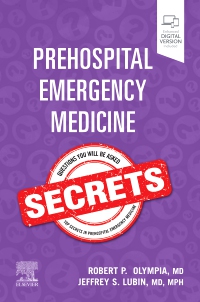

Prehospital Emergency Medicine Secrets, Elsevier E-Book on VitalSource, 1st Edition
Elsevier eBook on VitalSource
-
- The proven Secrets Series® format gives you the most return for your time – succinct, easy to read, engaging, and highly effective
- Covers the full range of essential topics including disaster and multiple casualty incidents, psychiatric emergencies, and prehospital skills and procedures for in-training or practicing professionals
- Fully revised and updated, including protocols and guidelines that are continuously evolving and that increasingly dictate best practices
- Includes chapters on public health and EMS, infectious disease emergencies/sepsis, telemedicine and emerging telecommunications, transport of the highly infectious patient, mass casualty evacuation and patient movement, biological and chemical terrorism, community disaster preparedness, and airway management, oxygenation, and ventilation
- Top 100 Secrets and Key Points boxes provide a fast overview of the secrets you must know for success in practice and on exams
- Bulleted lists, mnemonics, practical tips from global leaders in the field – all providing a concise overview of important board-relevant content
- Portable size makes it easy to carry with you for quick reference or review anywhere, anytime
- Enhanced eBook version included with purchase. Your enhanced eBook allows you to access all of the text, figures, and references from the book on a variety of devices
-
-
 Prehospital Emergency Medicine SecretsPaperback
-
-
1. History of Emergency Medical Services
2. Destination Guidelines and Hospital Designation
3. Emergency Vehicle Operation, EMS System Design, and Prehospital Communications
4. Media and Public Relations
5. Medical direction and Medicolegal Issues
6. Public Health and EMS
7. Quality Improvement and Research in EMS
8. Scene safety
9. Critical incident stress and Occupational Health Issues in EMS
10. Prehospital Physical Assessment and Critical Interpretation of Vital Signs
11. Cardiac Arrest, Including ECMO
12. Hypotension and Shock
13. Altered Mental Status
14. Arrhythmias and Electrocardiogram Interpretation
15. Cardiac Emergencies--Chest Pain, STEMI, ACS, CHF
16. Cardiac Device Emergencies
17. Gastrointestinal Emergencies
18. Diabetic Emergencies
19. Sepsis
20. Obstetric and Gynecologic Emergencies
21. Dyspnea
22. Seizures
23. Stroke and Transient Ischemic Attack
24. Syncope
25. General Adult Trauma Principles and Triage
26. Head Injuries and Facial Trauma
27. Cervical Spine and Spinal Cord Injuries
28. Chest, Abdominal, and Pelvic Injuries
29. Extremity Injuries
30. Thermal Burns and Inhalational Injuries
31. Care of the Entrapped Patient, Including Crush Injury
32. Prehospital Physical Assessment and Critical Interpretation of Vital Signs
33. Cardiac Arrest and Arrhythmias
34. Shock
35. Altered Mental Status
36. Chest Pain and Syncope
37. Respiratory Distress Emergencies
38. Seizures
39. Technology Dependent Children
40. General Pediatric Trauma Principles and Triage
40. Technology Dependent Children
41. Head Injuries and Facial Trauma
42. Cervical Spine and Spinal Cord Injuries
43. Chest, Abdominal, and Pelvic Injuries
44. Extremity Injuries
45. Thermal Burns and Inhalational Injuries
46. General Principles in Disasters and Multiple Casualty Incidents
46. General Principles in Disasters and Mass Casualty Incidents
47. Prehospital Triage for Mass Casualties
48. Mass Casualty Evacuation and Patient Movement
49. Biological and Chemical Terrorism
50. Radiation and Radiation Injury
51. Blast Injuries
52. Hazardous Materials Response
53. Tactical Emergency Medical Services
54. Search and Rescue
55. Community Disaster Preparedness
56. General Principles in Wilderness Medicine
56. General Principles in Wilderness Medicine
57. Bites, Stings, and Envenomations
58. Dysbarisms
59. Heat and Cold Related Illness
60. Lightning and Electrical Emergencies
61. Drowning and Submersion Injury
62. Interfacility Transport, Including Ground Critical Care Transport
63. Bariatric Emergencies
64. Geriatric Emergencies
65. Aeromedical Transport
66. Community Paramedicine
67. Intimate Partner Violence, Sexual Assault, and Child Maltreatment
68. End of Life Issues
69. Poisonings and Toxic Exposures
70. Airway Management, Oxygenation and Ventilation
71. Analgesia
72. Care of the Agitated/Suicidal Patient
73. CPR, AED, and Mechanical Compression
74. Field Amputation
75. Hemorrhage Control
76. Intravascular/Interosseous Access and Fluids Resuscitation
77. Perimortem Caesarian Section
78. EMS Point of Care Testing
79. Procedures in the Trauma Patient
80. Telemedicine and Emerging Telecommunications
81. +A2:A85Transport of the Highly Infectious Patient -
-
Ways of Reading
- The appearance of the text and page layout can be modified according to the capabilities of the reading system (font family and font size, spaces between paragraphs, sentences, words, and letters, as well as color of background and text)
- This e-publication is accessible to the full extent that the file format and types of content allow, on a specific reading device, by default, without necessarily including any additions such as textual descriptions of images or enhanced navigation
- All content can be read as read aloud speech or dynamic braille
- Has alternative text descriptions for images
-
Conformance
- The certifier's credential is https://bornaccessible.benetech.org/certified-publishers/
- The publication was certified on 19-03-2026
-
Navigation
- Table of contents to all chapters of the text via links
- Index with links to referenced entries
- Page list to go to pages from the print source version
-
Rich Content
- Math formulas in accessible format (MathML)
- Information-rich images are described by extended descriptions
-
Hazards
- The publication contains no hazards
-
Product Content
- The primary content is text.
- Content includes a significant number of actionable (clickable) web links to external content, downloadable resources, supplementary material, etc.
- Content includes a significant number of actionable (clickable) cross-references, hyperlinked notes and annotations, or with other actionable links between largely textual elements (e.g., quiz/test questions, 'choose your own ending', etc.).
- Content includes additional textual content such as an interview, feature article, essay, bibliography, quiz/test, other background material, or text that is not included in a primary or 'unenhanced' version.
- Content includes photographs, whether in a plate section / insert or not.
- Content includes figures, diagrams, charts and/or graphs, including other 'mechanical' (i.e. non-photographic) illustrations.
- Content includes animated / interactive illustrations, e.g., animated diagrams, charts, graphs or other illustrations (usually without sound).
- Content includes narrative animation, e.g., cartoon, animatic or CGI animation (usually includes sound).
- Content includes text within images, including text-as-text embedded in diagrams, charts, or within images containing speech balloons, thought bubbles, captions, etc.
- At least some text - including text within other images - is 'text as an image' (i.e., a picture of text).
- Product includes actionable (clickable) links to external interactive content.
-
Legal Considerations
- No information is available
-
Additional Accessibility Information
- Content is enhanced with ARIA roles to optimize organization and facilitate navigation
- Page breaks included from the original print source
- For readers with color vision deficiency, use of color (e.g., in diagrams, graphics and charts, in prompts, or on buttons inviting a response) is not the sole means of graphical distinction or of conveying information
- The body text is presented with a contrast ratio of at least 4.5:1 (or 3:1 for large/heading text)
- Ultra-high contrast between text and background
- E-publication includes basic navigation (usually less detailed than TOC-based navigation)
- Where links, controls or buttons are included in the content, the purpose or functionality of each link, control or button is apparent from the associated text alone - or where it is unclear, separate link, control or button descriptions are provided
- All (or substantially all) textual matter is arranged in a single logical reading order (including text that is visually presented as separate from the main text flow, e.g., in boxouts, captions, tables, footnotes, endnotes, citations, etc.). Non-textual content is also linked from within this logical reading order. (Purely decorative non-text content can be ignored).
- Content provides explanations for unusual words, abbreviations, acronyms, idioms, jargon in an accessible form, such as glossaries, scripted pop-ups.
- Where interactive content is included in the product, controls are provided (e.g., for speed, pause and resume, reset) and labelled to make their use clear.
- The language of the text has been specified (e.g., via the HTML or XML lang attribute) to optimise text-to-speech (and other alternative renderings), both at the whole document level and, where appropriate, for individual words, phrases or passages in a different language.
-
Ways of Reading

 as described in our