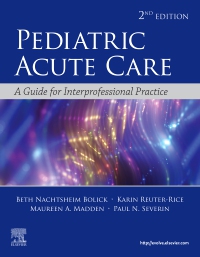

Pediatric Acute Care, 2nd Edition
Elsevier eBook on VitalSource
Now $89.59
**Selected for Doody’s Core Titles® 2024 in Critical Care**
Stay up-to-date on the latest evidence and clinical practice in pediatric acute care with the definitive textbook in the field. Now in its second edition, Pediatric Acute Care: A Guide for Interprofessional Practice takes an evidence-based, interprofessional approach to pediatric acute care as it exemplifies the depth and diversity that’s needed for the dynamic healthcare environments in which acutely ill children receive care. Coverage includes how to work with the pediatric patient and family, major acute care disorders and their management, emergency preparedness, common acute care procedures, and much more. With contributions from more than 200 practicing clinicians and academic experts, it represents a wide variety of disciplines including medicine, nursing, pharmacy, child life, nutrition, law, integrative medicine, education, public health, and psychology, among others. The second edition also features the addition of new physician and nurse practitioner co-editors as well as extensive content updates including updated evidence-based content throughout the text, the integration of the 2016 IPEC Core Competencies for Interprofessional Collaborative Practice, a new full-color design, and new vivid illustrations throughout.
-
- NEW! Updated evidence-based content has been added throughout to ensure that you’re up-to-date on all topics needed to provide care for pediatric patients in acute, inpatient, emergency, transport, and critical care settings
- NEW! Full-color design and illustrations enhance learning and make content easier to navigate and digest
- NEW! Integration of the 2016 IPEC Core Competencies ensure that you’re learning the professional skills and protocols required for effective, contemporary interprofessional collaborative practice
- UPDATED! Streamlined procedures unit focuses more sharply on need-to-know content
-
- NEW! Nora AI - an AI-powered learning assistant exclusive to Elsevier ebooks on VitalSource's Bookshelf® platform - offers built-in AI learning support that provides personalized answers based on content from the Elsevier ebook
- UNIQUE! Interprofessional collaborative approach includes contributions from more than 200 practicing clinicians and academic experts from the U.S. and Canada, including nursing, medicine, pharmacy, child life, nutrition, law, integrative medicine, education, public health, and psychology
- Consistent organization within disorder chapters begins with a section on Physiology and continues with sections on Pathophysiology, Epidemiology and Etiology, Presentation, Differential Diagnosis, Diagnostic Studies, and a Plan of Care that include Therapeutic Management, Consultation, Patient and Family Education and Disposition and Discharge Planning
- Comprehensive content spanning five units divides coverage into introductory information, the approach to the pediatric patient and family, major acute care disorders and their management, emergency preparedness, and common acute care procedures
-
-

-
 Pediatric Acute CarePaperback
-
-
Part I. Interprofessional Patient Care
1. The Interprofessional Team
2. Research and Evidence-Based Practice
3. Certification, Licensure, and Credentialing/Privileging
4. Documentation and Coding
5. Team Communication and Handoffs
6. Patient Safety
Part II. Approach to the Pediatric Patient and Family
7. Child Life: Developmental Considerations
8. Patient and Family-Centered Care
9. Communicating Bad News
10. Ethical Considerations
11. Care of the Minor and Legal Implications
12. Transition to Adulthood
13. Care of Children with Medical Complexity
14. Management in the Emergency Setting
15. Management in the Inpatient Setting
16. The Premature Infant in the Pediatric Acute Care Setting
17. Management of the Chronically Critically Ill
18. Transport of the Ill or Injured Pediatric Patient
19. Rehabilitation
20. Palliative Care and Integrative Medicine
Part III. Selected Disorders and Their Management
21. Analgesia, Paralytics, Sedation, Withdrawal, and Opioid Disorders
22. Cardiac Disorders
23. Dermatologic Disorders
24. Endocrine Disorders
25. Fluid, Electrolytes, and Nutrition
26. Gastrointestinal Disorders
27. Genetic and Metabolic Disorders
28. Hematologic and Oncologic Disorders
29. Immunologic/Autoimmune and Rheumatologic Disorders
30. Infectious Disorders
31. Kidney and Genitourinary Disorders
32. Musculoskeletal Disorders
33. Neurologic Disorders
34. Orofacial Disorders
35. Pulmonary Disorders
36. Child Maltreatment
37. Toxicologic Exposures
38. Traumatic Injuries
Part IV. Emergency Preparedness
39. Principles of Disaster Management and Clinical Practice
Part V. Procedures
40. Arterial Catheter Insertion
41. Central Venous Catheter Insertion and Removal
42. Chest Tube Insertion and Removal
43. Intracardiac Line Removal
44. Intraventricular Catheter Insertion and Shunt Access
45. Lumbar Puncture
46. Postpyloric Feeding Tube Insertion
47. Peripherally Inserted Central Venous Catheter (PICC) Insertion and Removal
48. Peritoneal Catheter Insertion
49. Rapid-Sequence Intubation
50. Ultrasound Guidance
51. Wound Closure
Part VI. Lab Values
52. Laboratory Values
Part VII. Learning and Evaluation
53. Simulation
54. The Role of Assessment in Teaching and Learning -
-
Ways of Reading
- The appearance of the text and page layout can be modified according to the capabilities of the reading system (font family and font size, spaces between paragraphs, sentences, words, and letters, as well as color of background and text)
- This e-publication is accessible to the full extent that the file format and types of content allow, on a specific reading device, by default, without necessarily including any additions such as textual descriptions of images or enhanced navigation
- All content can be read as read aloud speech or dynamic braille
- Has alternative text descriptions for images
-
Conformance
- The publication contains a conformance statement that it meets the EPUB Accessibility 1.1, WCAG 2.1, Level AA standard. Please see https://bornaccessible.benetech.org/certified-publishers/ for further details of our compatibility testing.
- The certifier's credential is https://bornaccessible.benetech.org/certified-publishers/
- For detailed accessibility information, see Elsevier's website at https://www.elsevier.com/about/accessibility
- For queries regarding accessibility information, contact [email protected]
- The publication was certified on 11-02-2026
-
Navigation
- Table of contents to all chapters of the text via links
- Index with links to referenced entries
- Elements such as headings, tables, etc. for structured navigation
- Page list to go to pages from the print source version
-
Rich Content
- Information-rich images are described by extended descriptions
-
Hazards
- The publication contains no hazards
-
Product Content
- Content includes any type of illustrations.
- The primary content is text.
- Content includes a significant number of actionable (clickable) web links to external content, downloadable resources, supplementary material, etc.
- Content includes a significant number of actionable (clickable) cross-references, hyperlinked notes and annotations, or with other actionable links between largely textual elements (e.g., quiz/test questions, 'choose your own ending', etc.).
- Content includes figures, diagrams, charts and/or graphs, including other 'mechanical' (i.e. non-photographic) illustrations.
- Content includes a significant number of web links (printed URLs, QR codes etc.).
- Content includes text within images, including text-as-text embedded in diagrams, charts, or within images containing speech balloons, thought bubbles, captions, etc.
- Content includes chemical notations, formulae.
- Content includes mathematical notations, formulae.
-
Legal Considerations
- No information is available
-
Additional Accessibility Information
- Content is enhanced with ARIA roles to optimize organization and facilitate navigation
- Page breaks included from the original print source
- For readers with color vision deficiency, use of color (e.g., in diagrams, graphics and charts, in prompts, or on buttons inviting a response) is not the sole means of graphical distinction or of conveying information
- The body text is presented with a contrast ratio of at least 4.5:1 (or 3:1 for large/heading text)
- Ultra-high contrast between text and background
- E-publication includes basic navigation (usually less detailed than TOC-based navigation)
- Where links, controls or buttons are included in the content, the purpose or functionality of each link, control or button is apparent from the associated text alone - or where it is unclear, separate link, control or button descriptions are provided
- All (or substantially all) textual matter is arranged in a single logical reading order (including text that is visually presented as separate from the main text flow, e.g., in boxouts, captions, tables, footnotes, endnotes, citations, etc.). Non-textual content is also linked from within this logical reading order. (Purely decorative non-text content can be ignored).
- Where interactive content is included in the product, controls are provided (e.g., for speed, pause and resume, reset) and labelled to make their use clear.
- The language of the text has been specified (e.g., via the HTML or XML lang attribute) to optimise text-to-speech (and other alternative renderings), both at the whole document level and, where appropriate, for individual words, phrases or passages in a different language.
-
Ways of Reading

 as described in our