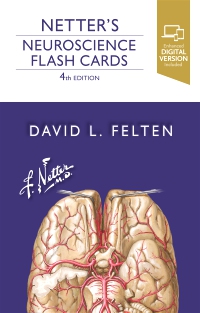

Netter's Neuroscience Flash Cards Elsevier eBook on VitalSource, 4th Edition
Elsevier eBook on VitalSource
Now $40.49
-
- Cards provide clinically important correlations in neuroanatomy, cell biology, and neurophysiology; extensive imaging, cross-sectional anatomy, and vascular information; and clinical pearls and helpful summaries of the results of neurological damage or injuries on the back of each card
- New neuropathology coverage from traumatic brain injury and coma to bipolar disorder and schizophrenia
- New access to cross-sectional anatomy cards online
- Coverage of timely topics such as cannabinoids, opioids, PTSD, OCD, and aging and the nervous system
- Pre-punched holes and convenient binding ring allow you to carry selected groups of flash cards with you anywhere
- A perfect study aid and complement to Dr. Felton’s related titles: Netter’s Atlas of Neuroscience, 3rd Edition (to which the cards are cross-referenced), and Netter’s Neuroscience Coloring Book
- Enhanced eBook version included with purchase. Your enhanced eBook allows you to access all of the text, figures, and references from the book on a variety of devices
-
1 Overview of the Nervous System Plates 1-1 to 1-64
1-22 Anatomy of the Basal Surface of the Brain, with the Brain Stem and Cerebellum Removed
1-23 Brain Imaging: Computed Tomography Scans, Coronal and Sagittal
1-24 Brain Imaging: Magnetic Resonance Imaging, Axial and Sagittal T1-Weighted Images
1-25 Brain Imaging: Magnetic Resonance Imaging, Axial and Sagittal T2-Weighted Images
1-26 Horizontal Brain Sections Showing the Basal Ganglia
1-27 Major Limbic Forebrain Structures
1-28 Color Imaging of the Corpus Callosum by Diffusion Tensor Imaging
1-29 Hippocampal Formation and Fornix
1-30 Thalamic Anatomy
1-31 Thalamic Nuclei
1-32 Brain Stem Surface Anatomy: Posterolateral View
1-33 Brain Stem Surface Anatomy: Anterior View
1-34 Cerebellar Anatomy: Internal Features
1-35 Spinal Column: Bony Anatomy
1-36 Spinal Cord: Gross Anatomy In Situ
1-37 Spinal Cord: Its Meninges and Spinal Roots
1-38 Spinal Cord: Cross-Sectional Anatomy In Situ
1-39 Spinal Cord: White and Gray Matter
1-40 Ventricular Anatomy
1-41 Ventricular Anatomy in Coronal Forebrain Section
1-42 Anatomy of the Fourth Ventricle: Lateral View
1-43 Magnetic Resonance Imaging of the Ventricles: Axial and Coronal Views
1-44 Circulation of the Cerebrospinal Fluid
1-45 Arterial Supply to the Brain and Meninges
1-46 Common Sites of Cerebrovascular Occlusive Disease
1-47 Arterial Distribution to the Brain: Basal View
1-48 Arterial Distribution to the Brain: Cutaway Basal View Showing the Circle of Willis
1-49 Arterial Distribution to the Brain: Coronal Forebrain Section
1-50 Circle of Willis: Schematic Illustration and Vessels In Situ
1-51 Arterial Distribution to the Brain: Lateral and Medial Views
1-52 Magnetic Resonance Angiography: Coronal Full Vessel View
1-53 Vertebrobasilar Arterial System
1-54 Arterial Blood Supply to the Spinal Cord: Longitudinal View
1-55 Arterial Supply to the Spinal Cord: Cross-Sectional View
1-56 Meninges and Superficial Cerebral Veins
1-57 Venous Sinuses
1-58 Magnetic Resonance Venography
1-59 Neurulation
1-60 Neural Tube Development and Neural Crest Formation
1-61 Development of Peripheral Axons
1-62 Early Brain Development: 36-Day-Old Embryo
1-63 Early Brain Development: 49-Day-Old Embryo and 3-Month-Old Embryo
1-64 Development of the Ventricles
2 Regional Neuroscience Plates 2-1 to 2-99
2-1 Spinal Cord and PNS Schematic
2-2 Anatomy of a Peripheral Nerve
2-3 Cutaneous Receptors
2-4 Neuromuscular Junction
2-5 Dermatomal Distribution
2-6 Cutaneous Distribution of Peripheral Nerves
2-7 Cutaneous Nerves of the Head and Neck
2-8 Phrenic Nerve
2-9 Brachial Plexus
2-10 Cutaneous Innervation of the Upper Limb from Peripheral Nerves
2-11 Scapular, Axillary, and Radial Nerves above the Elbow
2-12 Radial Nerve in the Forearm
2-13 Musculocutaneous Nerve
2-14 Median Nerve
2-15 Ulnar Nerve
2-16 Lumbar Plexus
2-17 Sacral and Coccygeal Plexuses
2-18 Femoral and Lateral Femoral Cutaneous Nerves
2-19 Obturator Nerve
2-20 Sciatic and Posterior Femoral Cutaneous Nerves
2-21 Tibial Nerve
2-22 Common Peroneal Nerve
2-23 Schematic of the Autonomic Nervous System
2-24 Autonomic Distribution to the Head and Neck—Medial View
2-25 Autonomic Distribution to the Head and Neck—Lateral View
2-26 Autonomic Distribution to the Eye
2-27 Thoracic Sympathetic Chain and Splanchnic Nerves
2-28 Innervation of the Tracheobronchial Tree
2-29 Innervation of the Heart
2-30 Abdominal Nerves and Ganglia
2-31 Nerves of the Esophagus
2-32 Nerves of the Stomach and Duodenum
2-33 Nerves of the Small Intestine
2-34 Nerves of the Large Intestine
2-35 Enteric Nervous System
2-36 Autonomic Innervation of the Liver and Biliary Tract
2-37 Autonomic Innervation of the Pancreas
2-38 Innervation of the Adrenal Gland
2-39 Nerves of the Kidneys, Ureters, and Urinary Bladder
2-40 Innervation of the Male Reproductive Organs
2-41 Innervation of the Female Reproductive Organs
2-42 Cytoarchitecture of the Spinal Cord Gray Matter
2-43 Spinal Cord Cross Sections 1 (C7, T7)
2-44 Spinal Cord Cross Sections 2 (L4, S2)
2-45 Spinal Cord Imaging
2-46 Spinal Somatic Reflex Pathways
2-47 Muscle and Joint Receptors and Muscle Spindles
2-48 Brain Stem Cross Section: Medulla–Spinal Cord Transition
2-49 Brain Stem Cross Section: Medulla at the Level of the Obex
2-50 Brain Stem Cross Section: Medulla at the Level of the Inferior Olive
2-51 Brain Stem Cross Section: Medulla at the Level of CN X and the Vestibular Nuclei
2-52 Brain Stem Cross Section: Medullo-Pontine Junction
2-53 Brain Stem Cross Section: Pons at the Level of the Facial Nucleus
2-54 Brain Stem Cross Section: Pons at the Level of the Genu of the Facial Nerve
2-55 Brain Stem Cross Sections: Pons at the Level of the Trigeminal Motor and Main Sensory Nuclei
2-56 Brain Stem Cross Section: Pons-Midbrain Junction
2-57 Brain Stem Cross Section: Midbrain at the Level of the Inferior Colliculus
2-58 Brain Stem Cross Section: Midbrain at the Level of the Superior Colliculus and Geniculate Nuclei
2-59 Brain Stem Cross Section: Midbrain-Diencephalic Junction
2-60 Brain Stem Arterial Syndromes
2-61 Cranial Nerves: Basal View of the Brain
2-62 Cranial Nerves and Their Nuclei: Schematic View
2-63 Nerves of the Orbit
2-64 Extraocular Cranial Nerves
2-65 Trigeminal Nerve (CN V)
2-66 Facial Nerve (CN VII)
2-67 Vestibulocochlear Nerve (CN VIII)
2-68 Glossopharyngeal Nerve (CN IX)
2-69 Vagus Nerve (CN X)
2-70 Accessory Nerve (CN XI)
2-71 Hypoglossal Nerve (CN XII)
2-72 Reticular Formation and Nuclei
2-73 Sleep-Wakefulness Control
2-74 Cerebellar Organization: Lobes and Regions
2-75 Cerebellar Anatomy: Deep Nuclei and Cerebellar Peduncles
2-76 Thalamic Anatomy and Interconnections with the Cerebral Cortex
2-77 Hypothalamus and Pituitary Gland
2-78 Hypothalamic Nuclei
2-79 Axial Sections through the Forebrain: Midpons
2-80 Axial Sections through the Forebrain: Midbrain
2-81 Axial Sections through the Forebrain: Rostral Midbrain and Hypothalamus
2-82 Axial Sections through the Forebrain: Anterior Commissure and Caudal Thalamus
2-83 Axial Sections through the Forebrain: Head of the Cudate Nucleus and Midthalamus
2-84 Axial Sections through the Forebrain: Basal Ganglia and Internal Capsule
2-85 Axial Section through the Forebrain: Dorsal Caudate Nucleus, Splenium and Genu of the Internal Capsule
2-86 Coronal Sections through the Forebrain: Genu of the Corpus Callosum
2-87 Coronal Sections through the Forebrain: Head of the Caudate Nucleus and Nucleus Accumbens
2-88 Coronal Sections through the Forebrain: Anterior Commissure and Columns of the Fornix
2-89 Coronal Sections through the Forebrain: Amygdala, Anterior Limb of the Internal Capsule
2-90 Coronal Sections through the Forebrain: Mammillary Bodies
2-91 Coronal Sections through the Forebrain: Midthalamus
2-92 Coronal Sections through the Forebrain: Geniculate Nuclei
2-93 Cortical Association Pathways
2-94 Color Imaging of Projection Pathways from the Cerebral Cortex
2-95 Noradrenergic Pathways
2-96 Serotonergic Pathways
2-97 Dopaminergic Pathways
2-98 Central Cholinergic Pathways
2-99 Olfactory Nerves
3 Systemic Neuroscience Plates 3-1 to 3-62
3-1 Somatosensory Afferents to the Spinal Cord
3-2 Somatosensory System: Spinocerebellar Pathways
3-3 Somatosensory System: Dorsal Column System and Epicritic Modalities
3-4 Somatosensory System: Spinothalamic and Spinoreticular Systems and Protopathic Modalities
3-5 Mechanisms of Neuropathic Pain and Sympathetically Maintained Pain
3-6 Descending Control of Pain Processing
3-7 Trigeminal Sensory and Associated Sensory Systems
3-8 Pain-Sensitive Structures of the Head, and Pain Referral
3-9 Taste Pathways
3-10 Peripheral Pathways for Sound Reception
3-11 Bony and Membranous Labyrinths
3-12 VIII Nerve Innervation of Hair Cells of the Organ of Corti
3-13 Auditory Pathways
3-14 Centrifugal (Efferent) Auditory Pathways
3-15 Vestibular Receptors
3-16 Vestibular Pathways
3-17 Nystagmus
3-18 Anatomy of the Eye
3-19 Anterior and Posterior Chambers of the Eye
3-20 Retina: Retinal Layers
3-21 Arteries and Veins of the Eye
3-22 Optic Chiasm
3-23 Visual Pathways: Retinal Projections to the Thalamus, Hypothalamus, and Brain Stem
3-24 Pupillary Light Reflex
3-25 Visual Pathway: Retino-Geniculo-Calcarine Pathway
3-26 Visual Pathways in the Parietal and Temporal Lobes
3-27 Distribution of Lower Motor Neurons (LMNs) in the Brain Stem
3-28 Cortical Efferent Pathways
3-29 Color Imaging of Cortical Efferent Pathways
3-30 Corticobulbar Tract
3-31 Corticospinal Tract
3-32 Rubrospinal Tract
3-33 Vestibulospinal Tracts
3-34 Reticulospinal Tracts
3-35 Central Control of Eye Movements
3-36 Central Control of Respiration
3-37 Cerebellar Neuronal Circuitry
3-38 Afferent Pathways to the Cerebellum
3-39 Cerebellar Efferent Pathways
3-40 Connections of the Basal Ganglia
3-41 General Organization of the Autonomic Nervous System
3-42 Sections through the Rostral Hypothalamus: Preoptic and Supraoptic Zones
3-43 Sections through the Midhypothalamus: Tuberal Zone
3-44 Sections through the Caudal Hypothalamus: Mammillary Zone
3-45 Schematic Reconstruction of the Hypothalamus
3-46 Afferent and Efferent Pathways Associated with the Hypothalamus
3-47 Paraventricular Nucleus of the Hypothalamus
3-48 Mechanisms of Cytokine Influences on the Hypothalamus and Other Brain Regions and on Behavior
3-49 Circumventricular Organs
3-50 Hypophysial Portal Vasculature
3-51 Regulation of the Anterior Pituitary Hormone Secretion
3-52 Posterior Pituitary (Neurohypophysial) Hormones: Oxytocin and Vasopressin
3-53 Hypothalamus and Thermoregulation
3-54 Hypothalamic Regulation of Cardiac Function
3-55 Neuroimmunomodulation
3-56 Anatomy of the Limbic Forebrain
3-57 Hippocampal Formation: General Anatomy
3-58 Neuronal Connections of the Hippocampal Formation
3-59 Major Afferent and Efferent Connections of the Hippocampal Formation
3-60 Major Efferent Connections of the Amygdala
3-61 Major Connections of the Cingulate Cortex
3-62 Olfactory Pathways -
-
Ways of Reading
- The appearance of the text and page layout can be modified according to the capabilities of the reading system (font family and font size, spaces between paragraphs, sentences, words, and letters, as well as color of background and text)
- This e-publication is accessible to the full extent that the file format and types of content allow, on a specific reading device, by default, without necessarily including any additions such as textual descriptions of images or enhanced navigation
- No information about nonvisual reading is available
-
Conformance
- No information is available
-
Navigation
- Table of contents to all chapters of the text via links
- Page list to go to pages from the print source version
-
Rich Content
- No information is available
-
Hazards
- No information is available
-
Product Content
- No information is available
-
Legal Considerations
- No information is available
-
Additional Accessibility Information
- Page breaks included from the original print source
- For readers with color vision deficiency, use of color (e.g., in diagrams, graphics and charts, in prompts, or on buttons inviting a response) is not the sole means of graphical distinction or of conveying information
- E-publication includes basic navigation (usually less detailed than TOC-based navigation)
- Where links, controls or buttons are included in the content, the purpose or functionality of each link, control or button is apparent from the associated text alone - or where it is unclear, separate link, control or button descriptions are provided
- All (or substantially all) textual matter is arranged in a single logical reading order (including text that is visually presented as separate from the main text flow, e.g., in boxouts, captions, tables, footnotes, endnotes, citations, etc.). Non-textual content is also linked from within this logical reading order. (Purely decorative non-text content can be ignored).
- The language of the text has been specified (e.g., via the HTML or XML lang attribute) to optimise text-to-speech (and other alternative renderings), both at the whole document level and, where appropriate, for individual words, phrases or passages in a different language.
-
Ways of Reading

 as described in our