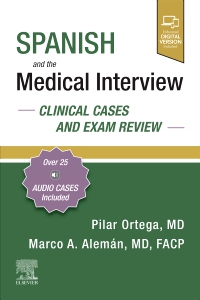

Spanish and the Medical Interview: Clinical Cases and Exam Review - Elsevier E-Book on VitalSource, 1st Edition
Elsevier eBook on VitalSource
Now $26.59
Offering a practical, case-based approach, Spanish and the Medical Interview: Clinical Cases and Exam Review is a unique, immersive study and review resource for medical Spanish. It provides extensive training and review in two formats: the print book contains numerous cases spanning a wide variety of clinical settings, formatted as a patient would present for medical attention, while the audio cases provide multiple opportunities to hone your listening comprehension skills. Together, these learning components test your knowledge and skills in caring for Spanish-speaking patients and prepare you for case-based examinations that test clinical skills in Spanish.
This first-of-its-kind title is ideal as a stand-alone resource or as a companion to Dr. Ortega’s Spanish and the Medical Interview: A Textbook for Clinically Relevant Medical Spanish.
-
- NEW! Nora AI - an AI-powered learning assistant exclusive to Elsevier ebooks on VitalSource's Bookshelf® platform - offers built-in AI learning support that provides personalized answers based on content from the Elsevier ebook
- Helps you improve your interviewing skills, your understanding of patient responses, and your ability to explain a diagnosis and plan of care to Spanish-speaking patients, so you can provide a higher quality of patient care and safety in your practice
- Covers multiple presentations of cases in main organ system areas, including musculoskeletal, cardiovascular, pulmonary, gastrointestinal, endocrine, genitourinary, neurologic, psychiatric, eye/ear/nose/throat, and pediatric, in multiple patient care settings such as urgent care, emergency department, outpatient clinic, and inpatient wards
- Focuses on topics that are particularly common in Hispanic/Latino patients and includes cultural health issues that may impact the patient's understanding of medical information, belief system, decision-making preferences, or access to care—all of which have a significant impact on your medical decision making and interviewing styles and effectiveness
- Leads you through key information for each case, prompting you to use your medical Spanish clinical skills in a series of prompts and questions as the case unfolds. Assessment questions follow each case to test your comprehension
- Provides more than two dozen audio cases to improve your listening comprehension of different nationalities and accents of Spanish-speaking patients
- Provides real-world content from Drs. Pilar Ortega and Marco Alemán, who serve on the steering committee for the national, interdisciplinary Medical Spanish Taskforce that aims to standardize the educational approach to a national assessment examination for Medical Spanish
- Expands your global skills set: in your home country, when caring for patients who speak Spanish, or when caring for patients in other countries through global medicine programs
- Enhanced eBook version included with purchase. Your enhanced eBook allows you to access all of the text, figures, and references from the book on a variety of devices
-
1. ¡Bienvenidos! Welcome & Introduction
2. Musculoskeletal/dermatologic cases
Case 1 - Knee pain
Case 2 - Motor vehicle collision
Case 3 - Rash
3. Cardiovascular cases
Case 1 - Chest pain
Case 2 - Fatigue
Case 3 - Syncope
Case 4 - Palpitations
4. Pulmonary cases
Case 1 - Shortness of breath
Case 2 - Cough
Case 3 - Wheezing
5. Gastrointestinal cases
Case 1 - Abdominal pain
Case 2 - Rectal bleeding
Case 3 - Diarrhea
6. Endocrine cases
Case 1 - Fatigue
Case 2 - Abdominal pain
Case 3 - High blood sugar reading
7. Genitourinary cases
Case 1 - Vomiting
Case 2 - Flank pain
Case 3 - Discharge
Case 4 - Irregular menses
8. Neurologic cases
Case 1 - Weakness
Case 2 - Seizure
Case 3 - Headache
9. Psychiatric cases
Case 1 - Chest pain
Case 2 - Depression
Case 3 - Insomnia
Case 4 - Hallucinations
10. Eye/ear/nose/throat cases
Case 1 - Vertigo
Case 2 - Epistaxis
Case 3 - Blurry vision
Case 4 - Throat pain
11. Pediatric cases
Case 1 - Irritable infant
Case 2 - Fever
Case 3 - Vomiting
12. Y Ahora, ¿qué? (And now, what?) Learner self-assessment & Next steps -
-
Ways of Reading
- The appearance of the text and page layout can be modified according to the capabilities of the reading system (font family and font size, spaces between paragraphs, sentences, words, and letters, as well as color of background and text)
- This e-publication is accessible to the full extent that the file format and types of content allow, on a specific reading device, by default, without necessarily including any additions such as textual descriptions of images or enhanced navigation
- No information about nonvisual reading is available
-
Conformance
- No information is available
-
Navigation
- Table of contents to all chapters of the text via links
- Page list to go to pages from the print source version
-
Rich Content
- No information is available
-
Hazards
- No information is available
-
Product Content
- No information is available
-
Legal Considerations
- No information is available
-
Additional Accessibility Information
- Page breaks included from the original print source
- For readers with color vision deficiency, use of color (e.g., in diagrams, graphics and charts, in prompts, or on buttons inviting a response) is not the sole means of graphical distinction or of conveying information
- E-publication includes basic navigation (usually less detailed than TOC-based navigation)
- Where links, controls or buttons are included in the content, the purpose or functionality of each link, control or button is apparent from the associated text alone - or where it is unclear, separate link, control or button descriptions are provided
- All (or substantially all) textual matter is arranged in a single logical reading order (including text that is visually presented as separate from the main text flow, e.g., in boxouts, captions, tables, footnotes, endnotes, citations, etc.). Non-textual content is also linked from within this logical reading order. (Purely decorative non-text content can be ignored).
- The language of the text has been specified (e.g., via the HTML or XML lang attribute) to optimise text-to-speech (and other alternative renderings), both at the whole document level and, where appropriate, for individual words, phrases or passages in a different language.
-
Ways of Reading


 as described in our