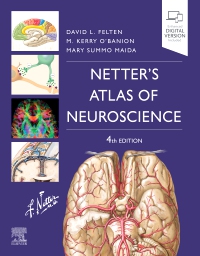

Netter's Atlas of Neuroscience Elsevier eBook on VitalSource, 4th Edition
Elsevier eBook on VitalSource
Now $52.19
Ideal for any student of neuroanatomy, neuroscience, or other medical or science disciplines involving the nervous system, Netter's Atlas of Neuroscience, 4th Edition, is a highly visual, clinically oriented exploration of structure and function—from neurons to motor and sensory systems to global neural function and dysfunction. This award-winning text approaches this complex topic from three perspectives: Neuroscience Overview, Regional Neuroscience, and Systemic Neuroscience. Illustrations by Frank H. Netter, MD, and others following in his tradition are framed by concise, expert text and accompanied by neuroimaging, photomicrographs, and summary diagrams.
New Edition Expected Availability: 12-24-2026

Netter's Atlas of Neuroscience - Elsevier E-Book on VitalSource
-
- Combines Netter and Netter-like illustrations, and beautiful molecular and cellular illustrations, with succinct text and clinical points, delivering the essential information students need for both basic science and clinical programs
- Presents organizational and summarized neurosciences information, enabling students to review complex concepts, functions, and systems in several contexts
- Provides an overview of the basic features of cellular and molecular neuroscience; peripheral nerves, spinal cord, brain stem and cerebellum, and the brain; reviews the neural vasculature, meninges and cerebrospinal fluid, and developmental neuroscience
- Highlights cross-sectional spinal cord and brain stem anatomy and side-by-side comparisons of Netter illustrations and MRIs of axial and coronal brain sections, including extensive clinical correlations
- Focuses on foundational concepts as well as clinically relevant discussions
- Expands basic neural connectivity and functional roles of limbic structures and behavior
- Reviews Global Neural Functions and Disorders in a brand new chapter with more than a dozen new art plates
- Includes many new art plates covering current topics including neural foundations of addiction, dementias, several neuropsychiatric disorders, consciousness, coma and its assessment, sleep regulation, postnatal and adult neurogenesis, endogenous opioid systems, endogenous cannabinoid systems, and others
- Enhanced eBook version included with purchase. Your enhanced eBook allows you to access all of the text, figures, and references from the book on a variety of devices
-
-
 Netter's Atlas of NeurosciencePaperback
-
-
Blue is new
Section I Overview of the Nervous System
- Neurons and Their Properties
- Skull and Meninges
- Brain
- Brain Stem and Cerebellum
- Spinal Cord
- Ventricles and the Cerebrospinal Fluid
- Vasculature
- Developmental Neuroscience
- Peripheral Nervous System
- Spinal Cord
- Brain Stem and Cerebellum
- Diencephalon
- Telencephalon
- Sensory Systems
- Motor Systems
- Autonomic-Hypothalamic-Limbic Systems
- Orbitofronal Cortex
- Prefrontal Cortex
- Amygdala and Behavior
- Ventral Tegmental Area and Mesolimbic and Mesocortical Systems
- Nucleus Accumbens
- Bed Nucleus of the Stria Terminalis
- Insular Cortex
- Nucleus Basalis of Meynert
- Circumventricular Organs
Anatomical and Molecular Properties
Neuronal Ultrastructure
Molecular Techniques for Studying Neurons
Genetic Models for Studying Neurological Diseases
Electrical Properties
Neurotransmitter and Signaling Properties
Endogenous Opioid Systems
Cannabinoid Systems
Neuropeptide Neurotransmitters
Amino Acid Neurotransmitters
Arterial System
Venous System
Postnatal and Adult Neurogenesis
Sex Steroid Influences on Brain DevelopmentMaternal and Neonatal Stress Influences on the Developing Nervous System
Fetal Alcohol SyndromeSection II Regional Neuroscience
Introduction and Basic Organization
Somatic Nervous System
Somatosensory System Nuclear Neuronal Organization
Autonomic Nervous System
Spinal Cord Cross-Section Cytoarchitecture
Columnar Organization and Neural Sheet Structure in Spinal Cord
Spinal Cord LMN Organization of Inputs and Local ConnectionsBrain Stem Cross-Sectional Anatomy
Lateral View of Whole Brain and Brain Stem
Cerebral Cortex Nissl-Stained Histological Sections
Periaqueductal Gray
Cranial Nerves and Cranial Nerve Nuclei
Reticular Formation
Raphe Nuclei and Locus Coeruleus
Dendrite Bundles and their Functional Role
Cerebellum
Section III Systemic Neuroscience
Somatosensory Systems
Trigeminal Sensory System
Sensory System for Taste
Auditory System
Vestibular System
Visual System
Lower Motor Neurons
Upper Motor Neurons
Cerebellum
Basal Ganglia
Autonomic Nervous System
Hypothalamus and Pituitary
Anterior Pituitary Hormone and Target Feedback
Hypothalamus: Afferent and Efferent Pathways
Estrogen and Androgen Effects on Behavior
Glucocorticoid Effects in the Periphery and Central Consequences
Catecholamine Effects in the Periphery and Central Consequences
Oxytocin and Vasopressin Effects on Behavior
Limbic System
Olfactory System
Section IV Global Brain Functions
- Dementias
- Neuropsychiatric Disorders
- Tramatic Brain Injury (TBI)
- Brain Substrates and Addictive Behaviors
- Aging and the Nervous System
- Memory and Concentration
- Consciousness
- Focus and Attention
- Coma
- Music and the Brain
Alzheimer’s Disease and Its Mechanisms
Schizophrenia
Unipolar and Bipolar Depression
Panic and Anxiety Disorders
Post-Traumati Stress (PTSD)
Opioid Addiction and Abuse
-
-
Ways of Reading
- The appearance of the text and page layout can be modified according to the capabilities of the reading system (font family and font size, spaces between paragraphs, sentences, words, and letters, as well as color of background and text)
- This e-publication is accessible to the full extent that the file format and types of content allow, on a specific reading device, by default, without necessarily including any additions such as textual descriptions of images or enhanced navigation
- No information about nonvisual reading is available
-
Conformance
- No information is available
-
Navigation
- Table of contents to all chapters of the text via links
- Page list to go to pages from the print source version
-
Rich Content
- No information is available
-
Hazards
- No information is available
-
Product Content
- No information is available
-
Legal Considerations
- No information is available
-
Additional Accessibility Information
- Page breaks included from the original print source
- For readers with color vision deficiency, use of color (e.g., in diagrams, graphics and charts, in prompts, or on buttons inviting a response) is not the sole means of graphical distinction or of conveying information
- E-publication includes basic navigation (usually less detailed than TOC-based navigation)
- Where links, controls or buttons are included in the content, the purpose or functionality of each link, control or button is apparent from the associated text alone - or where it is unclear, separate link, control or button descriptions are provided
- All (or substantially all) textual matter is arranged in a single logical reading order (including text that is visually presented as separate from the main text flow, e.g., in boxouts, captions, tables, footnotes, endnotes, citations, etc.). Non-textual content is also linked from within this logical reading order. (Purely decorative non-text content can be ignored).
- The language of the text has been specified (e.g., via the HTML or XML lang attribute) to optimise text-to-speech (and other alternative renderings), both at the whole document level and, where appropriate, for individual words, phrases or passages in a different language.
-
Ways of Reading

 as described in our