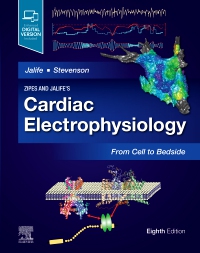
ISBN:
9780323757454
Copyright:
2022
Publication Date:
12-17-2021
Page Count:
1696
Imprint:
Elsevier
List Price:
$273.99
Zipes and Jalife’s Cardiac Electrophysiology: From Cell to Bedside, 8th Edition
by Jose Jalife, MD, PhD and William Gregory Stevenson, MD
Hardcover
ISBN:
9780323757454
Copyright:
2022
Publication Date:
12-17-2021
Page Count:
1696
Imprint:
Elsevier
List Price:
$273.99
Was
$273.99
Now $260.29
Free Shipping!
In Stock
This item has low stock levels and may be back-ordered. We'll let you know if it is back-ordered, and you will not be charged until the item ships.
**Selected for Doody’s Core Titles® 2024 in Cardiology**
Fully updated from cover to cover, Zipes and Jalife’s Cardiac Electrophysiology: From Cell to Bedside, 8th Edition, provides the comprehensive, multidisciplinary coverage you need—from new knowledge in basic science to the latest clinical advances in the field. Drs. José Jalife and William Gregory Stevenson lead a team of global experts who provide cutting-edge content and step-by-step instructions for all aspects of cardiac electrophysiology.
Fully updated from cover to cover, Zipes and Jalife’s Cardiac Electrophysiology: From Cell to Bedside, 8th Edition, provides the comprehensive, multidisciplinary coverage you need—from new knowledge in basic science to the latest clinical advances in the field. Drs. José Jalife and William Gregory Stevenson lead a team of global experts who provide cutting-edge content and step-by-step instructions for all aspects of cardiac electrophysiology.
New Edition Expected Availability: 02-22-2027

-
- Packs each chapter with the latest information necessary for optimal basic research as well as patient care
- Covers new technologies such as CRISPR, protein research, improved cardiac imaging, optical mapping, and wearable devices
- Contains significant updates in the areas of molecular biology and genetics, iPSCs (induced pluripotent stem cells), embryonic stem cells, precision medicine, antiarrhythmic drug therapy, cardiac mapping with advanced techniques, and ablation technologies including stereotactic radioablation
- Includes 47 new chapters covering both basic science and clinical topics
- Discusses extensive recent progress in the understanding, diagnosis, and management of arrhythmias, including new clinical insights on atrial fibrillation and stroke prevention, new advances in the understanding of ventricular arrythmias in genetic disease, and advances in implantable devises and infection management
- Features 1,600 high-quality photographs, anatomic and radiographic images, electrocardiograms, tables, algorithms, and more., with additional figures, tables, and videos online
- Recipient of a 2018 Highly Commended award from the British Medical Association
- Enhanced eBook version included with purchase. Your enhanced eBook allows you to access all of the text, figures, and references from the book on a variety of devices
-
Section 1 STRUCTURAL AND MOLECULAR BASES OF ION CHANNEL FUNCTION
1. Voltage-gated sodium channels and electrical excitability of the heart
2. Voltage-gated calcium
3. Voltage-gated potassium channels
4. Structural and molecular bases of cardiac inward rectifier potassium channel function
5. Mammalian calcium pumps in health and disease
6. Structural and molecular bases of sarcoplasmic reticulum ion channel function
7. Organellar ion channels and transporters
8. Molecular organization, gating, and function of connexin-based gap junction channels and hemichannels
Section 2 BIOPHYSICS OF CARDIAC ION CHANNEL FUNCTION
9. Structure-function relations of heterotrimetric complexes of sodium channel a and β subunits
10. Regulation of cardiac calcium channels
11. Inhibition of phosphoinositide 3-kinase and acquired long QT syndrome
12. Structural determinants and biophysical properties of hERG1 channel gating
13. Molecular regulation of cardiac inward rectifier potassium channels by pharmacologic agents
14. Cardiac stretch-activated channels and mechano-electric coupling
15. Biophysical properties of gap junctions
16. Excitation-contraction coupling
Section 3 INTERMOLECULAR INTERACTIONS AND CARDIOMYOCYTE ELECTRICAL FUNCTION
17. Ion channel trafficking in the heart
18. Microdomain interactions of macromolecular complexes and regulation of the sodium channel nav1.5
19. Fibroblast growth factor homologous factors modulate cardiac calcium channels
20. Macromolecular complexes and cardiac potassium channels
21. Reciprocity of cardiac sodium and potassium channels in the control of excitability and arrhythmias
22. The intercalated disc: A molecular network that integrates electrical coupling, intercellular adhesion and cell excitability
23. Function and dysfunction of ion channel membrane trafficking and post translational modification
24. Feedback mechanisms for cardiac-specific microRNAs and cAMP signaling in electrical remodeling
Section 4 CELL BIOLOGY OF CARDIAC IMPULSE INITIATION AND PROPAGATION
25. Stem cell-derived nodal-like cardiomyocytes as a novel pharmacologic tool: Insights from sinoatrial node development and function
26. Gene therapy and biologic pacing
27. Intercellular communication and impulse propagation
28. Mechanisms of normal and dysfunctional sinoatrial nodal excitability and propagation
29. Cell biology of the specialized cardiac conduction system
30. Cardiac remodeling and regeneration
Section 5 MODELS OF CARDIAC EXCITATION
31. Ionic mechanisms of atrial action potentials
32. Genetic algorithms to generate dynamical complexity electrophysiological models
33. Calcium signaling in cardiomyocyte dodels with realistic geometries
34. Theory of rotors and arrhythmias
35. Computational approaches for accurate rotor localization in the human atria
36. Modeling the aging heart
Section 6 NEURAL CONTROL OF CARDIAC ELECTRICAL ACTIVITY
37. Innervation of the sinoatrial node
38. Mechanism for altered autonomic and oxidant regulation of cardiac sodium currents.
39. Pulmonary vein ganglia and the neural regulation of the heart rate
40. Neural activity and atrial tachyarrhythmias
41. Sympathetic innervation and cardiac arrhythmias
Section 7 ARRHYTHMIA MECHANISMS
42. The molecular pathophysiology of atrial fibrillation
43. Myofibroblasts, cytokines, and persistent atrial fibrillation
44. Role of the autonomic nervous system in atrial fibrillation
45. Rotors in human atrial fibrillation
46. Body surface frequency-phase mapping of atrial fibrillation
47. Panoramic mapping of atrial fibrillation from the body surface
48. Mechanisms of human ventricular tachycardia and human ventricular fibrillation
49. Genetics of atrial fibrillation
Section 8 MOLECULAR GENETICS AND PHARMACOGENOMICS
50. Mechanisms in heritable sodium channel diseases
51. Genetic, ionic, and cellular mechanisms underlying the J-wave syndromes
52. Inheritable potassium channel diseases
53. Inheritable phenotypes associated with altered intracellular calcium regulation
Section 9 PHARMACOLOGIC, GENETIC, AND CELL THERAPY OF ION CHANNEL DYSFUNCTION
54. Pharmacologic bases of antiarrhythmic therapy
55. Pharmacogenomics of cardiac arrhythmias
56. Gene therapy to treat cardiac arrhythmias
57. Highly mature human iPSC-derived cardiomyocytes as models for cardiac electrophysiology and drug testing
58. Cardiac repair with human induced pluripotent stem cell-derived cardiovascular cells.
Section 10 DIAGNOSTIC EVALUATION
59. Assessment of the patient with a cardiac arrhythmia
60. Electrocardiography of tachyarrhythmias: Differential diagnosis of narrow and wide QRS complex tachycardias
61. Electroanatomic mapping for arrhythmias
62. Computed tomography for electrophysiology
63. Magnetic resonance imaging for electrophysiology
64. Intracardiac echocardiography for electrophysiology
65. Exercise-induced arrhythmias
66. Cardiac monitoring: short- and long-term recording
67. Head-up tilt table testing
68. Autonomic regulation and cardiac risk
69. T-wave alternans
70. Noninvasive electrocardiographic imaging of human ventricular arrhythmias and Electrophysiological Substrate
71. Genetic testing
Section 11 SUPRAVENTRICULAR TACHYARRHYTHIAS: MECHANISMS, CLINICAL FEATURES, AND MANAGEMENT
72. Sinus node abnormalities
73. Atrial tachycardia
74. Atrial tachycardia in adults with congenital heart disease
75. Typical and atypical atrial flutter: Mapping and ablation
76. Atrial fibrillation
77. Preexcitation, atrioventricular reentry, variants
78. Electrophysiological characteristics of atrioventricular nodal reentrant tachycardia: Implications for the rentrant circuits
79. Junctional tachycardia
Section 12 VENTRICULAR TACHYCARRHYTHMIAS: MECHANISMS, CLNICAL FEATURES, AND MANAGEMENT
80. Premature ventricular complexes
81. Outflow tract ventricular tachycardias: Mechanisms, clinical features, and management
82. Fascicular ventricular arrhythmias
83. Bundle branch reentry tachycardia
84. Ischemic heart disease
85. Ventricular tachycardia in patients with dilated cardiomyopathy
86. Ventricular arrhythmias in hypertrophic cardiomyopathy
87. Ventricular tachycardias in arrhythmogenic right ventricular dysplasia/cardiomyopathy
88. VTs in catcholaminergic cardiomyopathy (catecholaminergic polymorphic ventricular tachycardia)
89. Ventricular arrhythmias in heart failure
90. Arrhythmias and conduction disturbances in non-compaction cardiomyopathy
91. Takotsubo cardiomyopathy
92. Brugada syndrome
93. Long and short QT syndromes
94. Anderson-Tawil syndrome
95. Timothy syndrome
96. J-wave syndromes
97. Idiopathic ventricular fibrillation
98. Sudden infant death syndrome
99. Sudden cardiac arrest/death in adults
100. Neurologic disorders
101. Drug-induced ventricular tachycardia
102. Ventricular arrhythmias in congenital heart disease
Section 13 SYNCOPE AND BRADYARRHYTHMIAS
103. Syncope
104. Postural orthostatic tachycardia syndrome
105. Progressive conduction system disease
106. Atrioventricular block
Section 14 ARRHYTHMIAS IN SPECIAL POPULATIONS PHARMACOLOGIC THERAPY
107. Sex differences in arrhythmias
108. Sudden cardiac death in athletes, including commotio cordis
109. Pediatric populations
110. Sleep-disordered breathing and arrhythmias
111. Ventricular assist devices and cardiac transplantation recipients
Section 15 PHARMACOLOGIC THERAPY
112. Standard antiarrhythmic drugs
113. Innovations in antiarrhythmic drug therapy
114. Nontraditional drugs for sudden cardiac death
115. Prevention of stroke in atrial fibrillation: warfarin, anti-factor Xa and thrombin drugs
Section 16 CARDIAC IMPLANTABLE ELECTRONIC DEVICES
116. Implantable cardioverter defibrillators: technical aspects
117. Implantable cardioverter defibrillators: clinical aspects
118. Subcutaneous implantable defibrillator
119. Implantable pacemakers
120. Cardiac resynchronization therapy
121. Newer applications of pacemakers
122. Remote monitoring
Section 17 CATHETER ABLATION
123. Catheter ablation: Technical aspects
124. Catheter ablation: Clinical aspects
125. Ablation for atrial fibrillation
126. Ablation of supraventricular tachycardias
127. Catheter ablation for ventricular tachycardias with/without structural heart disease
128. Epicardial and other approaches
129. Ventricular fibrillation
130. Ablation in pediatrics
131. Congenital heart disease
132. Anesthesiology for EP procedures
Section 18: SURGERY FOR ARRHYTHMIAS
133. Surgery for atrial fibrillation and other supraventricular tachycardias
134. Surgery for ventricular tachycardia
Section 19 NEW APPROACHES
135. Cervical vagal stimulation for heart failure
136. Baroreflex stimulation
137. Spinal cord stimulation for heart failure and arrhythmias
138. Renal artery denervation
139. Left atrial appendage occlusion/ligation -
No accessibility information is available for this product.
Was
$273.99
Now $260.29
Free Shipping!
In Stock
This item has low stock levels and may be back-ordered. We'll let you know if it is back-ordered, and you will not be charged until the item ships.

 as described in our