
ISBN:
9780323757676
Copyright:
2020
Publication Date:
11-13-2019
Page Count:
346
Imprint:
Saunders
List Price:
$84.99

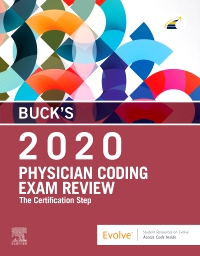
Buck's Physician Coding Exam Review 2020 Elsevier eBook on VitalSource, 1st Edition
by Elsevier
Elsevier eBook on VitalSource
ISBN:
9780323757676
Copyright:
2020
Publication Date:
11-13-2019
Page Count:
346
Imprint:
Saunders
List Price:
$84.99
$84.99
Or $0.00 with a valid access code
Not Yet Available
Prepare to succeed on your physician coding certification exam with Buck’s Physician Coding Exam Review 2020: The Certification Step! This extensive exam review provides complete coverage of all topics included on the physician coding certification exam — including anatomy, terminology, and pathophysiology for each body system; reimbursement issues; CPT, HCPCS, and ICD-10-CM coding; and more. Four full practice exams (with answers and rationales) simulate the testing experience and provide enough practice to reassure even the most insecure exam-taker. It’s the only physician coding exam review you need!
-
- NEW! Updated content features the latest coding information available, promoting accurate coding and success on the job.
-
- UNIQUE! Four full practice exams on Evolve simulate the experience of taking the actual physician coding exam, allowing you to assess your strengths and weaknesses in order to develop a plan for focused study.
- Answers and rationales to questions on the practice exams let you check your work.
- Concise outline format helps you access key information quickly and study more efficiently.
- Mobile-optimized quick quizzes offer on-the-go practice with more than 350 medical terminology, pathophysiology, CPT, HCPCS, and ICD-10-CM questions.
- "Real-life" coding reports simulate the reports that you will encounter on the job, and challenge you to apply key coding principles to actual cases.
- Test-taking tips in the Success Strategies section guide you step-by-step through the entire exam process.
-
Success Strategies
Course Syllabus and Student Calendar
Unit 1: Anatomy, Terminology, and Pathophysiology
Unit 2: Reimbursement Issues
Unit 3: CPT and HCPCS Coding
Unit 4: ICD-10-CM Coding
Unit 5: Coding Challenge
Appendix A: Resources
Appendix B: Answers
Appendix C: Medical Terminology
Appendix D: Combining Forms
Appendix E: Prefixes
Appendix F: Suffixes
Appendix G: Abbreviations
Appendix H: Further Text Resources -
-
Ways of Reading
- The appearance of the text and page layout can be modified according to the capabilities of the reading system (font family and font size, spaces between paragraphs, sentences, words, and letters, as well as color of background and text)
- This e-publication is accessible to the full extent that the file format and types of content allow, on a specific reading device, by default, without necessarily including any additions such as textual descriptions of images or enhanced navigation
- No information about nonvisual reading is available
-
Conformance
- No information is available
-
Navigation
- Table of contents to all chapters of the text via links
- Page list to go to pages from the print source version
-
Rich Content
- No information is available
-
Hazards
- No information is available
-
Product Content
- No information is available
-
Legal Considerations
- No information is available
-
Additional Accessibility Information
- Page breaks included from the original print source
- For readers with color vision deficiency, use of color (e.g., in diagrams, graphics and charts, in prompts, or on buttons inviting a response) is not the sole means of graphical distinction or of conveying information
- E-publication includes basic navigation (usually less detailed than TOC-based navigation)
- Where links, controls or buttons are included in the content, the purpose or functionality of each link, control or button is apparent from the associated text alone - or where it is unclear, separate link, control or button descriptions are provided
- All (or substantially all) textual matter is arranged in a single logical reading order (including text that is visually presented as separate from the main text flow, e.g., in boxouts, captions, tables, footnotes, endnotes, citations, etc.). Non-textual content is also linked from within this logical reading order. (Purely decorative non-text content can be ignored).
- The language of the text has been specified (e.g., via the HTML or XML lang attribute) to optimise text-to-speech (and other alternative renderings), both at the whole document level and, where appropriate, for individual words, phrases or passages in a different language.
-
Ways of Reading
$84.99
Or $0.00 with a valid access code
Not Yet Available

 as described in our