ISBN:
9780323759014
Copyright:
2023
Publication Date:
05-18-2022
Page Count:
608
Imprint:
Elsevier
List Price:
$63.99

Brenner and Stevens’ Pharmacology - Elsevier eBook on VitalSource, 6th Edition
by Craig W. Stevens, PhD
Elsevier eBook on VitalSource
ISBN:
9780323759014
Copyright:
2023
Publication Date:
05-18-2022
Page Count:
608
Imprint:
Elsevier
List Price:
$63.99
Was
$63.99
Now $44.79
Or $0.00 with a valid access code
**Selected for 2026 Doody's Core Titles in Pharmacology**
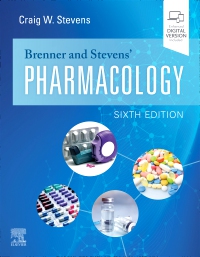
More detailed than an outlined review but less overwhelming than an encyclopedic reference, Brenner and Stevens’ Pharmacology, 6th Edition, focuses on the essential principles you need to know in a concise, easy-to-understand manner. Authored by Craig W. Stevens, PhD, this highly illustrated introductory text helps you learn and retain key information in pharmacology—taking you from course exams and the USMLE Step 1 right through to clinical practice. New and extensively revised content keeps you up to date with the latest pharmacologic mechanisms and applications.
More detailed than an outlined review but less overwhelming than an encyclopedic reference, Brenner and Stevens’ Pharmacology, 6th Edition, focuses on the essential principles you need to know in a concise, easy-to-understand manner. Authored by Craig W. Stevens, PhD, this highly illustrated introductory text helps you learn and retain key information in pharmacology—taking you from course exams and the USMLE Step 1 right through to clinical practice. New and extensively revised content keeps you up to date with the latest pharmacologic mechanisms and applications.
New Edition Expected Availability: 04-08-2027

Brenner and Stevens’ Pharmacology - Elsevier eBook on VitalSource
Elsevier eBook on VitalSource
ISBN: 9780443436833
-
- Teaches the fundamental aspects of pharmacology using full-color illustrations, detailed explanations, and a consistent format to present classification of drugs for each system/disease
- Helps you understand both the basic science foundations and clinical applications of pharmacology, with useful tables, drug classifications boxes, case studies, and self-assessments in each chapter to help you review and prepare for course exams and Step 1
- Includes the latest drugs and therapeutic indications (more than 100 are new to this edition), along with an entirely new chapter on recent developments of immunopharmacology drugs, including antivirals and vaccinations
- Addresses key topics such as antiviral and monoclonal drugs to treat COVID-19, the opioid epidemic, and gene therapy
- Features more than 700 new and updated images, with many revised figures focused on clearing presenting the mechanism of action of drugs
- Includes access to bonus eBook content such as animations, an additional glossary, chapter-by-chapter summaries and case studies, a full list of featured drugs, 150 USMLE-style self-assessment questions, and more
- Enhanced eBook version included with purchase. Your enhanced eBook allows you to access all of the text, figures, and references from the book on a variety of devices
-
-
 Brenner and Stevens’ PharmacologyPaperback
-
-
Section I PRINCIPLES OF PHARMACOLOGY
1. Introduction to Pharmacology and Drug Names
2. Pharmacokinetics or What the Body Does to the Drug
3. Pharmacodynamics or What the Drug Does to the Body
4. Drug Development and Drug Safety 35
5. Toxicology Principles and the Treatment of Poisoning
Section II AUTONOMIC AND NEUROMUSCULAR PHARMACOLOGY
6. Parasympathetic, Neuromuscular Pharmacology, and Cholinergic Agonists
7. Cholinergic Receptor Antagonists
8. Sympathetic Neuropharmacology and Adrenergic Agonists
9. Adrenergic Receptor Antagonists
Section III CARDIOVASCULAR, RENAL, AND HEMATOLOGIC PHARMACOLOGY
10. Antihypertensive Drugs
11. Antianginal Drugs
12. Drugs for the Treatment of Heart Failure
13. Diuretic Drugs
14. Drugs for Cardiac Dysrhythmia
15. Drugs for Hyperlipidemia
16. Antithrombotic and Thrombolytic Drugs
17. Hematopoietic Drugs
Section IV CENTRAL NERVOUS SYSTEM PHARMACOLOGY
18. Introduction to Central Nervous System Pharmacology
19. Sedative-Hypnotic and Anxiolytic Drugs
20. Antiepileptic Drugs
21. Local and General Anesthetics
22. Psychotherapeutic Drugs
23. Opioid Analgesics and Antagonists
24. Drugs for Neurodegenerative Diseases
25. Drugs of Abuse
Section V PHARMACOLOGY OF RESPIRATORY AND OTHER SYSTEMS
26. Autacoid Drugs That Mimic Endogenous Substances
27. Pharmacological Treatment of Respiratory Disorders
28. Pharmacological Treatment of Gastrointestinal Disorders
29. Drugs for Headache Disorders
30. Drugs for Pain, Inflammation, and Arthritic Disorders
Section VI ENDOCRINE PHARMACOLOGY
31. Hypothalamic and Pituitary Hormone Drugs
32. Drugs for the Treatment of Thyroid Disorders
33. Adrenal Steroids and Related Drugs
34. Fertility and Reproduction Drugs
35. Drugs for the Treatment of Diabetes
36. Drugs Affecting Calcium and Bone Formation
Section VII ANTIMICROBIAL AND CHEMOTHERAPEUTIC AGENTS
37. Principles of Antimicrobial Chemotherapy
38. Antibiotics That Inhibit Bacterial Cell Wall Synthesis
39. Antibiotics That Inhibit Bacterial Protein Synthesis
40. Other Antimicrobial Agents Such as Quinolones and Antifolate Drugs
41. Antimycobacterial Drugs for Treating Tuberculosis and Other Diseases
42. Drugs for the Treatment of Fungal Infections
43. Drugs for the Treatment of Viral Infections
44. Drugs for the Treatment of Parasites
45. Antineoplastic Agents
46. Immunopharmacology, Biologicals, and Gene Therapy -
-
Ways of Reading
- The appearance of the text and page layout can be modified according to the capabilities of the reading system (font family and font size, spaces between paragraphs, sentences, words, and letters, as well as color of background and text)
- This e-publication is accessible to the full extent that the file format and types of content allow, on a specific reading device, by default, without necessarily including any additions such as textual descriptions of images or enhanced navigation
- No information about nonvisual reading is available
-
Conformance
- No information is available
-
Navigation
- Table of contents to all chapters of the text via links
- Page list to go to pages from the print source version
-
Rich Content
- No information is available
-
Hazards
- No information is available
-
Product Content
- No information is available
-
Legal Considerations
- No information is available
-
Additional Accessibility Information
- Page breaks included from the original print source
- For readers with color vision deficiency, use of color (e.g., in diagrams, graphics and charts, in prompts, or on buttons inviting a response) is not the sole means of graphical distinction or of conveying information
- E-publication includes basic navigation (usually less detailed than TOC-based navigation)
- Where links, controls or buttons are included in the content, the purpose or functionality of each link, control or button is apparent from the associated text alone - or where it is unclear, separate link, control or button descriptions are provided
- All (or substantially all) textual matter is arranged in a single logical reading order (including text that is visually presented as separate from the main text flow, e.g., in boxouts, captions, tables, footnotes, endnotes, citations, etc.). Non-textual content is also linked from within this logical reading order. (Purely decorative non-text content can be ignored).
- The language of the text has been specified (e.g., via the HTML or XML lang attribute) to optimise text-to-speech (and other alternative renderings), both at the whole document level and, where appropriate, for individual words, phrases or passages in a different language.
-
Ways of Reading
Was
$63.99
Now $44.79
Or $0.00 with a valid access code

 as described in our