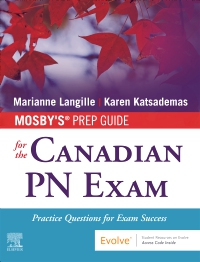

Mosby's Prep Guide for the Canadian PN Exam Elsevier eBook on VitalSource, 1st Edition
Elsevier eBook on VitalSource
Now $45.89
Prepare for success on the REx-PN™ and CPNRE® exams! Mosby's Prep Guide for the Canadian PN Exam: Practice Questions for Exam Success is the only concise examination study tool to focus specifically on Canada’s Practical Nurse licensure examination. Between the book and its accompanying website, this resource includes 1,000 practice questions along with a detailed rationale for each answer; it also provides valuable test-taking tips and strategies. From Canadian nursing experts Marianne Langille and Karen Katsademas, this self-study guide has everything you need to be completely ready for your PN exam.
-
- Strategic overview of the REx-PN™ and CPNRE® exams helps you prepare effectively for the Practical Nurse licensure examination.
- 600 practice questions in the book reflect the latest CCPNR national competencies (including Ontario and British Columbia) and provide three comprehensive practice exams of 200 questions each.
- Additional 400 practice questions on the companion Evolve website (for a total of 1,000) allow you the flexibility to test yourself in exam mode and self-study mode, with instant feedback to assess your progress.
- Rationales for answers explain why your answer is correct or incorrect.
- Test-taking tips and techniques help you answer the "tricky" questions, select the best answer from a choice of possible solutions, and tackle short-answer questions.
- Classification legends indicate the competency and taxonomy being tested for each question.
- Practical appendix includes the Entry-Level/Entry-to-Practice Canadian Council for Practical Nurse Regulators (CCPNR) Competencies for both the CPNRE© and the REx-PN™ licensure examinations.
- Study tools make it easier to determine the correct answer options.
- REx-PN™ format practice questions on Evolve provide an introduction and exam preparation for exam writers in Ontario and British Columbia.
-
Chapter 1: Introduction
Chapter 2: Description of the Canadian Registered Nurse Exam
Chapter 3: Study and Exam Tips
Chapter 4: Practice Exam #1
Case-Based Questions
Independent Questions
Chapter 5: Answers and Rationales for Practice Exam #1
Case-Based Questions Answers and Rationales
Independent Questions Answers and Rationales
Chapter 6: Practice Exam #2
Case-Based Questions
Independent Questions
Chapter 7: Answers and Rationales for Practice Exam #2
Case-Based Questions Answers and Rationales
Independent Questions Answers and Rationales
Chapter 8: Practice Exam #3
Case-Based Questions
Independent Questions
Chapter 9: Answers and Rationales for Practice Exam #3
Case-Based Questions Answers and Rationales
Independent Questions Answers and Rationales
Bibliography
Appendix: Entry-Level/Entry-to-Practice Competencies for Licensed/Registered Practical Nurses in Canada
-
-
Ways of Reading
- The appearance of the text and page layout can be modified according to the capabilities of the reading system (font family and font size, spaces between paragraphs, sentences, words, and letters, as well as color of background and text)
- This e-publication is accessible to the full extent that the file format and types of content allow, on a specific reading device, by default, without necessarily including any additions such as textual descriptions of images or enhanced navigation
- No information about nonvisual reading is available
-
Conformance
- No information is available
-
Navigation
- Table of contents to all chapters of the text via links
- Page list to go to pages from the print source version
-
Rich Content
- No information is available
-
Hazards
- No information is available
-
Product Content
- No information is available
-
Legal Considerations
- No information is available
-
Additional Accessibility Information
- Page breaks included from the original print source
- For readers with color vision deficiency, use of color (e.g., in diagrams, graphics and charts, in prompts, or on buttons inviting a response) is not the sole means of graphical distinction or of conveying information
- E-publication includes basic navigation (usually less detailed than TOC-based navigation)
- Where links, controls or buttons are included in the content, the purpose or functionality of each link, control or button is apparent from the associated text alone - or where it is unclear, separate link, control or button descriptions are provided
- All (or substantially all) textual matter is arranged in a single logical reading order (including text that is visually presented as separate from the main text flow, e.g., in boxouts, captions, tables, footnotes, endnotes, citations, etc.). Non-textual content is also linked from within this logical reading order. (Purely decorative non-text content can be ignored).
- The language of the text has been specified (e.g., via the HTML or XML lang attribute) to optimise text-to-speech (and other alternative renderings), both at the whole document level and, where appropriate, for individual words, phrases or passages in a different language.
-
Ways of Reading



 as described in our