ISBN:
9780323759533
Copyright:
2022
Publication Date:
08-23-2021
Page Count:
176
Imprint:
Elsevier
List Price:
$56.99

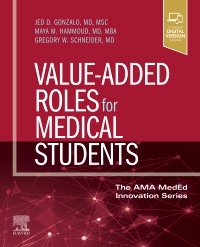
Value-Added Roles for Medical Students, Elsevier E-Book on VitalSource, 1st Edition
by Jed D. Gonzalo, MSc, MD, Maya M. Hammoud, MD, MBA and Gregory W. Schneider, MD
Elsevier eBook on VitalSource
ISBN:
9780323759533
Copyright:
2022
Publication Date:
08-23-2021
Page Count:
176
Imprint:
Elsevier
List Price:
$56.99
Was
$56.99
Now $39.89
Or $0.00 with a valid access code
Providing real-life clinical experiences and context to medical students is an essential part of today’s medical education, and the partnerships between medical schools and health systems are an integral part of this approach. Value-Added Roles for Medical Students, the second volume in the American Medical Association’s MedEd Innovation Series, is a first-of-its-kind, instructor-focused field book that inspires educators to transform the relationship between medical schools and health systems with authentic workplace roles for medical students, adding relevance to medical education and patient care.
-
-
- Contains both theoretical and practical material for instructors and administrators, including guidance on how to implement value-added roles for medical students in today’s institutions
- Explains how to apply a framework to implement value-added clinical systems learning roles for students, develop meaningful medical school-health system partnerships, and train a generation of future physicians prepared to lead health systems change
- Provides numerous examples from schools with successful implementation of value-added medical student roles such as patient navigators, community-based health care programs involving medical students, and more
- Describes real-world strategies for building mutually beneficial medical school-health system partnerships, including developing a shared vision and strategy and identifying learning goals and objectives; empowering broad-based action and overcoming barriers in implementation; and generating short-term wins in implementation
- Helps medical school faculty and instructors address gaps in physician training and prepare new doctors to practice effectively in 21st century health care systems
- One of the American Medical Association Change MedEd initiatives and innovations, written and edited by members of the Accelerating Change in Medical Education Consortium – a unique, innovative collaborative that allows for the sharing and dissemination of groundbreaking ideas and projects
- Enhanced eBook version included with purchase. Your enhanced eBook allows you to access all of the text, figures, and references from the book on a variety of devices
-
-
-
 Value-Added Roles for Medical StudentsPaperback
-
-
Part 1 Theory
1. Concept of Value-Added Roles: Creating a Community of Practice
2. Current and Emerging Models
3. The Role of Program Evaluation in Valued-Added Medical Education: Overall Outcomes and Connections to the Assessment of Learning
Part 2 Practice/Preclerkship, Clerkship, and Longitudinal Experiences
4. Students as Patient Navigators: The Penn State College of Medicine
5. Students as Patient Navigators: Case Western Reserve University School of Medicine
6. Primary Care Quality Improvement: The University of North Carolina at Chapel Hill
7. Household-Centered Service-Learning: Florida International University Herbert Wertheim College of Medicine
8. Early Medical Students as Clinical Microsystem Agents of Change—Improving Quality, Value, and the Patient Experience: University of California, San Francisco, School of Medicine
9. Plan-Do-Study-Act: Vanderbilt University School of Medicine
10. Community Health in Action: A.T. Still University’s School of Osteopathic Medicine in Arizona
Part 3 Implementation
11. Vision and Planning Value-Added Roles
12. Launching and Sustaining Value-Added Roles
13. Improving and Growing Value-Added Roles -
-
Ways of Reading
- The appearance of the text and page layout can be modified according to the capabilities of the reading system (font family and font size, spaces between paragraphs, sentences, words, and letters, as well as color of background and text)
- This e-publication is accessible to the full extent that the file format and types of content allow, on a specific reading device, by default, without necessarily including any additions such as textual descriptions of images or enhanced navigation
- No information about nonvisual reading is available
-
Conformance
- No information is available
-
Navigation
- Table of contents to all chapters of the text via links
- Page list to go to pages from the print source version
-
Rich Content
- No information is available
-
Hazards
- No information is available
-
Product Content
- No information is available
-
Legal Considerations
- No information is available
-
Additional Accessibility Information
- Page breaks included from the original print source
- For readers with color vision deficiency, use of color (e.g., in diagrams, graphics and charts, in prompts, or on buttons inviting a response) is not the sole means of graphical distinction or of conveying information
- E-publication includes basic navigation (usually less detailed than TOC-based navigation)
- Where links, controls or buttons are included in the content, the purpose or functionality of each link, control or button is apparent from the associated text alone - or where it is unclear, separate link, control or button descriptions are provided
- All (or substantially all) textual matter is arranged in a single logical reading order (including text that is visually presented as separate from the main text flow, e.g., in boxouts, captions, tables, footnotes, endnotes, citations, etc.). Non-textual content is also linked from within this logical reading order. (Purely decorative non-text content can be ignored).
- The language of the text has been specified (e.g., via the HTML or XML lang attribute) to optimise text-to-speech (and other alternative renderings), both at the whole document level and, where appropriate, for individual words, phrases or passages in a different language.
-
Ways of Reading
Was
$56.99
Now $39.89
Or $0.00 with a valid access code

 as described in our