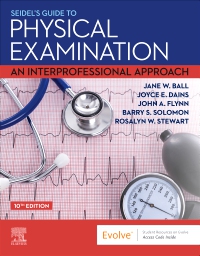

Seidel's Guide to Physical Examination - Elsevier EBook on VitalSource, 10th Edition
Elsevier eBook on VitalSource
Teach your students how to conduct a patient-centered health history and physical examination! Seidel's Guide to Physical Examination: An Interprofessional Approach, 10th Edition takes a uniquely interprofessional collaborative approach to health assessment, with a strong emphasis on lifespan considerations and differential diagnosis of unexpected findings. Each core chapter is organized into four sections — Anatomy and Physiology, Review of Related History, Examination and Findings, and Abnormalities — with lifespan content integrated into each area. Written by a team of nurse practitioners and physicians, this one-of-a-kind textbook uses evidence-based guidelines to help students master hands-on exam techniques as well as communication skills that build rapport and trust with the patient.
New Edition Expected Availability: 02-27-2026

Seidel's Guide to Physical Examination - Elsevier eBook on VitalSource
-
- NEW! 60 new illustrations and new videos include 30 drawings and 30 photos in the textbook, along with 15 new health assessment videos (including The Head-to-Toe Exam and Navigating the EMR) provided free on the Evolve website with every new copy of the textbook
- NEW! Updated content includes human trafficking screening, genetics and genomics, Healthy People 2030 guidelines, and a new mnemonics quick reference inside the back cover
- NEW! Thoroughly revised The Patient Record chapter is refocused to reflect the EMR’s benefits (such as order entry, clinical decision support, and linkages to lab results) and how to overcome challenges (such as poor patient experience and the need to be careful about what is written in the record)
- NEW! Updated LGBTQ+ considerations (e.g., health screening considerations) and cultural content throughout reflect a current understanding of and greater sensitivity to these often underserved patient populations
- NEW Think About… boxes direct you to next steps when you see particular clusters of findings
- NEW Unexpected Findings icon helps beginning practitioners differentiate common normal variations from abnormalities that might warrant follow-up
-
- NEW! 60 new illustrations and new videos include 30 drawings and 30 photos in the textbook, along with 15 new health assessment videos (including The Head-to-Toe Exam and Navigating the EMR) from Elsevier’s Clinical Skills Assessment Collection, which are provided free on the Evolve website with every new copy of the textbook
- NEW! Updated content includes human trafficking screening, genetics and genomics, Healthy People 2030 guidelines, and a new mnemonics quick reference inside the back cover
- NEW! Thoroughly revised The Patient Record chapter (formerly, Documentation) is refocused to reflect the EMR’s benefits (such as order entry, clinical decision support, population health, care gap analysis, and linkages to lab results) and how to overcome challenges (such as poor patient experience and the need to be careful about what is written in the record)
- NEW! Updated LGBTQ+ considerations (e.g., health screening considerations) and cultural content throughout reflect a current understanding of and greater sensitivity to these often underserved patient populations
- NEW Think About… boxes direct students to next steps when they see particular clusters of findings
- NEW Unexpected Findings icon helps beginning practitioners differentiate common normal variations from abnormalities that might warrant follow-up
- UNIQUE! Interprofessional collaborative approach is written by two advanced practice nurses and three physicians, providing balanced expertise in both pediatric and adult-geriatric health
- UNIQUE! Integrated lifespan content provides separate sections in each chapter for Infants and Children, Adolescents, Pregnant Patients, and Older Adults
- UNIQUE! Compassionate, patient-centered approach emphasizes developing good communication skills, use of effective hands-on examination techniques, and reliance on clinical reasoning and clinical decision-making skills
- UNIQUE! Strong emphasis on social inclusiveness and patient-centeredness incorporates LGBTQ+ patients and providers, with special emphasis on cultural competency, history taking, and special considerations for examination of the breasts, female and male genitalia, reproductive health, thyroid, and the anus/rectum/prostate
- UNIQUE! Cross-references to Dains’ Advanced Health Assessment & Clinical Diagnosis in Primary Care help students take the next step in clinical reasoning and provide a seamless user experience for the development of diagnostic reasoning skills
- Differential Diagnosis tables are provided throughout the text
- Clinical Pearls offer insights and practical, real-world expertise
- Evolve website includes assessment video clips, animations, review questions, performance checklists, and more
-
-
 Book-Organized: Sherpath for Ball Seidel's Guide to Physical ExaminationSherpath Book-Organized
 -
 Sherpath Vantage for Ball Seidel's Guide to Physical ExaminationSherpath Vantage
 -
 Elsevier Adaptive Quizzing for Seidel's Guide to Physical ExaminationElsevier Adaptive Quizzing - Next Generation
 -
 Student Laboratory Manual for Seidel's Guide to Physical Examination Elsevier eBook on VitalSourceElsevier eBook on VitalSource
 -

-

-
-
1. The History and Interviewing Process
2. Cultural Competency
3. Examination Techniques and Equipment
4. Taking the Next Steps: Clinical Reasoning
5. The Patient Record
6. Vital Signs and Pain Assessment
7. Mental Status
8. Growth, Measurement, and Nutrition
9. Skin, Hair, and Nails
10. Lymphatic System
11. Head and Neck
12. Eyes
13. Ears, Nose, and Throat
14. Chest and Lungs
15. Heart
16. Blood Vessels
17. Breasts and Axillae
18. Abdomen
19. Female Genitalia
20. Male Genitalia
21. Anus, Rectum, and Prostate
22. Musculoskeletal System
23. Neurologic System
24. Head-to-Toe Examination
25. Sports Participation Evaluation
26. Emergency or Life-Threatening Situations -
-
Ways of Reading
- The appearance of the text and page layout can be modified according to the capabilities of the reading system (font family and font size, spaces between paragraphs, sentences, words, and letters, as well as color of background and text)
- This e-publication is accessible to the full extent that the file format and types of content allow, on a specific reading device, by default, without necessarily including any additions such as textual descriptions of images or enhanced navigation
- No information about nonvisual reading is available
-
Conformance
- For detailed accessibility information, see Elsevier's website at https://www.elsevier.com/about/accessibility
- For queries regarding accessibility information, contact [email protected]
- The publication was certified on 18-11-2025
-
Navigation
- Table of contents to all chapters of the text via links
-
Rich Content
- No information is available
-
Hazards
- No information is available
-
Product Content
- No information is available
-
Legal Considerations
- No information is available
-
Additional Accessibility Information
- For readers with color vision deficiency, use of color (e.g., in diagrams, graphics and charts, in prompts, or on buttons inviting a response) is not the sole means of graphical distinction or of conveying information
- E-publication includes basic navigation (usually less detailed than TOC-based navigation)
- Where links, controls or buttons are included in the content, the purpose or functionality of each link, control or button is apparent from the associated text alone - or where it is unclear, separate link, control or button descriptions are provided
- All (or substantially all) textual matter is arranged in a single logical reading order (including text that is visually presented as separate from the main text flow, e.g., in boxouts, captions, tables, footnotes, endnotes, citations, etc.). Non-textual content is also linked from within this logical reading order. (Purely decorative non-text content can be ignored).
- The language of the text has been specified (e.g., via the HTML or XML lang attribute) to optimise text-to-speech (and other alternative renderings), both at the whole document level and, where appropriate, for individual words, phrases or passages in a different language.
-
Ways of Reading

 as described in our