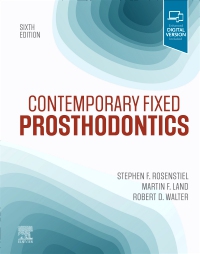

Contemporary Fixed Prosthodontics - Elsevier eBook on VitalSource, 6th Edition
Elsevier eBook on VitalSource
Now $154.79
Find everything you need to become an expert in tooth preparation, prostheses, and restorations! Contemporary Fixed Prosthodontics, 6th Edition provides a solid foundation in basic science as well as step-by-step guidelines to hundreds of fixed prosthodontic procedures. Using more than 3,500 high-quality drawings and photographs, this complete reference walks you through each step of patient care, from diagnosis and planning to prosthesis fabrication and follow-up care. Separate sections on planning and preparation, clinical procedures, and laboratory procedures make it easier to look up the information you need. This edition covers the latest advances in Computer-Aided Design and Computer-Aided Manufacturing technologies and adds new content on minimally invasive prosthodontic procedures through preventive, adhesive, and implant dentistry. From internationally recognized prosthodontic educators and clinicians Stephen Rosenstiel, Martin Land, and Robert Walter, this book includes an enhanced eBook with each new print purchase, featuring a fully searchable version of the entire text.
-
- NEW! Updated and new content includes minimally invasive prosthodontic procedures, tooth preparation for adhesive indirect restorations, implant dentistry and ceramic restorations, clinical photography and digital smile design, risk assessment, and assessment of patients with sleep disorders
- NEW full-color photos and drawings enhance your understanding of each topic, and show the newest instruments and equipment
- NEW! Advances in technology are broken down into their underlying principles and then integrated into the text, rather than including a single chapter with step-by-step CAD/CAM procedures that might soon be out of date
-
- Illustrated, full-color step-by-step procedures walk you through all the steps of treatment from the beginning to the final treatment result
- Summary charts provide a quick, at-glance review of specific procedures (such as Class II inlay preparation and ceramic crown preparation), highlighting the indications, contraindications, advantages, disadvantages, preparation steps, recommended armamentarium, and criteria
- Prosthodontic Diagnostic Index helps you determine the appropriate treatments for completely edentulous, partially edentulous, and dentate patients, using guidelines and illustrations from the American College of Prosthodontists
- Text boxes accompany selected illustrations, presenting quick facts and tips relating to techniques or concepts
- Study questions at the end of each chapter offer an opportunity to test your knowledge and comprehension
- An enhanced eBook is included with each new print purchase, featuring a fully searchable version of the entire text, images, and more!
-
PART I Planning and Preparation
1. History Taking and Clinical Examination
2. Diagnostic Procedures
3. Treatment Planning
4. Principles of Occlusion
5. Periodontal Considerations
6. Mouth Preparation
PART II Clinical Procedures: Section 1
7. Principles of Tooth Preparation
8. Tooth Preparation for Ceramic Restorations
9. The Complete Crown Preparation
10. The Ceramic-Veneered Crown Preparation
11. The Cast Partial Veneer Crown, Inlay, and Onlay Preparations
12. Restoration of the Endodontically Treated Tooth
13. Implant-Supported Fixed Prostheses
14. Tissue Management, Scanning, and Impression Making
15. Interim Fixed Restorations
PART III Laboratory Procedures
16. Communicating With the Dental Laboratory
17. Definitive Casts and Dies
18. Restoration Design
19. Framework Design and Metal Selection for Metal-Ceramic Restorations
20. Pontic Design
21. Retainers for Removable Partial Dentures
22. Metal Restoration Fabrication
23. Color, the Color-Replication Process, and Esthetics
24. Metal-Ceramic Restorations
25. Ceramic Restorations
26. Resin-Bonded Fixed Partial Dentures
27. Connectors for Fixed Partial Dentures
28. Finishing the Metal Restoration
PART IV Clinical Procedures: Section 2
29. Evaluation, Characterization, and Glazing
30. Luting Agents and Cementation Procedures
31. Postoperative Care -
-
Ways of Reading
- The appearance of the text and page layout can be modified according to the capabilities of the reading system (font family and font size, spaces between paragraphs, sentences, words, and letters, as well as color of background and text)
- This e-publication is accessible to the full extent that the file format and types of content allow, on a specific reading device, by default, without necessarily including any additions such as textual descriptions of images or enhanced navigation
- No information about nonvisual reading is available
-
Conformance
- For detailed accessibility information, see Elsevier's website at https://www.elsevier.com/about/accessibility
- For queries regarding accessibility information, contact [email protected]
- The publication was certified on 18-11-2025
-
Navigation
- Table of contents to all chapters of the text via links
-
Rich Content
- No information is available
-
Hazards
- No information is available
-
Product Content
- No information is available
-
Legal Considerations
- No information is available
-
Additional Accessibility Information
- For readers with color vision deficiency, use of color (e.g., in diagrams, graphics and charts, in prompts, or on buttons inviting a response) is not the sole means of graphical distinction or of conveying information
- E-publication includes basic navigation (usually less detailed than TOC-based navigation)
- Where links, controls or buttons are included in the content, the purpose or functionality of each link, control or button is apparent from the associated text alone - or where it is unclear, separate link, control or button descriptions are provided
- All (or substantially all) textual matter is arranged in a single logical reading order (including text that is visually presented as separate from the main text flow, e.g., in boxouts, captions, tables, footnotes, endnotes, citations, etc.). Non-textual content is also linked from within this logical reading order. (Purely decorative non-text content can be ignored).
- The language of the text has been specified (e.g., via the HTML or XML lang attribute) to optimise text-to-speech (and other alternative renderings), both at the whole document level and, where appropriate, for individual words, phrases or passages in a different language.
-
Ways of Reading



 as described in our