ISBN:
9780323776370
Copyright:
2024
Publication Date:
07-27-2023
Page Count:
680
Imprint:
Elsevier
List Price:
$80.99

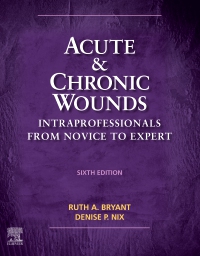
Acute and Chronic Wounds - Elsevier eBook on VitalSource, 6th Edition
by Ruth Bryant, PhD, RN, CWOCN-Retired/Emeritus, FAAWC and Denise Nix, RN, MS, CWOCN
Elsevier eBook on VitalSource
ISBN:
9780323776370
Copyright:
2024
Publication Date:
07-27-2023
Page Count:
680
Imprint:
Elsevier
List Price:
$80.99
Was
$80.99
Now $72.89
Or $0.00 with a valid access code
Acute & Chronic Wounds, 6th Edition provides the latest diagnostic and treatment guidelines to help novice to expert clinicians provide evidence-based, high-quality care for patients with wounds. This textbook presents an interprofessional approach to maintaining skin integrity and managing the numerous types of skin damage, including topics that range from the physiology of wound healing, general principles of wound management, special patient populations, management of percutaneous tubes, and specific care instructions to program development. Written by respected wound experts Ruth Bryant and Denise Nix, this bestselling reference also provides excellent preparation for all wound certification exams.
-
- NEW! Chapters on Postacute Care Settings; Telehealth and Wound Management; Quality Tracking Across the Continuum; and Medications and Phytotherapy: Impact on Wounds provide evidence-based coverage of these important topics
- UPDATED! Consolidated pressure injuries content puts everything you need to know into one chapter
- Expanded full-color insert includes 50 new images — for a total of 95 color plates with more than 160 images — that visually reinforce key concepts
- New information presents the latest developments in biofilm assessment and management, topical oxygen therapy, skin manifestations related to COVID-19, and strategies to enhance engagement, as well as updated product photos and more authors who are clinical experts and providers
-
- Comprehensive approach addresses the prevention and management of acute and chronic wounds, making it the preeminent resource for skin health and wound management across all disciplines involved in wound care, from novice to expert
- Learning Objectives at the beginning of each chapter emphasize the most important content
- Clinical Consult feature in each chapter provides a synthesis of the chapter content, illustrating how to assess, manage, and document a realistic clinical encounter using the ADPIE or SBAR framework
- Checklists provide a concise list of actions necessary to achieve the best patient care outcomes or satisfy a particular objective
- Practical tools and algorithms help in performing risk assessment, differential diagnosis, classification, treatment, and documentation
- Coverage of practice development issues addresses outcomes and productivity in agencies and institutions, home care, acute care, long-term care, and long-term acute care settings
- Self-assessment questions help you test your knowledge and prepare for certification exams
- Helpful appendices provide answers to self-assessment questions, as well as various tools, policies and procedures, competencies, patient and family education guidance, and more
-
-
 Acute and Chronic WoundsHardcover
-
-
SECTION 1: Foundations
1. Principles for Practice Development to Facilitate Outcomes and Productivity
2. Billing, Reimbursement, and Setting Up an Outpatient Clinic
3. Postacute Care Settings
4. Telehealth and Wound Management
5. Patient Engagement and Noncompliance
SECTION 2: Assessment
6. Quality Tracking Across the Continuum
7. Anatomy and Physiology of Skin and Soft Tissue
8. Wound-Healing Physiology and Factors that Affect the Repair Process
9. Types of Skin Damage and Differential Diagnosis
10. Skin and Wound Inspection and Assessment
SECTION 3: Pressure Injuries
11. Pressure Injuries
12. Pressure Redistribution Support Surfaces
SECTION 4: Lower Extremity Wounds
13. Lower Extremity Assessment
14. Arterial Ulcers
15. Venous Leg Ulcerations
16. Lymphedema
17. Neuropathic Wounds: The Diabetic Wound
18. Foot and Nail Care
SECTION 5: Wound Bed Preparation
19. Wound Infection and Bioburden: Detection and Management
20. Wound Debridement
21. Principles of Wound Healing and Topical Management
SECTION 6: Biophysical and Biologic Agents
22. Cellular- and/or Tissue-Based Products for Wounds
23. Molecular and Cellular Regulators
24. Negative Pressure Wound Therapy
25. Hyperbaric Oxygenation
26. Electrical Stimulation
27. Ultraviolet Light and Ultrasound
SECTION 7: Cofactors to Wound Healing
28. Wound Pain
29. Nutritional Assessment and Support
30. Medications and Phytotherapy: Impact on Wounds
31. Perfusion, Oxygenation, and Incision Care
SECTION 8: Special Populations
32. Uncommon Wounds and Manifestations of Intrinsic Disease
33. Traumatic Wounds: Bullets, Blasts, and Vehicle Crashes
34. Burns
35. Reconstructive Surgery
36. Skin Care Needs of the Patient with Obesity
37. Unique Skin Care Needs of the Neonatal and Pediatric Patient
38. Managing Wounds in Palliative Care and End of Life
39. Management of Draining Wounds and Fistulas
40. Percutaneous Tube Management -
-
Ways of Reading
- The appearance of the text and page layout can be modified according to the capabilities of the reading system (font family and font size, spaces between paragraphs, sentences, words, and letters, as well as color of background and text)
- This e-publication is accessible to the full extent that the file format and types of content allow, on a specific reading device, by default, without necessarily including any additions such as textual descriptions of images or enhanced navigation
- No information about nonvisual reading is available
-
Conformance
- For detailed accessibility information, see Elsevier's website at https://www.elsevier.com/about/accessibility
- For queries regarding accessibility information, contact [email protected]
- The publication was certified on 18-11-2025
-
Navigation
- Table of contents to all chapters of the text via links
-
Rich Content
- No information is available
-
Hazards
- No information is available
-
Product Content
- No information is available
-
Legal Considerations
- No information is available
-
Additional Accessibility Information
- For readers with color vision deficiency, use of color (e.g., in diagrams, graphics and charts, in prompts, or on buttons inviting a response) is not the sole means of graphical distinction or of conveying information
- E-publication includes basic navigation (usually less detailed than TOC-based navigation)
- Where links, controls or buttons are included in the content, the purpose or functionality of each link, control or button is apparent from the associated text alone - or where it is unclear, separate link, control or button descriptions are provided
- All (or substantially all) textual matter is arranged in a single logical reading order (including text that is visually presented as separate from the main text flow, e.g., in boxouts, captions, tables, footnotes, endnotes, citations, etc.). Non-textual content is also linked from within this logical reading order. (Purely decorative non-text content can be ignored).
- The language of the text has been specified (e.g., via the HTML or XML lang attribute) to optimise text-to-speech (and other alternative renderings), both at the whole document level and, where appropriate, for individual words, phrases or passages in a different language.
-
Ways of Reading
Was
$80.99
Now $72.89
Or $0.00 with a valid access code

 as described in our