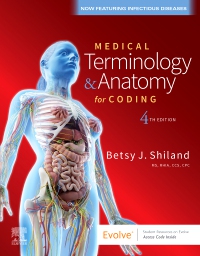

Medical Terminology & Anatomy for Coding Elsevier eBook on VitalSource, 4th Edition
Elsevier eBook on VitalSource
Now $77.39
**Selected for Doody’s Core Titles® 2024 with "Essential Purchase" designation in Dictionaries/Terminology**
Medical Terminology & Anatomy for Coding, 4th Edition is unlike any other medical terminology textbook on the market! With interspersed ICD-10 and CPT coding guidelines and notes, electronic medical records, and integrated exercises, it combines anatomy and physiology coverage with the latest medical terminology needed by coders and coding students. The ICD-10-CM classification system serves as the structure for organizing diseases and disorders, with carefully drawn, well-labelled illustrations to help you visualize the associated anatomy. A new Infectious Disease Process Basics appendix provides the terminology and physiology of infectious diseases. Updated CPT coding information indicates where physician coding differs from ICD-10 coding.
New Edition Expected Availability: 10-24-2024

Medical Terminology & Anatomy for Coding - Elsevier eBook on VitalSource
-
- NEW and UNIQUE! Infectious disease appendix provides the basic information coders and coding students need to be able to understand infectious diseases and to code them correctly.
- NEW and UNIQUE! Additional CPT notes and updated ICD-10 guidelines highlight connections between terminology and codes.
-
- UNIQUE! Anatomy and physiology content covers everything students need to know to code in ICD-10-CM, ICD-10-PCS, and CPT.
- UNIQUE! Pathology terms organized by ICD-10 disease and disorder categories allow students to learn terms in the same order they are presented in the coding manual.
- UNIQUE! Body Part key provides a complete list of body parts and how they should be coded in ICD-10.
-
Unit 1: Introduction to Medical Terminology
1. Introduction to Medical Terminology
2. Body Structure and Directional Terminology
Unit 2: Body Systems
3. Musculoskeletal System and Connective Tissue
4. Skin and Subcutaneous Tissue
5. Digestive System
6. Genitourinary System
7. Pregnancy, Childbirth, and the Puerperium
8. Blood, Blood-Forming Organs, and the Immune Mechanism
9. Circulatory System
10. Respiratory System
11. Nervous System
12. Mental and Behavioral Disorders
13. Eye and Adnexa
14. Ear and Mastoid Process
15. Endocrine System and Nutritional and Metabolic Diseases
Appendices
A: Pharmacology Basics
B: Oncology Basics
C: Infectious Disease Process Basics (NEW!)
D: Word Parts and Definitions
E: Definitions and Word Parts
F: Abbreviations
G: Normal Lab Values
H: Body Part Key
-
-
Ways of Reading
- The appearance of the text and page layout can be modified according to the capabilities of the reading system (font family and font size, spaces between paragraphs, sentences, words, and letters, as well as color of background and text)
- This e-publication is accessible to the full extent that the file format and types of content allow, on a specific reading device, by default, without necessarily including any additions such as textual descriptions of images or enhanced navigation
- No information about nonvisual reading is available
-
Conformance
- No information is available
-
Navigation
- Table of contents to all chapters of the text via links
- Page list to go to pages from the print source version
-
Rich Content
- No information is available
-
Hazards
- No information is available
-
Product Content
- No information is available
-
Legal Considerations
- No information is available
-
Additional Accessibility Information
- Page breaks included from the original print source
- For readers with color vision deficiency, use of color (e.g., in diagrams, graphics and charts, in prompts, or on buttons inviting a response) is not the sole means of graphical distinction or of conveying information
- E-publication includes basic navigation (usually less detailed than TOC-based navigation)
- Where links, controls or buttons are included in the content, the purpose or functionality of each link, control or button is apparent from the associated text alone - or where it is unclear, separate link, control or button descriptions are provided
- All (or substantially all) textual matter is arranged in a single logical reading order (including text that is visually presented as separate from the main text flow, e.g., in boxouts, captions, tables, footnotes, endnotes, citations, etc.). Non-textual content is also linked from within this logical reading order. (Purely decorative non-text content can be ignored).
- The language of the text has been specified (e.g., via the HTML or XML lang attribute) to optimise text-to-speech (and other alternative renderings), both at the whole document level and, where appropriate, for individual words, phrases or passages in a different language.
-
Ways of Reading


 as described in our