ISBN:
9780323776905
Copyright:
2022
Publication Date:
10-27-2021
Page Count:
664
Imprint:
Elsevier
List Price:
$119.99

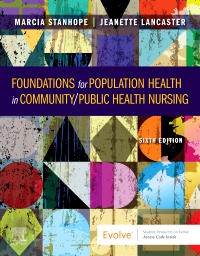
Foundations for Population Health in Community/Public Health Nursing - Elsevier eBook on VitalSource, 6th Edition
by Marcia Stanhope, PhD, RN, FAAN and Jeanette Lancaster, PhD, RN, FAAN
Elsevier eBook on VitalSource
ISBN:
9780323776905
Copyright:
2022
Publication Date:
10-27-2021
Page Count:
664
Imprint:
Elsevier
List Price:
$119.99
Most review copies are eBooks – how fast!
A review copy request is most likely to be fulfilled as an eBook on VitalSource rather than a print product, unless no eBook is available. eBooks become available in as little as a few hours. Print products will take between 7 and 10 days to arrive. To request a print copy, please contact us through the Evolve Support Center for further assistance or contact your Elsevier Sales Rep.
Help your students master the essentials of community and public health nursing! Foundations for Population Health in Community/Public Health Nursing, 6th Edition provides clear, concise coverage of the nurse’s role in preventing disease, promoting health, and providing health education in community settings. Case studies and critical thinking activities make it easier for students to apply concepts to community nursing practice. New to this edition are Healthy People 2030 guidelines and coverage of the latest issues, trends, and approaches. Covering the fundamentals that students need to know, this market-leading text shows how to design effective nursing strategies for vulnerable and special populations.
New Edition Expected Availability: 01-26-2026

Stanhope & Lancaster's Foundations for Population Health in Community/Public Health Nursing - Elsevier E-Book on VitalSource
Elsevier eBook on VitalSource
ISBN: 9780443284991
-
- NEW! COVID-19 pandemic information has been added
- NEW! Healthy People 2030 objectives are highlighted throughout the book, addressing the health priorities and emerging health issues expected in the next decade
- NEW! Updated content and figures reflect the most current data, issues, trends, and practices
- NEW! Expanded Check Your Practice boxes use Clinical Judgment (Next Generation NCLEX®) steps to guide your thinking about practice scenarios
-
- NEW! COVID-19 pandemic information has been added
- NEW! Healthy People 2030 objectives are highlighted throughout the book, addressing the health priorities and emerging health issues expected in the next decade
- Focus on health promotion throughout the text emphasizes initiatives, strategies, and interventions that promote the health of the community
- NEW! Updated content and figures reflect the most current data, issues, trends, and practices
- NEW! Expanded Check Your Practice boxes use Clinical Judgment (NGN) steps to guide student thinking about practice scenarios and promote active learning
- QSEN boxes illustrate how quality and safety goals, competencies, objectives, knowledge, skills, and attitudes can be applied in nursing practice in the community
- Levels of Prevention boxes identify specific nursing interventions at the primary, secondary, and tertiary levels, reinforcing the concept of prevention as it relates to community and public health care
- Applying Content to Practice boxes highlight how chapter content is applied to nursing practice in the community
- Practice Application scenarios present practice situations with questions and answers to help students apply concepts to community practice
- Genomics coverage provides a history of genetics and genomics and how they impact public/community health nursing care
- Coverage of ongoing health care reform issues includes the impact of the Patient Protection and Affordable Care Act of 2010 (ACA) on public health nursing
- Evidence-Based Practice boxes highlight current research findings, their application to practice, and how community/public health nurses can apply the study results
-
-

-

-
 Elsevier Adaptive Quizzing for Foundations for Population Health in Community/Public Health Nursing (eCommerce Version)Elsevier Adaptive Quizzing - Next Generation
 -

-
-
SECTION I Factors Influencing Nursing in Community and Population Health
1. Public Health Nursing and Population Health
2. The History of Public Health and Public and Community Health Nursing
3. US and Global Health Care
4. Government, the Law, and Policy Activism
5. Economics of US Health Care Delivery
SECTION 2 Forces Affecting Nurses in Community and Population Health Care Delivery
6. Ethics in Public and Community Health Nursing Practice
7. Culture of Populations in Communities
8. Environmental Health
9. Evidence-Based Practice
SECTION 3 Conceptual Frameworks Applied to Nursing Practice in the Community
10. Epidemiologic Applications
11. Infectious Disease Prevention and Control
12. Communicable and Infectious Disease Risks
13. Community Assessment and Evaluation
14. Health Education in the Community
SECTION 4 Issues and Approaches in Health Care of Populations
15. Case Management 16: Disaster Management
17. Public Health Surveillance and Outbreak Investigation
18. Program Management
19. Health Care Improvement in the Community
SECTION 5 Issues and Approaches in Family and Individual Health Care
20. Family Development and Family Nursing Assessment and Genomics
21. Family Health Risks
22. Health Risks Across the Life Span
SECTION 6 Vulnerability: Predisposing Factors
23. Health Equity and Care of Vulnerable Populations
24. Rural Health and Migrant Health
25. Poverty, Homelessness, Teen Pregnancy, and Mental Illness
26. Alcohol, Tobacco, and Other Drug Problems in the Community
27. Violence and Human Abuse
SECTION 7 Nursing Practice in the Community: Roles and Functions
28. Nursing Practice at the Local, State, and National Levels in Public Health
29. The Faith Community Nurse
30. The Nurse in Public Health, Home Health, Palliative Care, and Hospice
31. The Nurse in the Schools
32. The Nurse in Occupational Health
Appendices
A. Guidelines for Practice
B. Assessment Tools
C. Essential Elements of Public Health Nursing
D. Hepatitis Information -
-
Ways of Reading
- The appearance of the text and page layout can be modified according to the capabilities of the reading system (font family and font size, spaces between paragraphs, sentences, words, and letters, as well as color of background and text)
- This e-publication is accessible to the full extent that the file format and types of content allow, on a specific reading device, by default, without necessarily including any additions such as textual descriptions of images or enhanced navigation
- No information about nonvisual reading is available
-
Conformance
- For detailed accessibility information, see Elsevier's website at https://www.elsevier.com/about/accessibility
- For queries regarding accessibility information, contact [email protected]
- The publication was certified on 18-11-2025
-
Navigation
- Table of contents to all chapters of the text via links
-
Rich Content
- No information is available
-
Hazards
- No information is available
-
Product Content
- No information is available
-
Legal Considerations
- No information is available
-
Additional Accessibility Information
- For readers with color vision deficiency, use of color (e.g., in diagrams, graphics and charts, in prompts, or on buttons inviting a response) is not the sole means of graphical distinction or of conveying information
- E-publication includes basic navigation (usually less detailed than TOC-based navigation)
- Where links, controls or buttons are included in the content, the purpose or functionality of each link, control or button is apparent from the associated text alone - or where it is unclear, separate link, control or button descriptions are provided
- All (or substantially all) textual matter is arranged in a single logical reading order (including text that is visually presented as separate from the main text flow, e.g., in boxouts, captions, tables, footnotes, endnotes, citations, etc.). Non-textual content is also linked from within this logical reading order. (Purely decorative non-text content can be ignored).
- The language of the text has been specified (e.g., via the HTML or XML lang attribute) to optimise text-to-speech (and other alternative renderings), both at the whole document level and, where appropriate, for individual words, phrases or passages in a different language.
-
Ways of Reading
Most review copies are eBooks – how fast!
A review copy request is most likely to be fulfilled as an eBook on VitalSource rather than a print product, unless no eBook is available. eBooks become available in as little as a few hours. Print products will take between 7 and 10 days to arrive. To request a print copy, please contact us through the Evolve Support Center for further assistance or contact your Elsevier Sales Rep.

 as described in our