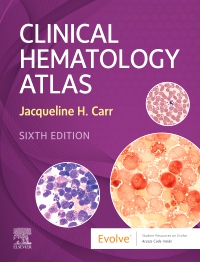

Clinical Hematology Atlas Elsevier eBook on VitalSource, 6th Edition
Elsevier eBook on VitalSource
Now $65.69
Learn how to accurately identify cells at the microscope with Clinical Hematology Atlas, 6th Edition. An excellent companion to Rodak's Hematology: Clinical Principles and Applications, this award-winning atlas offers complete coverage of the basics of hematologic morphology, including examination of the peripheral blood smear, maturation of the blood cell lines, and information on a variety of clinical disorders. Vivid photomicrographs, schematic diagrams, and electron micrographs clearly illustrate hematology from normal cell maturation to the development of various pathologies so you can be certain you’re making accurate conclusions in the lab.
New Edition Expected Availability: 09-03-2026

Clinical Hematology Atlas - Elsevier E-Book on VitalSource
-
- NEW! Revised chapters include updates based on extensive reviewer feedback
- NEW! Updated photos reflect the most up-to-date information and latest advances in the field
-
- NEW! Nora AI - an AI-powered learning assistant exclusive to Elsevier ebooks on VitalSource's Bookshelf® platform - offers built-in AI learning support that provides personalized answers based on content from the Elsevier ebook
- Schematic diagrams, photomicrographs, and electron micrographs in every chapter visually enhance student understanding of hematologic cellular morphology
- Compact size, concise text, and spiral binding make it easy to carry and reference this atlas in the laboratory
- Chapter on normal newborn peripheral blood morphology covers the normal cells found in neonatal blood
- Chapter on body fluids illustrates the other fluids found in the body besides blood, using images from cytocentrifuged specimens
- The most common cytochemical stains, along with a summary chart for interpretation, are featured in the leukemia chapters to assist in the classification of both malignant and benign leukoproliferative disorders
- Chapter featuring morphologic changes after myeloid hematopoietic growth factors is included in the text
- Morphologic abnormalities coverage in the chapters on erythrocytes and leukocytes, along descriptions of each cell, presents this information in a schematic fashion
- Appendix with comparison tables of commonly confused cells includes lymphocytes versus neutrophilic myelocytes and monocytes versus reactive lymphoctyes to help students see the subtle differences between them
- Glossary of hematologic terms at the end of the book provides a quick reference to easily look up definitions
-
-

-
 Clinical Hematology AtlasSpiral Bound
-
-
Section 1: Introduction
1. Introduction to Peripheral Blood Film Examination
Section 2: Hematopoiesis
2. Hematopoiesis
3. Erythrocyte Maturation
4. Megakaryocyte Maturation
5. Neutrophil Maturation
6. Monocyte Maturation
7. Eosinophil Maturation
8. Basophil Maturation
9. Lymphocyte Maturation
Section 3: Erythrocytes
10. Variations in Size and Color of Erythrocytes
11. Variations in Shape and Distribution of Erythrocytes
12. Inclusions in Erythrocytes
13. Diseases Affecting Erythrocytes
Section 4: Leukocytes
14. Nuclear and Cytoplasmic Changes in Leukocytes
15. Acute Myeloid Leukemia
16. Precursor Lymphoid Neoplasms
17. Myeloproliferative Neoplasms
18. Myelodysplastic Syndromes
19. Mature Lymphoproliferative Disorders
20. Morphologic Changes after Myeloid Hematopoietic Growth Factors
Section 5: Miscellaneous
21. Microorganisms
22. Miscellaneous Cells
23. Normal Newborn Peripheral Blood Morphology
24. Body Fluids -
-
Ways of Reading
- The appearance of the text and page layout can be modified according to the capabilities of the reading system (font family and font size, spaces between paragraphs, sentences, words, and letters, as well as color of background and text)
- This e-publication is accessible to the full extent that the file format and types of content allow, on a specific reading device, by default, without necessarily including any additions such as textual descriptions of images or enhanced navigation
- All content can be read as read aloud speech or dynamic braille
- Has alternative text descriptions for images
-
Conformance
- The publication contains a conformance statement that it meets the EPUB Accessibility 1.1, WCAG 2.1, Level AA standard. Please see https://bornaccessible.benetech.org/certified-publishers/ for further details of our compatibility testing.
- The certifier's credential is https://bornaccessible.benetech.org/certified-publishers/
- For detailed accessibility information, see Elsevier's website at https://www.elsevier.com/about/accessibility
- For queries regarding accessibility information, contact [email protected]
- The publication was certified on 24-03-2026
-
Navigation
- Table of contents to all chapters of the text via links
- Index with links to referenced entries
- Elements such as headings, tables, etc. for structured navigation
- Page list to go to pages from the print source version
-
Rich Content
- Information-rich images are described by extended descriptions
-
Hazards
- The publication contains no hazards
-
Product Content
- Content includes any type of illustrations.
- The primary content is text.
- Content includes maps and/or other cartographic content.
- Content includes a significant number of actionable (clickable) web links to external content, downloadable resources, supplementary material, etc.
- Content includes a significant number of actionable (clickable) cross-references, hyperlinked notes and annotations, or with other actionable links between largely textual elements (e.g., quiz/test questions, 'choose your own ending', etc.).
- Content includes photographs, whether in a plate section / insert or not.
- Content includes figures, diagrams, charts and/or graphs, including other 'mechanical' (i.e. non-photographic) illustrations.
- Content includes images displayed in a specific order for the purpose of graphic storytelling or giving information (e.g. graphic novels, comics and manga). May include text integrated into the image (as speech and thought bubbles, textual 'sound' effects, captions etc.).
- Content includes text within images, including text-as-text embedded in diagrams, charts, or within images containing speech balloons, thought bubbles, captions, etc.
- Content includes visual content that is purely decorative and is not necessary to understanding of the content.
- At least some text - including text within other images - is 'text as an image' (i.e., a picture of text).
-
Legal Considerations
- No information is available
-
Additional Accessibility Information
- Content is enhanced with ARIA roles to optimize organization and facilitate navigation
- Page breaks included from the original print source
- For readers with color vision deficiency, use of color (e.g., in diagrams, graphics and charts, in prompts, or on buttons inviting a response) is not the sole means of graphical distinction or of conveying information
- The body text is presented with a contrast ratio of at least 4.5:1 (or 3:1 for large/heading text)
- Ultra-high contrast between text and background
- E-publication includes basic navigation (usually less detailed than TOC-based navigation)
- Where links, controls or buttons are included in the content, the purpose or functionality of each link, control or button is apparent from the associated text alone - or where it is unclear, separate link, control or button descriptions are provided
- All (or substantially all) textual matter is arranged in a single logical reading order (including text that is visually presented as separate from the main text flow, e.g., in boxouts, captions, tables, footnotes, endnotes, citations, etc.). Non-textual content is also linked from within this logical reading order. (Purely decorative non-text content can be ignored).
- Content provides explanations for unusual words, abbreviations, acronyms, idioms, jargon in an accessible form, such as glossaries, scripted pop-ups.
- Where interactive content is included in the product, controls are provided (e.g., for speed, pause and resume, reset) and labelled to make their use clear.
- The language of the text has been specified (e.g., via the HTML or XML lang attribute) to optimise text-to-speech (and other alternative renderings), both at the whole document level and, where appropriate, for individual words, phrases or passages in a different language.
-
Ways of Reading

 as described in our