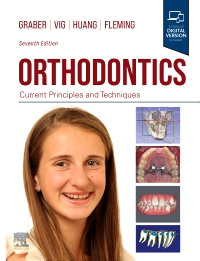

Orthodontics - Elsevier eBook on VitalSource, 7th Edition
Elsevier eBook on VitalSource
Now $244.79
**Selected for 2026 Doody's Core Titles as an Essential Purchase in Dentistry**
Comprehensive, cutting-edge content addresses contemporary orthodontic practice! Orthodontics: Current Principles and Techniques, 7th Edition provides an evidence-based approach to orthodontic diagnosis, treatment planning, and clinical techniques, including esthetics, genetics, temporary anchorage devices, aligners, technology-assisted biomechanics, and much more. New to this edition are seven chapters, covering topics like AI, maxillary expansion in adults, Class II correctors, and autotransplantation. Newly authored chapters on orthognathic surgery and the craniofacial team, the periodontal-orthodontic interface, interdisciplinary treatment, and accelerated tooth movement, among others, address current perspectives. The 7th edition comes with access to an enhanced eBook version, which includes videos and additional visuals to show concepts difficult to explain with words alone. Readers can also find additional, online-only chapters and a fully searchable version of the text. Respected editors Lee Graber, Katherine Vig, and Greg Huang are joined by new editor Pádhraig Fleming, along with expert contributors from around the world. This text provides the most current and comprehensive collection of orthodontic knowledge, making it the go-to book for orthodontic residents and practitioners!
-
- NEW! Seven chapters cover topics such as AI, maxillary expansion in adults, Class II correctors, and autotransplantation. Newly authored chapters on aligners, orthognathic surgery, the periodontal-orthodontic interface, interdisciplinary and computer-assisted treatment, temporary anchorage devices, and accelerated tooth movement, among others, address current perspectives
- UPDATED! Relevant literature and evidence-based practices are featured throughout the text
- NEW! Additional photos and illustrations visually reinforce key concepts and procedures
-
- Comprehensive coverage provides a one-stop resource for the field of orthodontics, including foundational theory and the latest on the materials and techniques used in today’s practice
- Experienced, renowned editors lead a team of expert, international contributors to provide the most authoritative clinical practice and supporting science from the best and brightest in the industry
- More than 3,400 images include a mixture of radiographs, full-color clinical photos, and anatomic or schematic line drawings, showing examples of treatment, techniques, and outcomes
- Detailed, illustrated case studies show the decision-making process, highlighting the consequences of various treatment techniques over time
- Extensive references make it easy to look up the latest in orthodontic research and evidence-based information, and all references also appear online
- Enhanced ebook, included with every print purchase, features a fully searchable version of the text and bonus online-only chapters, instructional videos, and more
-
-
 OrthodonticsHardcover
-
-
PART A Foundations of Orthodontics
1. The History of Orthodontics… From an Idea to a Profession
2. Craniofacial Growth and Development: Developing a Perspective
3. Genetics and Orthodontics
4. The Biological Basis for Orthodontics
5. Bone Physiology, Metabolism, and Biomechanics in Orthodontic Practice
6. Application of Bioengineering to Clinical Orthodontics
7. Clinically Relevant Aspects of Dental Materials Science in Orthodontics
8. The Role of Evidence in Orthodontics
9. Applications of Artificial Intelligence and Big Data Analytics in Orthodontics
PART B Diagnosis and Treatment Planning
10. The Decision-Making Process in Orthodontics
11. Psychological Aspects of Diagnosis and Treatment
12. Orthodontic Diagnosis and Treatment Planning with Cone-Beam Computed Tomography Imaging
13. Upper Airway, Cranial Morphology, and Sleep Apnea
14. Orthodontic Therapy and the Patient with Temporomandibular Disorders
15. The Orthodontist’s Role and Collaboration in a Cleft Palate–Craniofacial Team
PART C Orthodontic Treatment
16. Principles of Treatment: Balancing Outcome and Efficiency
17. Optimizing Orthodontics and Dentofacial Orthopedics
PART A: Patient Management and Motivation for the Child and Adolescent Patient
PART B: Treatment Timing and Mixed Dentition Therapy
18. Standard Edgewise: Tweed-Merrifield Philosophy, Diagnosis, Treatment Planning, and Force Systems
19. Contemporary Straight Wire Biomechanics
20. Self-Ligating Bracket Biomechanics
21. Lingual Appliance Treatment
22. Clear Aligner Treatment
23. New Frontiers in Fixed Class II Correctors
24. Temporary Anchorage Devices
PART A: Biomechanical Considerations with Temporary Anchorage Devices
PART B: The Use of Palatal Mini-Implant Anchorage: Conventional Approaches Versus Computer-Aided Design and Computer-Aided Manufacturing Workflows
PART C: Extraalveolar Bone Screw Anchorage Applied to Challenging Malocclusions
PART D: Orthopedic Changes with Bone-Anchored Miniplates and Functional Jaw Orthopedics: Biological Basis and Practice
25. Maxillary Expansion in Adults
26. Orthodontic–Periodontal Interface
27. Orthodontic Aspects of Orthognathic Surgery
28. Adult Interdisciplinary Therapy: Diagnosis and Treatment
PART D Specialized Treatment Considerations
29. Bonding in Orthodontics
30. Management of Impactions
31. Management of Dental Luxation and Avulsion Injuries in the Permanent Dentition
32. Autotransplantation of Developing Teeth
33. Iatrogenic Effects of Orthodontic Appliances
PART A: Prevention and Management of Demineralized Lesions
PART B: External Apical Root Resorption
34. Minimally Invasive and Noninvasive Approaches to Accelerate Tooth Movement
35. Aerosols in Orthodontics
36. Computer-Assisted Orthodontics: Integrating Computer-Aided Design and Computer-Aided Manufacturing Technology with Diagnosis, Treatment Planning, and Therapeutics
PART E Orthodontic Retention and Posttreatment Changes
37. Stability, Posttreatment Changes, and Retention
PART F Classic Chapters
38. Interceptive Guidance of Occlusion
39. Functional Appliances
40. Treatment of the Face with Biocompatible Orthodontics -
-
Ways of Reading
- The appearance of the text and page layout can be modified according to the capabilities of the reading system (font family and font size, spaces between paragraphs, sentences, words, and letters, as well as color of background and text)
- This e-publication is accessible to the full extent that the file format and types of content allow, on a specific reading device, by default, without necessarily including any additions such as textual descriptions of images or enhanced navigation
- No information about nonvisual reading is available
-
Conformance
- For detailed accessibility information, see Elsevier's website at https://www.elsevier.com/about/accessibility
- For queries regarding accessibility information, contact [email protected]
- The publication was certified on 18-11-2025
-
Navigation
- Table of contents to all chapters of the text via links
-
Rich Content
- No information is available
-
Hazards
- No information is available
-
Product Content
- No information is available
-
Legal Considerations
- No information is available
-
Additional Accessibility Information
- For readers with color vision deficiency, use of color (e.g., in diagrams, graphics and charts, in prompts, or on buttons inviting a response) is not the sole means of graphical distinction or of conveying information
- E-publication includes basic navigation (usually less detailed than TOC-based navigation)
- Where links, controls or buttons are included in the content, the purpose or functionality of each link, control or button is apparent from the associated text alone - or where it is unclear, separate link, control or button descriptions are provided
- All (or substantially all) textual matter is arranged in a single logical reading order (including text that is visually presented as separate from the main text flow, e.g., in boxouts, captions, tables, footnotes, endnotes, citations, etc.). Non-textual content is also linked from within this logical reading order. (Purely decorative non-text content can be ignored).
- The language of the text has been specified (e.g., via the HTML or XML lang attribute) to optimise text-to-speech (and other alternative renderings), both at the whole document level and, where appropriate, for individual words, phrases or passages in a different language.
-
Ways of Reading

 as described in our