
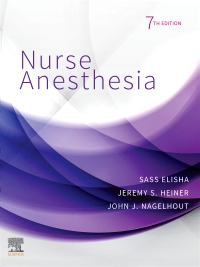

Nurse Anesthesia - Elsevier eBook on VitalSource, 7th Edition
Elsevier eBook on VitalSource
Now $125.83
Gain the knowledge and skills you need for clinical anesthesia practice! Written specifically for nurse anesthetists, Nurse Anesthesia, 7th Edition provides a solid foundation in scientific principles and evidence-based practice. Coverage includes a review of pharmacology, pharmacokinetics and pharmacodynamics, drug receptor concepts, intravenous agents, neuromuscular blocking agents, and more, followed by a discussion of anesthesia equipment and clinical monitoring, preoperative preparation of the patient, and the use of anesthesia for a variety of surgical procedures. From a team of expert authors led by Sass Elisha, Jeremy S. Heiner, and John J. Nagelhout, this text helps you prepare for certification and also provides a key reference for CRNAs to use in daily practice.
-
- Updated information on pharmacology includes pharmacokinetics, drug delivery systems, opiate antagonists, and key induction drugs.
- Interactions with other anesthetic agents are integrated where appropriate, along with other important considerations.
- Overview of basic science provides a thorough basis for understanding nurse anesthesia.
- Information on Joint Commission (TJC) standards covers monitoring and administering moderate sedation/analgesia, also adding coverage of patient safety, monitoring, and pharmacology.
- More than 800 full-color photos and illustrations depict anatomy, procedures, concepts, and equipment.
- Logical organization of the text covers basic principles first, and builds on those with individual chapters for each surgical specialty.
- More than 800 tables and boxes summarize essential information in a quick, easy-to-reference format.
- UNIQUE! Expert CRNA authors provide the most up-to-date clinical information for CRNAs to use in daily practice.
- Handy references make it quick and easy to find the latest and most important research in the field.
-
- NEW! Updated content reflects the latest changes in the industry
- NEW! Two new chapters include Crisis Resource Management and Patient Safety and Infection Control and Prevention
-
Unit I: Professional Issues
1. Nurse Anesthesia: A History of Challenge
2. Nurse Anesthesia Specialty Practice and Education in the United States
3. Legal Concepts in Nurse Anesthesia Practice
Unit II: Scientific Foundations
4. Nurse Anesthesia Research: Science of an Orderly, Purposeful, and Systematic Nature
5. General Principles, Pharmacodynamics, and Drug Receptor Concepts
6. Pharmacokinetics
7. Pharmacokinetics of Inhalation Anesthetics
8. Inhalation Anesthetics
9. Intravenous Induction Agents
10. Local Anesthetics
11. Opioid Agonists and Antagonists
12. Neuromuscular Blocking Agents, Reversal Agents, and Their Monitoring
13. Autonomic and Cardiac Pharmacology
14. Chemistry and Physics of Anesthesia
Unit III: Technology Related to Anesthesia Practice
15. Anesthesia Equipment
16. Clinical Monitoring I: Cardiovascular System
17. Clinical Monitoring II: Respiratory and Metabolic Systems
18. Clinical Monitoring III: Neurologic System
Unit IV: Preoperative Preparation
19. Preoperative Evaluation and Preparation of the Patient
Unit V: Intraoperative Management
20. Fluids, Electrolytes, and Blood Component Therapy
21. Positioning for Anesthesia and Surgery
22. Airway Management
23. Cardiovascular Anatomy, Physiology, Pathophysiology, and Anesthesia Management
24. Anesthesia for Cardiac Surgery
25. Anesthesia for Vascular Surgery
26. Respiratory Anatomy, Physiology, Pathophysiology, and Anesthetic Management
27. Anesthesia for Thoracic Surgery
28. Neuroanatomy, Neurophysiology, and Neuroanesthesia
29. Renal Anatomy, Physiology, Pathophysiology, and Anesthesia Management
30. Hepatobiliary and Gastrointestinal Disturbances and Anesthesia
31. Anesthesia for Laparoscopic Surgery
32. Musculoskeletal System Anatomy, Physiology, Pathophysiology, and Anesthesia Management
33. The Endocrine System and Anesthesia
34. Hematology and Anesthesia
35. Thermal Injury and Anesthesia
36. Trauma Anesthesia
37. Outpatient Anesthesia
38. Anesthesia for Ear, Nose, Throat, and Maxillofacial Surgery
39. Anesthesia for Ophthalmic Procedures
40. Anesthesia for Orthopedics and Podiatry
41. The Immune System and Anesthesia
42. Anesthesia and Laser Surgery
43. Obesity and Anesthesia Practice
44. Regional Anesthesia: Spinal and Epidural Anesthesia
45. Regional Anesthesia: Upper and Lower Extremity Blocks
46. Obstetric Anesthesia
47. Neonatal Anesthesia
48. Pediatric Anesthesia
49. Geriatrics and Anesthesia Practice
50. Postanesthesia Recovery
51. Pain Management
52. Anesthesia for Therapeutic and Diagnostic Procedures
53. Anesthesia Complications -
-
Ways of Reading
- The appearance of the text and page layout can be modified according to the capabilities of the reading system (font family and font size, spaces between paragraphs, sentences, words, and letters, as well as color of background and text)
- This e-publication is accessible to the full extent that the file format and types of content allow, on a specific reading device, by default, without necessarily including any additions such as textual descriptions of images or enhanced navigation
- No information about nonvisual reading is available
-
Conformance
- For detailed accessibility information, see Elsevier's website at https://www.elsevier.com/about/accessibility
- For queries regarding accessibility information, contact [email protected]
- The publication was certified on 18-11-2025
-
Navigation
- Table of contents to all chapters of the text via links
-
Rich Content
- No information is available
-
Hazards
- No information is available
-
Product Content
- No information is available
-
Legal Considerations
- No information is available
-
Additional Accessibility Information
- For readers with color vision deficiency, use of color (e.g., in diagrams, graphics and charts, in prompts, or on buttons inviting a response) is not the sole means of graphical distinction or of conveying information
- E-publication includes basic navigation (usually less detailed than TOC-based navigation)
- Where links, controls or buttons are included in the content, the purpose or functionality of each link, control or button is apparent from the associated text alone - or where it is unclear, separate link, control or button descriptions are provided
- All (or substantially all) textual matter is arranged in a single logical reading order (including text that is visually presented as separate from the main text flow, e.g., in boxouts, captions, tables, footnotes, endnotes, citations, etc.). Non-textual content is also linked from within this logical reading order. (Purely decorative non-text content can be ignored).
- The language of the text has been specified (e.g., via the HTML or XML lang attribute) to optimise text-to-speech (and other alternative renderings), both at the whole document level and, where appropriate, for individual words, phrases or passages in a different language.
-
Ways of Reading

 as described in our