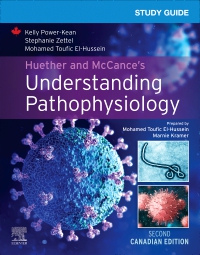

Study Guide for Huether and McCance's Understanding Pathophysiology, Canadian Edition - Elsevier E-Book on VitalSource, 2nd Edition
Elsevier eBook on VitalSource
Now $32.39
Take the shortest path to understanding pathophysiology with this Canadian workbook! Corresponding to the chapters in Huether and McCance's Understanding Pathophysiology, 2nd Canadian Edition, this study guide uses a variety of exercises, activities, and review questions to help you master pathophysiology concepts. Case studies help you put the information together and develop critical thinking and clinical judgment skills. With new Next Generation NCLEX®-style practice questions, this study tool prepares you for success on the NGN examination and in clinical practice.
-
- NEW! The only Canadian nursing pathophysiology study guide on the market allows you to more fully grasp and apply complex pathophysiology concepts
- NEW! Next Generation NCLEX® (NGN) case studies include questions to help you apply pathophysiology concepts and prepare for the NGN examination, with suggested answers included at the back of the book
-
- More than 2,600 interactive questions in a variety of formats help you review and master high-level pathophysiology content
- Wide range of engaging activities allows you to assess your knowledge or identify areas for further study with matching definitions, choosing correct words, completing sentences, categorizing clinical examples, explaining pictures, describing differences, and teaching others about pathophysiology
- Case scenarios feature brief, real-world case studies as well as application questions
- Close alignment with the format of the Huether and McCance's Understanding Pathophysiology text makes it easy to go back and forth between the two resources
- Teach People About Pathophysiology questions ask you to respond to questions posed directly from the patient’s point of view
- Answer key found in the back of the study guide allows you to check answers and evaluate your progress
-
-
 Huether and McCance's Understanding Pathophysiology, Canadian Edition - Elsevier eBook on VitalSourceElsevier eBook on VitalSource
 -

-

-
-
Unit 1: The Cell
1. Cellular Biology
2. Genes and Genetic Diseases
3. Epigenetics and Disease
4. Altered Cellular and Tissue Biology
5. Fluids and Electrolytes, Acids and Bases
Unit 2: Mechanisms of Self-Defense
6. Innate Immunity: Inflammation and Wound Healing
7. Adaptive Immunity
8. Infection and Defects in Mechanisms of Defense
9. Stress and Disease
Unit 3: Cellular Proliferation: Cancer
10. Biology of Cancer
11. Cancer Epidemiology
12. Cancer in Children and Adolescents
PART TWO: BODY SYSTEMS AND DISEASES
Unit 4: The Neurologic System
13. Structure and Function of the Neurologic System
14. Pain, Temperature, Sleep, and Sensory Function
15. Alterations in Cognitive Systems, Cerebral Hemodynamics and Motor Function
16. Disorders of the Central and Peripheral Nervous Systems and Neuromuscular Junction
17. Alterations of Neurologic Function in Children
Unit 5: The Endocrine System
18. Mechanisms of Hormonal Regulation
19. Alterations of Hormonal Regulation
Unit 6: The Hematologic System
20. Structure and Function of the Hematologic System
21. Alterations in Hematologic Function
22. Alterations of Hematologic Function in Children
Unit 7: The Cardiovascular and Lymphatic Systems
23. Structure and Function of the Cardiovascular and Lymphatic Systems
24. Alterations of Cardiovascular Function
25. Alterations of Cardiovascular Function in Children
Unit 8: The Pulmonary System
26. Structure and Function of the Pulmonary System
27. Alterations of Pulmonary Function
28. Alterations of Pulmonary Function in Children
Unit 9: The Renal and Urologic Systems
29. Structure and Function of the Renal and Urologic Systems
30. Alterations of Renal and Urinary Tract Function
31. Alterations of Renal and Urinary Tract Function in Children
Unit 10: The Reproductive Systems
32. Structure and Function of the Reproductive Systems
33. Alterations of the Female Reproductive System
34. Alterations of the Male Reproductive System
Unit 11: The Digestive System
35. Structure and Function of the Digestive System
36. Alterations of Digestive Function
37. Alterations in Digestive Function in Children
Unit 12: The Musculoskeletal and Integumentary Systems
38. Structure and Function of the Musculoskeletal System
39. Alterations of Musculoskeletal Function
40. Alterations of Musculoskeletal Function in Children
41. Structure, Function, and Disorders of the Integument
42. Alterations of the Integument in Children
43. Co-morbidity and Multi-morbidities -
-
Ways of Reading
- The appearance of the text and page layout can be modified according to the capabilities of the reading system (font family and font size, spaces between paragraphs, sentences, words, and letters, as well as color of background and text)
- This e-publication is accessible to the full extent that the file format and types of content allow, on a specific reading device, by default, without necessarily including any additions such as textual descriptions of images or enhanced navigation
- No information about nonvisual reading is available
-
Conformance
- No information is available
-
Navigation
- Table of contents to all chapters of the text via links
- Page list to go to pages from the print source version
-
Rich Content
- No information is available
-
Hazards
- No information is available
-
Product Content
- No information is available
-
Legal Considerations
- No information is available
-
Additional Accessibility Information
- Page breaks included from the original print source
- For readers with color vision deficiency, use of color (e.g., in diagrams, graphics and charts, in prompts, or on buttons inviting a response) is not the sole means of graphical distinction or of conveying information
- E-publication includes basic navigation (usually less detailed than TOC-based navigation)
- Where links, controls or buttons are included in the content, the purpose or functionality of each link, control or button is apparent from the associated text alone - or where it is unclear, separate link, control or button descriptions are provided
- All (or substantially all) textual matter is arranged in a single logical reading order (including text that is visually presented as separate from the main text flow, e.g., in boxouts, captions, tables, footnotes, endnotes, citations, etc.). Non-textual content is also linked from within this logical reading order. (Purely decorative non-text content can be ignored).
- The language of the text has been specified (e.g., via the HTML or XML lang attribute) to optimise text-to-speech (and other alternative renderings), both at the whole document level and, where appropriate, for individual words, phrases or passages in a different language.
-
Ways of Reading

 as described in our