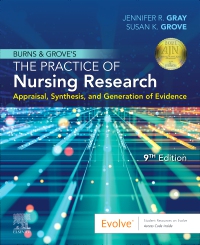

Burns and Grove's The Practice of Nursing Research Elsevier eBook on VitalSource, 9th Edition
Elsevier eBook on VitalSource
Winner of the 1st-place American Journal of Nursing Book of the Year award in nursing research/evidence-based practice for 2021!
Burns & Grove’s The Practice of Nursing Research: Appraisal, Synthesis, and Generation of Evidence, 9th Edition is a trusted resource to help students master the research methods that are foundational to evidence-based practice. This highly respected textbook both walks students through how to appraise and apply existing research evidence and instructs them on how to participate in research and quality improvement projects. This new 9th edition has been extensively updated to reflect today’s focus on online research in the digital era and includes clear, step-by-step guidelines for all major quantitative and qualitative research approaches — including supporting examples from the best current and classic literature. There’s also new content on translational research, coverage of the most current research tools and techniques, and an increased use of illustrations, tables, and other visuals to help engage visually oriented learners of all levels.
New Edition Expected Availability: 01-07-2026

Burns and Grove's The Practice of Nursing Research - Elsevier E-Book on VitalSource
-
- NEW! Extensively updated content reflects the most current quantitative and qualitative approaches to nursing research, as well as the most current research tools and techniques used in the digital era
- NEW! Updated research examples throughout incorporate the best examples of current literature, with increased emphasis on international examples to reflect the increasingly global nature of nursing research
- NEW! Increased use of visuals includes the addition of more illustrations, tables, and boxes to help break up long passages of text for today’s more visually oriented learners of all levels
- NEW! Revised chapters offer improved clarity and usability in the areas of research problems and purpose, quantitative research design, quantitative methodology, and qualitative methodology
- NEW! Increased emphasis on hospital magnet status reflects the effect this status has on improving nursing competency and quality outcomes
- UPDATED! Coverage of certain qualitative research content has been de-emphasized to reflect the decreased use of certain methodologies (e.g., historical research) and to allow the introduction of additional methodologies that are growing in use
-
- NEW! Extensively updated content reflects the most current quantitative and qualitative approaches to nursing research, as well as the most current research tools and techniques used in the digital era
- NEW! Updated research examples throughout incorporate the best examples of current literature, with increased emphasis on international examples to reflect the increasingly global nature of nursing research
- NEW! Increased use of visuals includes the addition of more illustrations, tables, and boxes to help break up long passages of text for today’s more visually oriented learners of all levels
- NEW! Revised chapters offer improved clarity and usability in the areas of research problems and purpose, quantitative research design, quantitative methodologies, and qualitative methodologies
- NEW! Increased emphasis on hospital magnet status reflects the effect this status has on improving nursing competency and quality outcomes
- UPDATED! Coverage of certain qualitative research methodologies has been de-emphasized to reflect the decreased use of certain methodologies (e.g., historical research) and to allow the introduction of additional methodologies that are growing in use
- Coverage of quantitative, qualitative, and other research methodologies gives students a solid foundation to conduct, appraise, and apply research evidence to the realities of today's clinical practice
- Balanced coverage of qualitative and quantitative methods addresses the qualitative research methodologies that are often the starting point of research projects, particularly in magnet hospitals and DNP programs
- Clear, comprehensive coverage is organized into five units that include: an introduction to nursing research; coverage of the research process; application for evidence-based health care; how to analyze data, determine outcomes, and disseminate research; and how to propose and seek funding for research
- Strong emphasis on evidence-based practice addresses this key graduate-level QSEN competency and helps students learn to generate research evidence and to appraise and synthesize existing research for application to clinical practice
- Rich examples from the nursing literature bring research principles to life
- Emphasis on the most currently used research methodologies focuses on the methods used in both quantitative research and qualitative research, as well as outcomes research and mixed-methods research
- Coverage of digital data collection guides students through the use of online research
- Quick-reference summaries include a table of research methods inside the front cover and a list of types of research syntheses (with definitions) inside the back cover
- Helpful student resources are included with each new text purchase on the companion Evolve website and feature 400 interactive review questions along with a library of 10 full-text research articles
-
Unit One: Introduction to Nursing Research
1. Discovering the World of Nursing Research
2. Evolution of Research in Building Evidence-Based Nursing Practice
3. Introduction to Quantitative Research
4. Introduction to Qualitative Research
Unit Two: The Research Process
5. Research Problem and Purpose
6. Objectives, Questions, Variables, and Hypotheses
7. Review of Relevant Literature
8. Frameworks
9. Ethics in Research
10. Quantitative Methodology: Noninterventional Designs and Methods
11. Quantitative Methodology: Interventional Designs and Methods
12. Qualitative Research Methods
13. Outcomes Research
14. Mixed Methods Research
15. Sampling
16. Measurement Concepts
17. Measurement Methods Used in Developing Evidence-Based Practice
Unit Three: Putting It All Together for Evidence-Based Health Care
18. Critical Appraisal of Nursing Studies
19. Evidence Synthesis and Strategies for Implementing Evidence-Based Practice
Unit Four: Analyzing Data, Determining Outcomes, and Disseminating Research
20. Collecting and Managing Data
21. Introduction to Statistical Analysis
22. Using Statistics to Describe Variables
23. Using Statistics to Examine Relationships
24. Using Statistics to Predict
25 Using Statistics to Determine Differences
26. Interpreting Research Outcomes
27. Disseminating Research Findings
Unit Five: Proposing and Seeking Funding for Research
28. Writing Research Proposals
29. Seeking Funding for Research
Appendices
A: Z Values Table
B: Critical Values for Student's t Distribution
C: Critical Values of r for Pearson Product Moment Correlation Coefficient
D: Critical Values of F for α = 0.05 and α = 0.01
E: Critical Values of the χ2 Distribution
F: Statistical Power Tables (Δ = Effect Size) -
-
Ways of Reading
- The appearance of the text and page layout can be modified according to the capabilities of the reading system (font family and font size, spaces between paragraphs, sentences, words, and letters, as well as color of background and text)
- This e-publication is accessible to the full extent that the file format and types of content allow, on a specific reading device, by default, without necessarily including any additions such as textual descriptions of images or enhanced navigation
- No information about nonvisual reading is available
-
Conformance
- No information is available
-
Navigation
- Table of contents to all chapters of the text via links
- Page list to go to pages from the print source version
-
Rich Content
- No information is available
-
Hazards
- No information is available
-
Product Content
- No information is available
-
Legal Considerations
- No information is available
-
Additional Accessibility Information
- Page breaks included from the original print source
- For readers with color vision deficiency, use of color (e.g., in diagrams, graphics and charts, in prompts, or on buttons inviting a response) is not the sole means of graphical distinction or of conveying information
- E-publication includes basic navigation (usually less detailed than TOC-based navigation)
- Where links, controls or buttons are included in the content, the purpose or functionality of each link, control or button is apparent from the associated text alone - or where it is unclear, separate link, control or button descriptions are provided
- All (or substantially all) textual matter is arranged in a single logical reading order (including text that is visually presented as separate from the main text flow, e.g., in boxouts, captions, tables, footnotes, endnotes, citations, etc.). Non-textual content is also linked from within this logical reading order. (Purely decorative non-text content can be ignored).
- The language of the text has been specified (e.g., via the HTML or XML lang attribute) to optimise text-to-speech (and other alternative renderings), both at the whole document level and, where appropriate, for individual words, phrases or passages in a different language.
-
Ways of Reading


 as described in our