ISBN:
9780323791472
Copyright:
2025
Publication Date:
01-02-2025
Page Count:
730
Imprint:
Elsevier
List Price:
$48.99

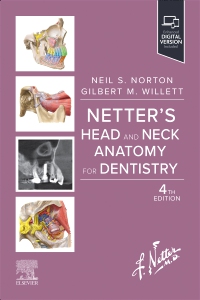
Netter's Head and Neck Anatomy for Dentistry,Elsevier eBook on VitalSource, 4th Edition
by Neil S. Norton, PhD and Gilbert M. Willett, PT, PhD, OCS, CSCS
Elsevier eBook on VitalSource
ISBN:
9780323791472
Copyright:
2025
Publication Date:
01-02-2025
Page Count:
730
Imprint:
Elsevier
List Price:
$48.99
Was
$48.99
Now $44.09
Or $0.00 with a valid access code
**Selected for 2026 Doody's Core Titles in Dentistry**
A concise and highly visual guide to clinically relevant anatomy for dentistry, as well as a valuable resource for any healthcare professional interested in head and neck anatomy, Netter’s Head and Neck Anatomy for Dentistry, 4th Edition, is an ideal text/atlas for class and exam preparation, as well as a quick review in professional practice. Concise text, high-yield tables, clinical correlations, and review questions combine to make this new edition a perfect choice for learning and remembering the need-to-know structures, relationships, and concepts, while beautiful illustrations enhance your visual mastery of the material.
A concise and highly visual guide to clinically relevant anatomy for dentistry, as well as a valuable resource for any healthcare professional interested in head and neck anatomy, Netter’s Head and Neck Anatomy for Dentistry, 4th Edition, is an ideal text/atlas for class and exam preparation, as well as a quick review in professional practice. Concise text, high-yield tables, clinical correlations, and review questions combine to make this new edition a perfect choice for learning and remembering the need-to-know structures, relationships, and concepts, while beautiful illustrations enhance your visual mastery of the material.
-
- Includes more than 100 multiple-choice questions to help you assess your knowledge of the material and prepare for exams
- Helps you quickly identify clinically relevant anatomy with classic Netter illustrations, as well as new art in the Netter tradition that depicts clinically important regions and procedures
- Features concise text and high-yield tables for fast access to important facts
- Gives context and clinical meaning to the anatomy with up-to-date coverage of clinical procedures
- Provides new coverage of tooth development, a new chapter on implants, and expanded information on cone beam imaging, mandible osteology, nerve block injections, and more
- Offers additional features online such as images with label quizzes and a rotatable 3D skull
- An eBook version is included with purchase. The eBook allows you to access all of the text, figures and references, with the ability to search, make notes and highlights, and have content read aloud
-
1. Development of the Head and Neck
2. Osteology
3. Basic Neuroanatomy and Cranial Nerves
4. The Neck
5. Scalp and Muscles of Facial Expression
6. Parotid Fossa and Gland
7. Temporal and Infratemporal Fossae
8. Muscles of Mastication
9. Temporomandibular Joint
10. Pterygopalatine Fossa
11. Nose and Nasal Cavity
12. Paranasal Sinuses
13. Oral Cavity
14. Tongue
15. Pharynx
16. Larynx
17. Cervical Fascia
18. Ear
19. Eye and Orbit
20. Autonomics of the Head and Neck
21. Intraoral Injections
22. Dental Implants
23. Introduction to the Upper Limb, Back, Thorax, and Abdomen -
-
Ways of Reading
- The appearance of the text and page layout can be modified according to the capabilities of the reading system (font family and font size, spaces between paragraphs, sentences, words, and letters, as well as color of background and text)
- This e-publication is accessible to the full extent that the file format and types of content allow, on a specific reading device, by default, without necessarily including any additions such as textual descriptions of images or enhanced navigation
- No information about nonvisual reading is available
-
Conformance
- No information is available
-
Navigation
- Table of contents to all chapters of the text via links
- Page list to go to pages from the print source version
-
Rich Content
- No information is available
-
Hazards
- No information is available
-
Product Content
- No information is available
-
Legal Considerations
- No information is available
-
Additional Accessibility Information
- Content is enhanced with ARIA roles to optimize organization and facilitate navigation
- Page breaks included from the original print source
- For readers with color vision deficiency, use of color (e.g., in diagrams, graphics and charts, in prompts, or on buttons inviting a response) is not the sole means of graphical distinction or of conveying information
- E-publication includes basic navigation (usually less detailed than TOC-based navigation)
- Where links, controls or buttons are included in the content, the purpose or functionality of each link, control or button is apparent from the associated text alone - or where it is unclear, separate link, control or button descriptions are provided
- All (or substantially all) textual matter is arranged in a single logical reading order (including text that is visually presented as separate from the main text flow, e.g., in boxouts, captions, tables, footnotes, endnotes, citations, etc.). Non-textual content is also linked from within this logical reading order. (Purely decorative non-text content can be ignored).
- The language of the text has been specified (e.g., via the HTML or XML lang attribute) to optimise text-to-speech (and other alternative renderings), both at the whole document level and, where appropriate, for individual words, phrases or passages in a different language.
-
Ways of Reading

Was
$48.99
Now $44.09
Or $0.00 with a valid access code

 as described in our