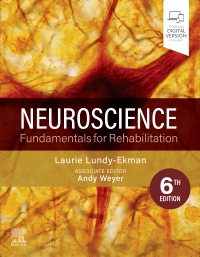

Neuroscience - Elsevier eBook on VitalSource, 6th Edition
Elsevier eBook on VitalSource
Now $96.89
Use your knowledge of the nervous system to understand and treat neurologic disorders! Neuroscience: Fundamentals for Rehabilitation, 6th Edition provides an illustrated guide to neurology and how it affects the practice of physical and occupational therapy. Case studies and first-person stories from people with neurologic disorders make it easier to develop clinical reasoning skills and apply your knowledge to the clinical setting. This edition includes an enhanced eBook free with each purchase of a new print book. Written by noted PT educator Laurie Lundy-Ekman, Neuroscience uses evidence-based research to help you evaluate and treat clients who have physical limitations due to nervous system damage or disease.
-
- NEW! Quick Reference Lists on the inside book covers make it easy to find frequently consulted figures, reflexes, tables, and summaries within the text
- NEW! Updated chapters include Pain as a Disease and as a Symptom, Motor System: Upper Motor Neurons, Motor and Psychologic Functions, Brainstem Region, and Neurologic Tests
- NEW! 85 new or updated figures are added to this edition
- NEW! Nearly 600 new references are added to this edition
- NEW! Enhanced eBook version – included with print purchase – allows you to access all of the text, figures, and references from the book on a variety of devices
- NEW! Answers to the book’s case studies and a student workbook with approximately 1,000 practice questions and answers are included in the eBook
-
- Logical, systems approach to neuroscience makes it easier to master complex information and provides a framework for conducting a neurologic examination and evaluation
- Clinical perspective of neuroscience is provided through case studies, personal stories written by people with neurologic disorders, and summaries of key features of neurologic disorders and the body systems they affect
- Six sections — Overview of Neurology, Neuroscience at the Cellular Level, Development of the Nervous System, Vertical Systems, Regions, and Neurologic Tests — first show how neural cells operate, and then allow you to apply your knowledge of neuroscience
- Coverage of key physical rehabilitation topics includes abnormal muscle tone, chronic pain, control of movement, and differential diagnosis of dizziness
- Hundreds of color-coded illustrations show body structures and functions across systems
- Full-color atlas includes photographs of the human brain along with labeled line drawings
- Clinical Notes case studies demonstrate how neuroscience concepts may be applied to clinical situations
- Pathology boxes provide a quick summary of the features of neurologic disorders commonly encountered in rehabilitation practice
-
-
 Evolve Resources for NeuroscienceResources
 -
 NeurosciencePaperback
-
-
Part 1: Overview of Neurology
1. Introduction to Neuroscience
2. Neuroanatomy
3. Neuroimaging and Neuroanatomy Atlas
Part 2: Neuroscience at the Cellular Level
4. Physical and Electrical Properties of Cells in the Nervous System
5. Neural Communication: Synaptic and Extrasynaptic Transmission
Part 3: Development of the Nervous System
6. Development of the Nervous System
Part 4: Vertical Systems
7. Autonomic Nervous System
8. Peripheral Somatosensory System
9. Central Somatosensory System
10. Pain as a Disease and as a Symptom
11. Motor System: Lower Motor Neurons and Spinal Motor Function
12. Motor System: Upper Motor Neurons
13. Motor System: Upper Motor Neuron Disorders
14. Motor, Cognitive, and Emotion Systems: The Cerebellum
15. Motor and Psychologic Functions: Basal Ganglia
16. Neural Control of Movement
Part 5: Neuroplasticity
17. Neuroplasticity
Part 6: Regions
18. Peripheral Region
19. Spinal Region
20. Cranial Nerves
21. Brainstem Region
22. Visual System
23. Vestibular system
24. Dizziness and Unsteadiness
25. Cerebrospinal Fluid System
26. Blood Supply, Stroke, Fluid Dynamics, and Intracranial Pressure
27. Cerebrum
28. Memory, Consciousness, Attention and Intellect
29. Behavior, Emotions, Decision Making, Personality
30. Communication and Spatial Cognition
Part 7: The Neurologic Examination
31. The Neurologic Examination
32. Examination of the Autonomic, Motor, and Somatosensory Systems
33. Examination of Spinal Reflexes, Coordination, Postural Control, and Gait
34. Examination of Olfaction, Vision, and Ocular Motor Control
35. Examination of Cranial Nerves 5 and 7-12 and Tests to Determine Causes of Dizziness
36. Examination of Mental Status
Glossary
-
-
Ways of Reading
- The appearance of the text and page layout can be modified according to the capabilities of the reading system (font family and font size, spaces between paragraphs, sentences, words, and letters, as well as color of background and text)
- This e-publication is accessible to the full extent that the file format and types of content allow, on a specific reading device, by default, without necessarily including any additions such as textual descriptions of images or enhanced navigation
- No information about nonvisual reading is available
-
Conformance
- For detailed accessibility information, see Elsevier's website at https://www.elsevier.com/about/accessibility
- For queries regarding accessibility information, contact [email protected]
- The publication was certified on 18-11-2025
-
Navigation
- Table of contents to all chapters of the text via links
-
Rich Content
- No information is available
-
Hazards
- No information is available
-
Product Content
- No information is available
-
Legal Considerations
- No information is available
-
Additional Accessibility Information
- For readers with color vision deficiency, use of color (e.g., in diagrams, graphics and charts, in prompts, or on buttons inviting a response) is not the sole means of graphical distinction or of conveying information
- E-publication includes basic navigation (usually less detailed than TOC-based navigation)
- Where links, controls or buttons are included in the content, the purpose or functionality of each link, control or button is apparent from the associated text alone - or where it is unclear, separate link, control or button descriptions are provided
- All (or substantially all) textual matter is arranged in a single logical reading order (including text that is visually presented as separate from the main text flow, e.g., in boxouts, captions, tables, footnotes, endnotes, citations, etc.). Non-textual content is also linked from within this logical reading order. (Purely decorative non-text content can be ignored).
- The language of the text has been specified (e.g., via the HTML or XML lang attribute) to optimise text-to-speech (and other alternative renderings), both at the whole document level and, where appropriate, for individual words, phrases or passages in a different language.
-
Ways of Reading

 as described in our