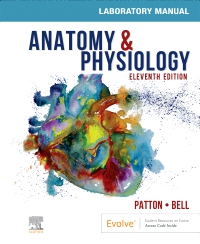

Anatomy & Physiology Laboratory Manual and E-Labs Elsevier eBook on VitalSource, 11th Edition
Elsevier eBook on VitalSource
Now $97.19
Gain the hands-on practice needed to understand anatomical structure and function! Anatomy & Physiology Laboratory Manual and eLabs, 11th Edition provides a clear, step-by-step guide to dissection, anatomy identification, and laboratory procedures. The illustrated, print manual contains 55 A&P exercises to be completed in the lab, with guidance including instructions, safety tips, and tear-out worksheets. Online, eight eLab modules enhance your skills with simulated lab experiences in an interactive 3-D environment. From noted educators Kevin Patton and Frank Bell, this laboratory manual provides you with a better understanding of the human body and how it works.
New Edition Expected Availability: 08-19-2026

Anatomy & Physiology Laboratory Manual and E-Labs Elsevier eBook on VitalSource
-
- NEW! More photos of various types of bones help you learn skeletal anatomy.
- NEW! More microscope slide images, including "zooming in" at high-power magnification, help you learn microscopic anatomy
- NEW! Updated lab tests align with what is currently in use in today’s lab environment
- NEW! Thorough revision of all chapters covers the latest anatomy and physiology lab exercises
-
- Labeling exercises and coloring exercises make it easier to identify and remember critical structures examined in the lab and in lectures
- Step-by-step "check-box" dissection instructions with accompanying illustrations and photos cover anatomical models and fresh or preserved specimens — and provide helpful guidance during dissection labs
- Tear-out Lab Reports contain checklists, drawing exercises, and questions that help demonstrate your understanding of the labs you have participated in, and also allow instructors to check your progress
- 250 illustrations include photos of cat, pig, and mink dissections, photos of various bones, microscopic and common histology slides, and depictions of proper procedures
- Complete lists of materials for each exercise provide handy checklists for planning and setting up laboratory activities, allowing for easy and efficient preparation
- Modern anatomical imaging techniques, such as computed tomography (CT), magnetic resonance imaging (MRI), and ultrasonography, are introduced to demonstrate how new technologies are changing and shaping health care
- Review questions throughout the manual provide tools to reinforce and apply your knowledge of anatomy and function concepts
- Eight eLabs improve the laboratory experience in an interactive digital environment.
- Convenient spiral binding allows for hands-free viewing in the lab setting
- Hint boxes provide special tips on handling specimens, using equipment, and managing lab activities
- Learning objectives at the beginning of each exercise offer a clear framework for learning
-
-
-
WELCOME TO THE ANATOMY AND PHYSIOLOGY LABORATORY
The Scientific Method
Measurement and Data Collection
How to Dissect
Using this Manual
Safety First!
How to Study for Lab Quizzes
THE BASICS
1. Organization of the body
2. Dissection: The whole body
3. The Microscope
4. Cell Anatomy
5. Transport through Cell Membranes
6. The Cell's Life Cycle
7. Epithelial Tissue
8. Connective Tissue
9. Muscle and Nerve Tissue
SUPPORT AND MOVEMENT
10. The Skin
11. Overview of the Skeleton
12. The Skull
13. The Vertebral Column and Thoracic Cage
14. The Upper Extremities
15. The Lower Extremities
16. Joints
17. Organization of the Muscular System
18. Skeletal Muscle Identification
19. Dissection: Skeletal Muscles
20. Skeletal Muscle Contractions
INTEGRATION AND CONTROL
21. Nerve Tissue
22. Nerve Reflexes
23. The Spinal Cord and Spinal Nerves
24. The Brain and Cranial Nerves
25. The Dissection: The Brain
26. Somatic Senses
27. Senses of Taste and Smell
28. The Ear
29. Hearing and Equilibrium
30. The Eye
31. Visual Function
32. Endocrine Glands
33. Hormones
REGULATION AND MAINTENANCE
34. Blood
35. Structure of the Heart
36. Electrical Activity of the Heart
37. The Pulse and Blood Pressure
38. The Circulatory Pathway
39. The Lymphatic System
40. Dissection: Cardiovascular and Lymphatic Systems
41. Respiratory Structures
42. Dissection: Respiratory System
43. Pulmonary Volumes and Capacities
44. Digestive Structures
45. Dissection: Digestive System
46. Enzymes and Digestion
47. Urinary Structures
48. Dissection: Urinary System
49. Urinalysis
REPRODUCTION
50. The Male Reproductive System
51. The Female Reproductive System
52. Dissection: Reproductive Systems
53. Development
54. Genetics and Heredity
SYNTHESIS
55. The Whole Body
LAB REPORT SUPPLEMENT -
-
Ways of Reading
- The appearance of the text and page layout can be modified according to the capabilities of the reading system (font family and font size, spaces between paragraphs, sentences, words, and letters, as well as color of background and text)
- This e-publication is accessible to the full extent that the file format and types of content allow, on a specific reading device, by default, without necessarily including any additions such as textual descriptions of images or enhanced navigation
- No information about nonvisual reading is available
-
Conformance
- No information is available
-
Navigation
- Table of contents to all chapters of the text via links
- Page list to go to pages from the print source version
-
Rich Content
- No information is available
-
Hazards
- No information is available
-
Product Content
- No information is available
-
Legal Considerations
- No information is available
-
Additional Accessibility Information
- Page breaks included from the original print source
- For readers with color vision deficiency, use of color (e.g., in diagrams, graphics and charts, in prompts, or on buttons inviting a response) is not the sole means of graphical distinction or of conveying information
- E-publication includes basic navigation (usually less detailed than TOC-based navigation)
- Where links, controls or buttons are included in the content, the purpose or functionality of each link, control or button is apparent from the associated text alone - or where it is unclear, separate link, control or button descriptions are provided
- All (or substantially all) textual matter is arranged in a single logical reading order (including text that is visually presented as separate from the main text flow, e.g., in boxouts, captions, tables, footnotes, endnotes, citations, etc.). Non-textual content is also linked from within this logical reading order. (Purely decorative non-text content can be ignored).
- The language of the text has been specified (e.g., via the HTML or XML lang attribute) to optimise text-to-speech (and other alternative renderings), both at the whole document level and, where appropriate, for individual words, phrases or passages in a different language.
-
Ways of Reading



 as described in our