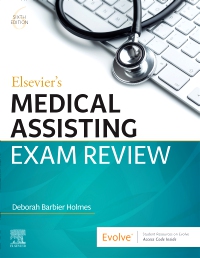

Elsevier's Medical Assisting Exam Review - Elsevier eBook on VitalSource, 6th Edition
Elsevier eBook on VitalSource
There’s no better way for students to get ready for Medical Assisting certification exams! With content review plus 3,000 test items and a customized online exam engine to generate practice sessions and mock exams, Elsevier’s Medical Assisting Exam Review, 6th Edition provides complete preparation for seven certification exams — the CMA, RMA, CMAS, CCMA, CMAA, CMAC, and NCMA. An illustrated, outline format makes it easy to review key medical assisting concepts and competencies, including anatomy and physiology, medical terminology, diseases and disorders, and administrative and clinical tasks. With answers and rationales for each question, this review helps students strengthen any weak areas and prepare for success on certification exams.
New Edition Expected Availability: 01-15-2026

Elsevier's Medical Assisting Exam Review - Elsevier eBook on VitalSource
-
- NEW! 3,000 questions — including 500 all-new items — include answers, rationales, and mapping to seven exam blueprints (CMA, RMA, CMAS, CCMA, CMAA, CMAC, and NCMA)
- NEW content is aligned with the latest exam blueprints, including the new CMA exam format effective in 2021
- NEW! Full-color illustrations reinforce student understanding of medical assisting content and include photos of clinical equipment and supplies
-
- NEW! 3,000 questions — including 500 all-new items — include answers, rationales, and mapping to seven exam blueprints (CMA, RMA, CMAS, CCMA, CMAA, CMAC, and NCMA).
- NEW content is aligned with the latest exam blueprints, including the new CMA exam format effective in 2021.
- NEW! Full-color illustrations reinforce student understanding of medical assisting content and include photos of clinical equipment and supplies.
- NEW! Three sample exams on Evolve Instructor Resources allow faculty to administer and track student progress and test-day readiness.
- UNIQUE! Online custom test generator allows students to focus on any topic and to create unique timed simulated exams at each visit.
- UNIQUE! Seven certification exams are covered: the CMA (AAMA), RMA (AMT), CMAS (AMT), CCMA (NHA), CMAA (NHT), CMAC (AMCA), and NCMA (NCCT).
- Convenient, easy-to-follow outline format provides at-a-glance review of the subject areas covered in Medical Assisting certification exams.
- Complete test preparation includes three pretests — administrative, clinical, and general — as well as a comprehensive posttest, with answers and rationales for all questions.
- Study tips and test-taking strategies provide students with advice and insight into preparing effectively for certification exams.
- Hundreds of additional practice questions are included on the Evolve website, along with flash cards and A&P animations, to boost students’ exam readiness and test-taking confidence.
-
Study Tips
Pretest 1 (General)
Pretest 2 (Administrative)
Pretest 3 (Clinical)
1. Medical Terminology
2. Anatomy and Physiology
3. Diseases and Disorders
4. Growth and Development
5. Communication
6. Law, Ethics, and HIPAA
7. Professionalism and Career Development
8. Computer Concepts, Written Communications, and Mail Processing
9. Records Management
10. Patient Reception
11. Office Management
12. Finances
13. Coding
14. Health Insurance
15. Infection Control and Asepsis
16. Vital Signs and Anthropometric Measurement
17. Assisting with the Physical Examination
18. Assisting with Medical Specialties
19. Nutrition
20. Therapeutic Modalities and Physical Agents to Promote Tissue Healing
21. Radiography and Diagnostic Imaging
22. Pharmacology, Medication Administration, and Intravenous Therapy
23. Minor Surgery
24. Clinical Laboratory
25. First Aid and Office Emergencies
Posttest
Answer Keys -
-
Ways of Reading
- The appearance of the text and page layout can be modified according to the capabilities of the reading system (font family and font size, spaces between paragraphs, sentences, words, and letters, as well as color of background and text)
- This e-publication is accessible to the full extent that the file format and types of content allow, on a specific reading device, by default, without necessarily including any additions such as textual descriptions of images or enhanced navigation
- All content can be read as read aloud speech or dynamic braille
- Has alternative text descriptions for images
-
Conformance
- The publication contains a conformance statement that it meets the EPUB Accessibility 1.1, WCAG 2.1, Level AA standard. Please see https://bornaccessible.benetech.org/certified-publishers/ for further details of our compatibility testing.
- The certifier's credential is https://bornaccessible.benetech.org/certified-publishers/
- For detailed accessibility information, see Elsevier's website at https://www.elsevier.com/about/accessibility
- For queries regarding accessibility information, contact [email protected]
- The publication was certified on 24-03-2026
-
Navigation
- Table of contents to all chapters of the text via links
- Elements such as headings, tables, etc. for structured navigation
- Page list to go to pages from the print source version
-
Rich Content
- Math formulas in accessible format (MathML)
- Information-rich images are described by extended descriptions
-
Hazards
- The publication contains no hazards
-
Product Content
- Content includes any type of illustrations.
- The primary content is text.
- Content includes maps and/or other cartographic content.
- Content includes a significant number of actionable (clickable) web links to external content, downloadable resources, supplementary material, etc.
- Content includes a significant number of actionable (clickable) cross-references, hyperlinked notes and annotations, or with other actionable links between largely textual elements (e.g., quiz/test questions, 'choose your own ending', etc.).
- Content includes photographs, whether in a plate section / insert or not.
- Content includes figures, diagrams, charts and/or graphs, including other 'mechanical' (i.e. non-photographic) illustrations.
- Content includes images displayed in a specific order for the purpose of graphic storytelling or giving information (e.g. graphic novels, comics and manga). May include text integrated into the image (as speech and thought bubbles, textual 'sound' effects, captions etc.).
- Content includes text within images, including text-as-text embedded in diagrams, charts, or within images containing speech balloons, thought bubbles, captions, etc.
- Content includes visual content that is purely decorative and is not necessary to understanding of the content.
- Content includes mathematical notations, formulae.
- At least some text - including text within other images - is 'text as an image' (i.e., a picture of text).
-
Legal Considerations
- No information is available
-
Additional Accessibility Information
- Content is enhanced with ARIA roles to optimize organization and facilitate navigation
- Page breaks included from the original print source
- For readers with color vision deficiency, use of color (e.g., in diagrams, graphics and charts, in prompts, or on buttons inviting a response) is not the sole means of graphical distinction or of conveying information
- The body text is presented with a contrast ratio of at least 4.5:1 (or 3:1 for large/heading text)
- Ultra-high contrast between text and background
- E-publication includes basic navigation (usually less detailed than TOC-based navigation)
- Where links, controls or buttons are included in the content, the purpose or functionality of each link, control or button is apparent from the associated text alone - or where it is unclear, separate link, control or button descriptions are provided
- All (or substantially all) textual matter is arranged in a single logical reading order (including text that is visually presented as separate from the main text flow, e.g., in boxouts, captions, tables, footnotes, endnotes, citations, etc.). Non-textual content is also linked from within this logical reading order. (Purely decorative non-text content can be ignored).
- Where interactive content is included in the product, controls are provided (e.g., for speed, pause and resume, reset) and labelled to make their use clear.
- The language of the text has been specified (e.g., via the HTML or XML lang attribute) to optimise text-to-speech (and other alternative renderings), both at the whole document level and, where appropriate, for individual words, phrases or passages in a different language.
-
Ways of Reading


 as described in our