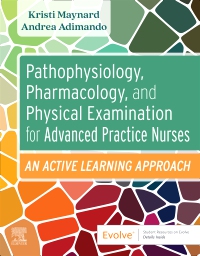

Pathophysiology, Pharmacology, and Physical Examination for Advanced Practice Nurses - Elsevier eBook on VitalSource, 1st Edition
Elsevier eBook on VitalSource
$97.99
-
- NEW and UNIQUE! The first and only book of its kind to integrate APN-level advanced pathophysiology, advanced physical examination, and advanced pharmacology using a case study approach
- UNIQUE! eBook hyperlinks connect to specific content in other core Elsevier APN textbooks in all three content areas, including:
- McCance: Pathophysiology: The Biologic Basis for Disease in Adults and Children
- Rosenthal: Lehne’s Pharmacotherapeutics for Advanced Practice Nurses and Physician Assistant
- Visovsky: Edmunds’ Pharmacology for the Primary Care Provider
- Jarvis: Health Assessment and Physical Examination
- Ball: Seidel’s Guide to Physical Examination: An Interprofessional Approach
- Conceptual organization and approach, with 104 cases organized by overarching concepts, helps reduce content saturation and promote “scaffolding” for future disorder-specific learning.
- Online submission and reflective feedback offer tools for self-assessment.
- Complete lifespan coverage addresses all stages of life, from childhood to older adulthood.
- Cases address all major outpatient settings in which primary care is delivered in today’s healthcare environment.
- Strong emphasis on APN-level clinical reasoning prepares you for real-world practice.
- Free Evolve ebook access is included with each new print purchase.
-
Unit 1: Perfusion
1. Shortness of Breath
2. Recurring Headaches
3. Increasing Fatigue
4. Thoracic Back Pain
5. Left Ankle Wound
6. Lower Extremity Edema
7. Palpitations
8. Left Calf Pain
9. Increasing Weakness
Unit 2: Gas Exchange
10. Activity Intolerance
11. Persistent Cough
12. Productive Cough
13. Heaviness in the Chest
14. Chest Pain with Dyspnea
15. Chronic Fatigue
Unit 3: Mobility
16. Left Knee Pain
17. Joint Stiffness
18. Recent Wrist Fracture
19. Hand Pain with Paresthesia
20. Left Ankle Injury
21. Right Ankle Pain
22. Right Knee Injury
23. Great Toe Pain
24. Nocturnal Paresthesia
Unit 4: Digestion
25. Dyspepsia
26. Acid Reflux
27. Painful Early Satiety
28. Gnawing Abdominal Pain
29. Stomach Pain with Belching
30. Frequent Diarrhea
31. Loose Stool with Abdominal Pain
32. Mucoid Diarrhea
33. Throbbing Rectal Pain
34. Fecal Urgency
35. Weakness and Paresthesia
36. Fecal Retention
37. Watery Stool
Unit 5: Urinary/Elimination
38. Urinary Incontinence
39. Pelvic Pressure
40. Painful Urination
41. Hematuria
42. Perineal Pressure
43. Nocturia
44. Flank Pain
45. Frothy Urination
46. Right Flank Pain
Unit 6: Tissue Integrity
47. Right Foot Wound
48. Thermal Injury
49. Bite Injury
Unit 7: Cognition
50. Altered Mental Status
51. Memory Loss
52. Chronic Headaches
53. Tremor
54. Disturbed Concentration
Unit 8: Metabolism/Glucose Regulation
55. Abdominal Pain with Nausea
56. Fatigue with Polyuria
57. Epigastric Pain with Nausea
58. Elevated BMI
59. Weight Gain
60. Ketonuria in Pregnancy
61. Impaired Weight Loss
62. Diaphoresis with Palpitations
Unit 9: Immunity/Inflammation
63. HIV Infection
64. Sore Throat with Cervical Lymphadenopathy
65. Erythematous Rash
66. Sore Throat with Fever
67. Dysuria with Abdominal Pain
68. Nausea and Malaise
69. Abdominal Pain with Fatigue
70. Left Ear Pain
71. Headache with Nasal Congestion
72. Red, Pruritic Left Eye
73. Painful Facial Rash
74. Painful Great Toe with Swelling
75. Acute Abdominal Pain
76. Radiating Abdominal Pain with Vomiting
77. Left Lower Abdominal Pain
Unit 10: Cellular Regulation
78. Blood in Stool
79. Breast Lump
80. Skin Growth
81. Pulmonary Nodule
82. Hip Pain with Anorexia
Unit 11: Reproduction
83. Missed Menstrual Cycle
84. Irregular Periods
85. Hot Flashes
86. Acute Groin Pain
87. Infertility
88. Decreased Libido
89. Gender-Affirming Care
Unit 12: Comfort
90. Excessive Fatigue
91. Difficulty Sleeping
92. Chronic Pain
93. Throbbing Headaches
94. Daily Headaches
95. Loss of Consciousness
Unit 13: Mood, Stress, Addiction, and Self-Perception
96. Decreased Motivation
97. Postpartum Fatigue
98. Nervousness
99. Chest Pain with Hallucinations
100. Severe Anxiety and Insomnia
101. Intrusive Thoughts
102. Back Pain
103. Concerns with Drinking
104. Weight Loss with Stomach Pain -
-
Ways of Reading
- The appearance of the text and page layout can be modified according to the capabilities of the reading system (font family and font size, spaces between paragraphs, sentences, words, and letters, as well as color of background and text)
- This e-publication is accessible to the full extent that the file format and types of content allow, on a specific reading device, by default, without necessarily including any additions such as textual descriptions of images or enhanced navigation
- All content can be read as read aloud speech or dynamic braille
-
Conformance
- The certifier's credential is https://bornaccessible.benetech.org/certified-publishers/
- For detailed accessibility information, see Elsevier's website at https://www.elsevier.com/about/accessibility
- For queries regarding accessibility information, contact [email protected]
- The publication was certified on 03-09-2025
-
Navigation
- Table of contents to all chapters of the text via links
- Page list to go to pages from the print source version
-
Rich Content
- No information is available
-
Hazards
- No information is available
-
Product Content
- No information is available
-
Legal Considerations
- No information is available
-
Additional Accessibility Information
- Content is enhanced with ARIA roles to optimize organization and facilitate navigation
- Page breaks included from the original print source
- For readers with color vision deficiency, use of color (e.g., in diagrams, graphics and charts, in prompts, or on buttons inviting a response) is not the sole means of graphical distinction or of conveying information
- The body text is presented with a contrast ratio of at least 4.5:1 (or 3:1 for large/heading text)
- Ultra-high contrast between text and background
- E-publication includes basic navigation (usually less detailed than TOC-based navigation)
- Where links, controls or buttons are included in the content, the purpose or functionality of each link, control or button is apparent from the associated text alone - or where it is unclear, separate link, control or button descriptions are provided
- All (or substantially all) textual matter is arranged in a single logical reading order (including text that is visually presented as separate from the main text flow, e.g., in boxouts, captions, tables, footnotes, endnotes, citations, etc.). Non-textual content is also linked from within this logical reading order. (Purely decorative non-text content can be ignored).
- Where interactive content is included in the product, controls are provided (e.g., for speed, pause and resume, reset) and labelled to make their use clear.
- The language of the text has been specified (e.g., via the HTML or XML lang attribute) to optimise text-to-speech (and other alternative renderings), both at the whole document level and, where appropriate, for individual words, phrases or passages in a different language.
-
Ways of Reading



 as described in our