
ISBN:
9780323798587
Copyright:
2024
Publication Date:
10-14-2022
Page Count:
320
Imprint:
Mosby
List Price:
$67.99

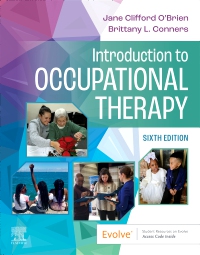
Introduction to Occupational Therapy - Elsevier eBook on VitalSource, 6th Edition
by Jane Clifford O'Brien, PHD, MS.ED.L, OTR/L, FAOTA and Brittany Conners, OTD, OTR/L
Elsevier eBook on VitalSource
ISBN:
9780323798587
Copyright:
2024
Publication Date:
10-14-2022
Page Count:
320
Imprint:
Mosby
List Price:
$67.99
Was
$67.99
Now $59.83
Or $0.00 with a valid access code
Prepare for success in OT practice with a complete overview of the profession! Introduction to Occupational Therapy, 6th Edition helps you master the roles and responsibilities of the OT practitioner. Content examines OT practice — from client evaluation to planning interventions and goals to reaching optimal outcomes. You will also learn valuable skills in clinical reasoning and in providing occupational therapy across the client's lifespan. Written by the respected author team of Jane Clifford O'Brien and Brittany Conners, this comprehensive resource discusses today's OT practice and adds new chapters on self-care, supportive technology, advocacy, and the lived experience of OT practitioners.
-
- Complete coverage of OT practice provides an overview of practice in a variety of rehabilitation, mental health, and community settings, and across the lifespan
- A broad perspective fits the needs of both Occupational Therapy and Occupational Therapy Assistant students
- Case studies and activities in each chapter help you apply concepts and develop problem-solving skills
- Emphasis on evidence-based practice helps you learn to think logically and use research to create intervention plans
- Helpful tables and boxes provide easy access to material for practice, action steps, and outlines of processes
- The OT Practice Framework provides a sound basis for decision making, defining occupational therapy areas of concern and the OT process
- Chapter objectives, key terms, chapter summaries, and review questions highlight important content in each chapter
-
- NEW! Additional chapters cover Prioritizing Self Care; Leadership and Advocacy; The Lived Experience of OT Practitioners; and Technology to Support Occupational Engagement
- UPDATED! Revised content throughout provides the most current information needed to be an effective practitioner today
- NEW! Current content addresses societal trends influencing the profession, including occupational justice, diversity, equity, and inclusion
- NEW! Expanded content includes historical influences of Black OTs, OTs of color, LGBTQIA, and multicultural groups, emphasizing action steps to promote, advocate, and enable diversity, equity, and inclusion within the profession
- NEW! Perspectives from students, practitioners (therapists and OT assistants), professors, entrepreneurs, and retired practitioners are embedded in chapters
- UPDATED! The latest references and examples ensure the content is current and applicable for today’s students
- Follows the Occupational Therapy Practice Framework (4th Edition) (OTPF) and the newest Accreditation Council for Occupational Therapy Education (ACOTE) Curriculum standards [2018]
- Boxes with tips in many chapters apply content in practice related to concepts such as self-care, advocacy, critical thinking, and inclusion
- Representation of the diversity of the OT profession is reflected throughout the text in content and photos
-
SECTION I Occupational Therapy:The Profession
1. Introductory Questions
2. Looking Back: A History of Occupational Therapy
3. Philosophical Base and Values of Occupational Therapy
4. Current Trends in Occupational Therapy
5. A Global Perspective of Occupational Therapy
SECTION II Occupational Therapy: The Practitioner
6. From Student to Practitioner: Preparation and Certification
7. Occupational Therapy Roles
8. Practicing Legally and Ethically
9. Leadership and Advocacy
10. Prioritizing Self-Care
11. The Lived Experience of Occupational Therapy Practitioners
SECTION III The Practice of Occupational Therapy
12. Occupational Therapy Practice Framework: Domain and Process
13. Occupational Therapy Across the Life Span
14. Treatment Settings and Models of Health Care
15. Technology to Support Occupational Engagement
SECTION IV The Process of Occupational Therapy
16. Occupational Therapy Process: Evaluation,Intervention,and Outcomes
17. Models of Practice and Frames of Reference
18. Intervention Modalities
19. Therapeutic Relationships
20. Therapeutic Reasoning -
-
Ways of Reading
- The appearance of the text and page layout can be modified according to the capabilities of the reading system (font family and font size, spaces between paragraphs, sentences, words, and letters, as well as color of background and text)
- This e-publication is accessible to the full extent that the file format and types of content allow, on a specific reading device, by default, without necessarily including any additions such as textual descriptions of images or enhanced navigation
- All content can be read as read aloud speech or dynamic braille
- Has alternative text descriptions for images
-
Conformance
- The publication contains a conformance statement that it meets the EPUB Accessibility 1.1, WCAG 2.1, Level AA standard. Please see https://bornaccessible.benetech.org/certified-publishers/ for further details of our compatibility testing.
- The certifier's credential is https://bornaccessible.benetech.org/certified-publishers/
- For detailed accessibility information, see Elsevier's website at https://www.elsevier.com/about/accessibility
- For queries regarding accessibility information, contact [email protected]
- The publication was certified on 06-02-2026
-
Navigation
- Table of contents to all chapters of the text via links
- Index with links to referenced entries
- Elements such as headings, tables, etc. for structured navigation
- Page list to go to pages from the print source version
-
Rich Content
- Information-rich images are described by extended descriptions
-
Hazards
- The publication contains no hazards
-
Product Content
- Content includes any type of illustrations.
- The primary content is text.
- Content includes a significant number of actionable (clickable) web links to external content, downloadable resources, supplementary material, etc.
- Content includes a significant number of actionable (clickable) cross-references, hyperlinked notes and annotations, or with other actionable links between largely textual elements (e.g., quiz/test questions, 'choose your own ending', etc.).
- Content includes figures, diagrams, charts and/or graphs, including other 'mechanical' (i.e. non-photographic) illustrations.
- Content includes a significant number of web links (printed URLs, QR codes etc.).
- Content includes text within images, including text-as-text embedded in diagrams, charts, or within images containing speech balloons, thought bubbles, captions, etc.
-
Legal Considerations
- No information is available
-
Additional Accessibility Information
- Content is enhanced with ARIA roles to optimize organization and facilitate navigation
- Page breaks included from the original print source
- For readers with color vision deficiency, use of color (e.g., in diagrams, graphics and charts, in prompts, or on buttons inviting a response) is not the sole means of graphical distinction or of conveying information
- The body text is presented with a contrast ratio of at least 4.5:1 (or 3:1 for large/heading text)
- Ultra-high contrast between text and background
- E-publication includes basic navigation (usually less detailed than TOC-based navigation)
- Where links, controls or buttons are included in the content, the purpose or functionality of each link, control or button is apparent from the associated text alone - or where it is unclear, separate link, control or button descriptions are provided
- All (or substantially all) textual matter is arranged in a single logical reading order (including text that is visually presented as separate from the main text flow, e.g., in boxouts, captions, tables, footnotes, endnotes, citations, etc.). Non-textual content is also linked from within this logical reading order. (Purely decorative non-text content can be ignored).
- Content provides explanations for unusual words, abbreviations, acronyms, idioms, jargon in an accessible form, such as glossaries, scripted pop-ups.
- Where interactive content is included in the product, controls are provided (e.g., for speed, pause and resume, reset) and labelled to make their use clear.
- The language of the text has been specified (e.g., via the HTML or XML lang attribute) to optimise text-to-speech (and other alternative renderings), both at the whole document level and, where appropriate, for individual words, phrases or passages in a different language.
-
Ways of Reading

Was
$67.99
Now $59.83
Or $0.00 with a valid access code

 as described in our