ISBN:
9780323810791
Copyright:
2023
Publication Date:
02-03-2022
Page Count:
376
Imprint:
Saunders
List Price:
$48.99

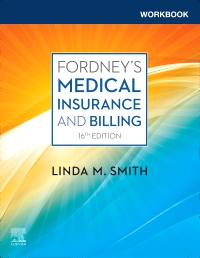
Workbook for Fordney’s Medical Insurance and Billing - Elsevier eBook on VitalSource, 16th Edition
by Linda M. Smith, CPC, CPC-1, CEMC, CMBS
Elsevier eBook on VitalSource
ISBN:
9780323810791
Copyright:
2023
Publication Date:
02-03-2022
Page Count:
376
Imprint:
Saunders
List Price:
$48.99
Was
$48.99
Now $44.09
Or $0.00 with a valid access code
Get hands-on practice in medical insurance billing and coding! Corresponding to the chapters in Fordney's Medical Insurance and Billing, 16th Edition, this workbook provides realistic exercises that help you apply concepts and develop the critical thinking skills needed by insurance billing specialists. Review questions reinforce your understanding of your role and responsibilities, and assignments ask you to complete claim forms by extracting information from patient records and properly selecting procedural and diagnostic codes. Not only will you master the CMS-1500 and 837P claim forms, but you will understand each stage of an insurance claim.
New Edition Expected Availability: 04-07-2025

Workbook for Fordney’s Medical Insurance and Billing - Elsevier eBook on VitalSource
Elsevier eBook on VitalSource
ISBN: 9780443110528
-
- NEW! Additional procedures provide more practice, helping you remember the material
-
- Self-study exercises reinforce your understanding with matching, true/false, multiple-choice, mix and match, and fill-in-the-blank questions, as well as critical thinking assignments
- Key terms and abbreviations at the beginning of each chapter provide a quick reference to the health insurance terminology you need to know
- Study outlines focus your review by listing the key points for each chapter
- Performance objectives make learning easier by highlighting what you need to accomplish in each chapter
- Critical Thinking assignments are based on short, real-world vignettes, preparing you to work in a real medical office and allowing you to apply theory learned from the textbook
- Updated mock fee schedules present the latest information available, for use in completing forms and activities
- Expanded coverage of inpatient insurance billing includes ICD-10 coding and CMS coding, ensuring that you are prepared to work in healthcare facility settings as well as the physician’s office and outpatient settings
- Updated information on general compliance issues, HIPAA, the Affordable Care Act, and coding reflects changes to the Fordney's Medical Insurance and Billing, 16th Edition text
- Ambulatory Surgery Center chapter provides the foundation and skills needed for billing in this outpatient setting
-
-
 Fordney’s Medical Insurance and Billing - Elsevier eBook on VitalSourceElsevier eBook on VitalSource
-
-
Unit One: Career Roles and Responsibilities
1. Role of an Insurance Billing Specialist
2. Privacy, Security and HIPAA
3. Compliance, Fraud and Abuse
Unit Two: Introduction to Health Insurance
4. Basics of Health Insurance
5. The Blue Plans, Private Insurance and Managed Care Plans
6. Medicare
7. Medicaid and Other State Programs
8. TRICARE and Veteran’s Health Care
9. Workers Compensation
10. Disability Income Insurance and Disability Benefit Insurance
Unit Three: Documentation and Coding for Professional Services
11. Medical Documentation and the Electronic Health Record
12. Diagnostic Coding
13. Procedural Coding
Unit Four: Claims Submission in the Medical Office
14. The Paper Claim CMS-1500
15. The Electronic Claim
Unit Five: The Claim Follow-Up and Payment Process
16. Receiving Payments and Insurance Problem Solving
17. Collection Strategies
Unit Six: Healthcare Facility Billing
18. Ambulatory Surgery Center
19. Hospital Outpatient and Inpatient Billing
Unit Seven: Employment
20. Seeking a Job and Attaining Professional Advancement -
-
Ways of Reading
- The appearance of the text and page layout can be modified according to the capabilities of the reading system (font family and font size, spaces between paragraphs, sentences, words, and letters, as well as color of background and text)
- This e-publication is accessible to the full extent that the file format and types of content allow, on a specific reading device, by default, without necessarily including any additions such as textual descriptions of images or enhanced navigation
- No information about nonvisual reading is available
-
Conformance
- No information is available
-
Navigation
- Table of contents to all chapters of the text via links
- Page list to go to pages from the print source version
-
Rich Content
- No information is available
-
Hazards
- No information is available
-
Product Content
- No information is available
-
Legal Considerations
- No information is available
-
Additional Accessibility Information
- Page breaks included from the original print source
- For readers with color vision deficiency, use of color (e.g., in diagrams, graphics and charts, in prompts, or on buttons inviting a response) is not the sole means of graphical distinction or of conveying information
- E-publication includes basic navigation (usually less detailed than TOC-based navigation)
- Where links, controls or buttons are included in the content, the purpose or functionality of each link, control or button is apparent from the associated text alone - or where it is unclear, separate link, control or button descriptions are provided
- All (or substantially all) textual matter is arranged in a single logical reading order (including text that is visually presented as separate from the main text flow, e.g., in boxouts, captions, tables, footnotes, endnotes, citations, etc.). Non-textual content is also linked from within this logical reading order. (Purely decorative non-text content can be ignored).
- The language of the text has been specified (e.g., via the HTML or XML lang attribute) to optimise text-to-speech (and other alternative renderings), both at the whole document level and, where appropriate, for individual words, phrases or passages in a different language.
-
Ways of Reading
Was
$48.99
Now $44.09
Or $0.00 with a valid access code

 as described in our