
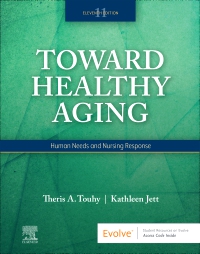

Toward Healthy Aging Elsevier eBook on VitalSource, 11th Edition
Elsevier eBook on VitalSource
Now $80.95
**American Journal of Nursing (AJN) Book of the Year Awards, 1st Place in Gerontologic Nursing, 2023**
**Selected for Doody’s Core Titles® 2024 in Geriatrics**
Provide holistic, compassionate nursing care for older adults! Based on evidence-based protocols, Toward Healthy Aging, 11th Edition helps you master gerontological nursing skills with an approach that focuses on health, wholeness, and the potential in aging. In promoting healthy aging, the text emphasizes caring and respect for the person. Special sections provide an honest look at the universal experience of aging. Written by gerontological nursing experts Theris A. Touhy and Kathleen F. Jett, this classic text helps you learn to apply scientific research, build critical thinking skills, and prepare for success on the NCLEX® exam and in clinical practice.

-
-
 Sherpath for Touhy Toward Healthy AgingSherpath Book-Organized
 -
 Sherpath Vantage for Touhy Toward Healthy AgingSherpath Vantage
 -
 Elsevier Adaptive Quizzing for Toward Healthy Aging (eCommerce Version)Elsevier Adaptive Quizzing - Next Generation
 -

-
-
- Promoting Healthy Aging: Implications for Gerontological Nursing sections help you apply concepts to assessments and interventions.
- A Student Speaks and An Elder Speaks sections at the beginning of every chapter provide perspectives of older people and nursing students.
- Nursing Studies provide practice examples designed to assist you in assessment, planning, interventions, and outcomes to promote healthy aging.
- Learning objectives in every chapter introduce important content and define learning goals and expectations.
- Key concepts provide a concise review of the most important points found in each chapter.
- Critical Thinking Questions and Activities help you apply concepts and build clinical judgment skills.
- Safety Alerts emphasize QSEN competencies and safety issues related to care of older adults.
- Tips for Best Practice boxes summarize evidence-based nursing interventions for practice.
- Research Highlights boxes summarize important research studies in the field of gerontology
- Research Questions include suggestions and ideas for pursuing nursing research.
- Healthy People boxes reference the goals cited in Healthy People 2020.
-
- NEW! Next Generation NCLEX® (NGN) examination-style case studies at the end of chapters include questions to help you prepare for the NGN exam.
- NEW! Completely updated content helps you develop clinical judgment skills, identified by the NCSBN and the AACN as a key attribute of professional nursing.
- NEW! Updated topics include COPD guidelines, theories of aging, medication use and misuse, palliative care, wound care guidelines, genomic research, and LGBT family relationships and sexualty in older adults.
-
PART 1 Foundations for Clinical Judgment to Promote Healthy Aging
1 Gerontological Nursing Across the Continuum of Care
2 Aging, Health, and Wellness in a Global Community
3 Theories of Aging
4 Providing Cross-Cultural Care
5 Economics and Health Care in Late Life
6 Promoting Excellence in Long-Term Care
PART 2 Foundations for Taking Action
7 Therapeutic Communication With Older Adults
8 Cognitive Health and Learning
9 Recognizing and Analyzing Cues to Maximize Outcomes
10 Using Laboratory Data in Clinical Judgment
11 Safe Medication Use
PART 3 Clinical Judgment to Promote Wellness and Function
12 Visual Health
13 Auditory Health
14 Healthy Skin
15 Nutritional Health
16 Hydration and Oral Health
17 Elimination
18 Sleep
19 Activity and Exercise
20 Falls and Fall Risk Reduction
21 Safe and Secure Environments
PART 4 Clinical Judgment to Promote Wellness for Persons With Chronic Illnesses
22 Living Well With Chronic Illness
23 Vascular Disorders
24 Respiratory Disorders
25 Neurocognitive Disorders
26 Care of Individuals With Neurocognitive Disorders
27 Endocrine and Immune Disorders
28 Common Musculoskeletal Disorders
29 Pain and Comfort
30 Mental Health
PART 5 Clinical Judgment to Promote Healthy
Aging With Older Adults and Families
31 Ethics, Decision Making, and Mistreatment
32 Relationships, Roles, and Life Transitions
33 Intimacy and Sexual Health
34 Loss, Death, and Palliative Care
35 Spiritual Health, Meaning, and Self-Actualization
Index -
-
Ways of Reading
- The appearance of the text and page layout can be modified according to the capabilities of the reading system (font family and font size, spaces between paragraphs, sentences, words, and letters, as well as color of background and text)
- This e-publication is accessible to the full extent that the file format and types of content allow, on a specific reading device, by default, without necessarily including any additions such as textual descriptions of images or enhanced navigation
- All content can be read as read aloud speech or dynamic braille
- Has alternative text descriptions for images
-
Conformance
- The publication contains a conformance statement that it meets the EPUB Accessibility 1.1, WCAG 2.1, Level AA standard. Please see https://bornaccessible.benetech.org/certified-publishers/ for further details of our compatibility testing.
- The certifier's credential is https://bornaccessible.benetech.org/certified-publishers/
- For detailed accessibility information, see Elsevier's website at https://www.elsevier.com/about/accessibility
- For queries regarding accessibility information, contact [email protected]
- The publication was certified on 24-03-2026
-
Navigation
- Table of contents to all chapters of the text via links
- Index with links to referenced entries
- Elements such as headings, tables, etc. for structured navigation
- Page list to go to pages from the print source version
-
Rich Content
- Information-rich images are described by extended descriptions
-
Hazards
- The publication contains no hazards
-
Product Content
- Content includes any type of illustrations.
- The primary content is text.
- Content includes maps and/or other cartographic content.
- Content includes a significant number of actionable (clickable) web links to external content, downloadable resources, supplementary material, etc.
- Content includes a significant number of actionable (clickable) cross-references, hyperlinked notes and annotations, or with other actionable links between largely textual elements (e.g., quiz/test questions, 'choose your own ending', etc.).
- Content includes photographs, whether in a plate section / insert or not.
- Content includes figures, diagrams, charts and/or graphs, including other 'mechanical' (i.e. non-photographic) illustrations.
- Content includes images displayed in a specific order for the purpose of graphic storytelling or giving information (e.g. graphic novels, comics and manga). May include text integrated into the image (as speech and thought bubbles, textual 'sound' effects, captions etc.).
- Content includes text within images, including text-as-text embedded in diagrams, charts, or within images containing speech balloons, thought bubbles, captions, etc.
- Content includes visual content that is purely decorative and is not necessary to understanding of the content.
- At least some text - including text within other images - is 'text as an image' (i.e., a picture of text).
-
Legal Considerations
- No information is available
-
Additional Accessibility Information
- Content is enhanced with ARIA roles to optimize organization and facilitate navigation
- Page breaks included from the original print source
- For readers with color vision deficiency, use of color (e.g., in diagrams, graphics and charts, in prompts, or on buttons inviting a response) is not the sole means of graphical distinction or of conveying information
- The body text is presented with a contrast ratio of at least 4.5:1 (or 3:1 for large/heading text)
- Text-to-speech has been optimized through provision of PLS lexicons, SSML or CSS Speech synthesis hints or other speech synthesis markup languages or hinting
- Ultra-high contrast between text and background
- E-publication includes basic navigation (usually less detailed than TOC-based navigation)
- Where links, controls or buttons are included in the content, the purpose or functionality of each link, control or button is apparent from the associated text alone - or where it is unclear, separate link, control or button descriptions are provided
- All (or substantially all) textual matter is arranged in a single logical reading order (including text that is visually presented as separate from the main text flow, e.g., in boxouts, captions, tables, footnotes, endnotes, citations, etc.). Non-textual content is also linked from within this logical reading order. (Purely decorative non-text content can be ignored).
- Content provides explanations for unusual words, abbreviations, acronyms, idioms, jargon in an accessible form, such as glossaries, scripted pop-ups.
- Where interactive content is included in the product, controls are provided (e.g., for speed, pause and resume, reset) and labelled to make their use clear.
- The language of the text has been specified (e.g., via the HTML or XML lang attribute) to optimise text-to-speech (and other alternative renderings), both at the whole document level and, where appropriate, for individual words, phrases or passages in a different language.
-
Ways of Reading

 as described in our