ISBN:
9780323811835
Copyright:
2024
Publication Date:
07-26-2023
Page Count:
384
Imprint:
Mosby
List Price:
$35.99

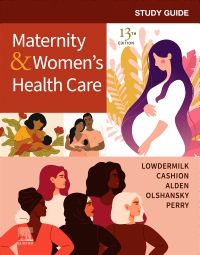
Study Guide for Maternity & Women's Health Care Elsevier eBook on VitalSource, 13th Edition
by Deitra Leonard Lowdermilk, RNC, PhD, FAAN, Kitty Cashion, RN, BC, MSN, Kathryn Rhodes Alden, EdD, MSN, RN, IBCLC, Ellen Olshansky, PhD, RN, WHNP-E, FAAN and Shannon E. Perry, RN, PhD, FAAN
Elsevier eBook on VitalSource
ISBN:
9780323811835
Copyright:
2024
Publication Date:
07-26-2023
Page Count:
384
Imprint:
Mosby
List Price:
$35.99
Was
$35.99
Now $32.39
Or $0.00 with a valid access code
Corresponding to the chapters in the 13th edition of Lowdermilk's market-leading Maternity and Women's Health Care, this study guide offers a complete review of content and a wide range of activities to help you understand key nursing concepts and apply your knowledge. It includes clinical judgment exercises and cases for the Next Generation NCLEX®, multiple-choice and matching questions, and more. Answers are included in the back of the book.
-
- NEW! Clinical judgment sections and case studies for the Next Generation NCLEX® help you prepare for the licensure exam and clinical practice
-
- Chapter review activities reinforce your knowledge of textbook content with fill-in-the-blank, matching, multiple-choice, and short-answer questions
- Perforated pages make it easy to use study guide activities as assignments to be handed in and graded
- Answer key at the end of the study guide allows you to assess your comprehension of key content
-
-
 Maternity and Women's Health Care Elsevier eBook on VitalSourceElsevier eBook on VitalSource
 -
 Maternity and Women's Health CarePaperback
 -
 Maternity and Women's Health Care - Binder ReadyBinder Ready
 -

-
-
1. 21st Century Maternity and Women’s Health Nursing
2. Community Care: The Family and Culture
3. Nursing and Genomics
4. Assessment and Health Promotion
5. Violence Against Women
6. Reproductive System Concerns
7. Sexually Transmitted and Other Infections
8. Contraception and Abortion
9. Infertility
10. Problems of the Breast
11. Structural Disorders and Neoplasms of the Reproductive System
12. Conception and Fetal Development
13. Anatomy and Physiology of Pregnancy
14. Nursing Care of the Family During Pregnancy
15. Maternal Nutrition
16. Labor and Birth Processes
17. Maximizing Comfort for The Laboring Person
18. Fetal Assessment During Labor
19. Nursing Care of the Family During Labor and Birth
20. Postpartum Physiologic Changes
21. Nursing Care of the Family During the Postpartum Period
22. Transition to Parenthood
23. Physiologic and Behavioral Adaptations of the Newborn
24. Nursing Care of the Newborn and Family
25. Newborn Nutrition and Feeding
26. Assessment of High-Risk Pregnancy
27. Hypertensive Disorders
28. Hemorrhagic Disorders
29. Endocrine and Metabolic Disorders
30. Medical-Surgical Disorders
31. Mental Health Disorders and Substance Abuse
32. Labor and Birth Complications
33. Postpartum Complications
34. Nursing Care of the High-Risk Newborn
35. Acquired Problems of the Newborn
36. Hemolytic Disorders and Congenital Anomalies
37. Perinatal Loss, Bereavement, and Grief
Answer Key -
-
Ways of Reading
- The appearance of the text and page layout can be modified according to the capabilities of the reading system (font family and font size, spaces between paragraphs, sentences, words, and letters, as well as color of background and text)
- This e-publication is accessible to the full extent that the file format and types of content allow, on a specific reading device, by default, without necessarily including any additions such as textual descriptions of images or enhanced navigation
- All content can be read as read aloud speech or dynamic braille
- Has alternative text descriptions for images
-
Conformance
- The publication contains a conformance statement that it meets the EPUB Accessibility 1.1, WCAG 2.1, Level AA standard. Please see https://bornaccessible.benetech.org/certified-publishers/ for further details of our compatibility testing.
- The certifier's credential is https://bornaccessible.benetech.org/certified-publishers/
- For detailed accessibility information, see Elsevier's website at https://www.elsevier.com/about/accessibility
- For queries regarding accessibility information, contact [email protected]
- The publication was certified on 12-02-2026
-
Navigation
- Table of contents to all chapters of the text via links
- Elements such as headings, tables, etc. for structured navigation
- Page list to go to pages from the print source version
-
Rich Content
- Information-rich images are described by extended descriptions
-
Hazards
- The publication contains no hazards
-
Product Content
- Content includes any type of illustrations.
- The primary content is text.
- Content includes a significant number of actionable (clickable) web links to external content, downloadable resources, supplementary material, etc.
- Content includes a significant number of actionable (clickable) cross-references, hyperlinked notes and annotations, or with other actionable links between largely textual elements (e.g., quiz/test questions, 'choose your own ending', etc.).
- Content includes figures, diagrams, charts and/or graphs, including other 'mechanical' (i.e. non-photographic) illustrations.
- Content includes a significant number of web links (printed URLs, QR codes etc.).
- Content includes assessment material, e.g., Questions or student exercises, problems, quizzes or tests (as an integral part of the work).
- Content includes text within images, including text-as-text embedded in diagrams, charts, or within images containing speech balloons, thought bubbles, captions, etc.
-
Legal Considerations
- No information is available
-
Additional Accessibility Information
- Content is enhanced with ARIA roles to optimize organization and facilitate navigation
- Page breaks included from the original print source
- For readers with color vision deficiency, use of color (e.g., in diagrams, graphics and charts, in prompts, or on buttons inviting a response) is not the sole means of graphical distinction or of conveying information
- The body text is presented with a contrast ratio of at least 4.5:1 (or 3:1 for large/heading text)
- Ultra-high contrast between text and background
- E-publication includes basic navigation (usually less detailed than TOC-based navigation)
- Where links, controls or buttons are included in the content, the purpose or functionality of each link, control or button is apparent from the associated text alone - or where it is unclear, separate link, control or button descriptions are provided
- All (or substantially all) textual matter is arranged in a single logical reading order (including text that is visually presented as separate from the main text flow, e.g., in boxouts, captions, tables, footnotes, endnotes, citations, etc.). Non-textual content is also linked from within this logical reading order. (Purely decorative non-text content can be ignored).
- Where interactive content is included in the product, controls are provided (e.g., for speed, pause and resume, reset) and labelled to make their use clear.
- The language of the text has been specified (e.g., via the HTML or XML lang attribute) to optimise text-to-speech (and other alternative renderings), both at the whole document level and, where appropriate, for individual words, phrases or passages in a different language.
-
Ways of Reading
Was
$35.99
Now $32.39
Or $0.00 with a valid access code

 as described in our