
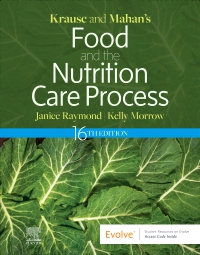

Krause and Mahan’s Food and the Nutrition Care Process, 16e, Elsevier eBook on VitalSource, 16th Edition
Elsevier eBook on VitalSource
Now $145.19
**Selected for Doody’s Core Titles® 2024 with "Essential Purchase" designation in Nutrition**
Provide optimal nutritional care with the latest guidelines to evidence-based practice! Krause and Mahan’s Food & the Nutrition Care Process, 16th Edition provides an all-in-one resource for the dietetics information you need to care for patients throughout the entire life cycle. With insight from clinical specialists, the book guides you through the steps of assessment, diagnosis and intervention, monitoring, and evaluation. It also covers nutrition in each stage of life, weight management, medical nutrition therapies for conditions and disorders, and the use of nutrition therapies in childhood. From a team of nutrition experts led by Janice L. Raymond and Kelly Morrow, this classic text has been trusted by nurses, nutritionists, and dieticians for since 1952.
-
- UNIQUE! Pathophysiology algorithms and flow charts present the cause, pathophysiology, and medical nutrition management for a variety of disorders and conditions to help you understand illness and provide optimal nutritional care
- Clinical case studies help you translate academic knowledge into practical patient care using a framework of the nutrition care process
- Sample Nutrition Diagnosis boxes present a problem, its etiology, and its signs and symptoms, then conclude with a nutrition diagnosis, providing scenarios you may encounter in practice
- Clinical Insight boxes expand on information in the text, highlight new areas of focus, and contain information on studies and clinical resources
- New Directions boxes suggest areas for further research by spotlighting emerging areas of interest in nutrition care
- Focus On boxes provide thought-provoking information on key nutrition concepts
- Summary boxes highlight CRISPR, the Indigenous food movement, hearing assessment, health disparities, and the Health At Every Size movement, and include a tribute to Dr. George Blackburn, a respected specialist in obesity and nutrition
- Key terms are listed at the beginning of each chapter and bolded within the text
-
- NEW Infectious Diseases chapter is written by a new author with specific expertise in infectious diseas
- NEW Transgender Nutrition chapter is added, from two new authors
- NEW! COVID-19 updates are provided in multiple chapters, each relating to epidemiology and patient care
- NEW! Information on the FODMAP diet is included in the appendix, covering the sugars that may cause intestinal distress
- NEW! Emphasis on diversity, equity, and inclusion is included in all chapters
- NEW! Updated International Dysphagia Diet Standardisation Initiative (IDDSI) information is included in the appendix
- NEW! Updated pregnancy growth charts are added to this edition
- NEW! Updated Healthy People 2030 information is added throughout the book
-
PART I: NUTRITION ASSESSMENT
1. Intake: Gastrointestinal Digestion, Absorption, and Excretion of Nutrients
2. Intake: Energy
3. Clinical: Water, Electrolytes, and Acid–Base Balance
4. Intake: Assessment of Food- and Nutrition-Related History
5. Clinical: Biochemical, Physical, and Functional Assessment
6. Clinical: Nutritional Genomics
7. Inflammation and the Pathophysiology of Chronic Disease
8. Behavioral-Environmental: The Individual in the Community
PART II: NUTRITION DIAGNOSIS AND INTERVENTION
9. Overview of Nutrition Diagnosis and Intervention
10. Food-Nutrient Delivery: Planning the Diet With Cultural Competency
11. Food and Nutrient Delivery: Complementary and Integrative Medicine and Dietary Supplements
12. Food and Nutrient Delivery: Nutrition Support Methods
13. Education and Counseling: Behavioral Change
PART III: NUTRITION IN THE LIFE CYCLE
14. Nutrition in Pregnancy and Lactation
15. Nutrition in Infancy
16. Nutrition in Childhood
17. Nutrition in Adolescence
18. Nutrition for Transgender People
19. Nutrition in the Adult Years
20. Nutrition in Aging
PART IV: NUTRITION FOR A HEALTHY LIFESTYLE
21. Nutrition in Weight Management
22. Nutrition in Eating Disorders
23. Nutrition in Exercise and Sports Performance
24. Nutrition and Bone Health
25. Nutrition for Oral and Dental Health
PART V: MEDICAL NUTRITION THERAPY
26. Medical Nutrition Therapy for Adverse Reactions to Food: Allergies and Intolerances
27. Medical Nutrition Therapy for Upper Gastrointestinal Tract Disorders
28. Medical Nutrition Therapy for Lower Gastrointestinal Tract Disorders
29. Medical Nutrition Therapy for Hepatobiliary and Pancreatic Disorders
30. Medical Nutrition Therapy for Diabetes Mellitus and Hypoglycemia of Nondiabetic Origin
31. Medical Nutrition Therapy for Thyroid, Adrenal, and Other Endocrine Disorders, 661
32. Medical Nutrition Therapy for Anemia
33. Medical Nutrition Therapy for Cardiovascular Disease
34. Medical Nutrition Therapy for Pulmonary Disease
35. Medical Therapy for Renal Disorders
36. Medical Nutrition Therapy for Cancer Prevention, Treatment, and Survivorship
37. Medical Nutrition Therapy for Infectious Diseases
38. Medical Nutrition Therapy for HIV and AIDS
39. Medical Nutrition Therapy in Critical Care
40. Medical Nutrition Therapy for Rheumatic and Musculoskeletal Disease
41. Medical Nutrition Therapy for Neurologic Disorders
42. Medical Nutrition Therapy for Psychiatric and Cognitive Disorders
PART VI: PEDIATRIC SPECIALTIES
43. Medical Nutrition Therapy for Low-Birth Weight Infants
44. Medical Nutrition Therapy for Genetic Metabolic Disorders
45. Medical Nutrition Therapy for Intellectual and Developmental Disabilities -
-
Ways of Reading
- The appearance of the text and page layout can be modified according to the capabilities of the reading system (font family and font size, spaces between paragraphs, sentences, words, and letters, as well as color of background and text)
- This e-publication is accessible to the full extent that the file format and types of content allow, on a specific reading device, by default, without necessarily including any additions such as textual descriptions of images or enhanced navigation
- No information about nonvisual reading is available
-
Conformance
- For detailed accessibility information, see Elsevier's website at https://www.elsevier.com/about/accessibility
- For queries regarding accessibility information, contact [email protected]
- The publication was certified on 18-11-2025
-
Navigation
- Table of contents to all chapters of the text via links
-
Rich Content
- No information is available
-
Hazards
- No information is available
-
Product Content
- No information is available
-
Legal Considerations
- No information is available
-
Additional Accessibility Information
- For readers with color vision deficiency, use of color (e.g., in diagrams, graphics and charts, in prompts, or on buttons inviting a response) is not the sole means of graphical distinction or of conveying information
- E-publication includes basic navigation (usually less detailed than TOC-based navigation)
- Where links, controls or buttons are included in the content, the purpose or functionality of each link, control or button is apparent from the associated text alone - or where it is unclear, separate link, control or button descriptions are provided
- All (or substantially all) textual matter is arranged in a single logical reading order (including text that is visually presented as separate from the main text flow, e.g., in boxouts, captions, tables, footnotes, endnotes, citations, etc.). Non-textual content is also linked from within this logical reading order. (Purely decorative non-text content can be ignored).
- The language of the text has been specified (e.g., via the HTML or XML lang attribute) to optimise text-to-speech (and other alternative renderings), both at the whole document level and, where appropriate, for individual words, phrases or passages in a different language.
-
Ways of Reading


 as described in our