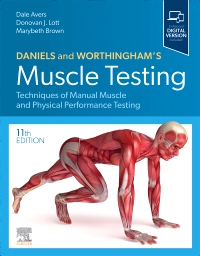

Daniels & Worthingham's Muscle Testing - Elsevier eBook on VitalSource, 11th Edition
Elsevier eBook on VitalSource
Now $91.79
**2026 Textbook and Academic Authors Association (TAA) McGuffey Longevity Award Winner**
Daniels and Worthingham's Muscle Testing, 11th Edition offers the clear information needed to master procedures and enhance clinical decision making in manual muscle testing and performance testing. Comprehensive discussion of the value of strength testing with clear, illustrated instructions provide a detailed guide to patient positioning, clinician instructions, and application of skill. In addition to updated muscle testing of normal individuals and others with weakness or paralysis, this edition includes updated information on alternative strength and performance tests for all adult populations. Updated comprehensive coverage for muscle dynamometry and ideal exercises enhances this texts’ relevance for today’s clinician. An eBook version included with print purchase provides access to all the text, figures, and references, with the ability to search, customize content, make notes and highlights, and have content read aloud.
-
- Updated content throughout provides the most current information needed to be an effective practitioner
- Updated references ensure content is current and applicable for today’s practice
- NEW! eBook version included with print purchase provides access to all the text, figures, and references, with the ability to search, customize content, make notes and highlights, and have content read aloud. Plus, the eBook includes video clips and bonus Ready Reference Anatomy and Assessment of Muscles Innervated by Cranial Nerves content
-
- Drawings and arrows, along with clear written directions, make it easy to understand and perform muscle testing procedures to assess deficits in strength, balance, and range of motion
- More than 500 illustrations clearly show testing sequences, muscle anatomy, and muscle innervation
- Content on the muscle dynamometer and muscle dynamometry data introduces you to muscle dynamometry, including muscle dynamometer methods and results with each muscle
- Ideal exercises for selected muscles thoroughly explain procedures based on the literature
- Chapter on functional performance testing covers functional strength testing in older adults and those with functional decline, and testing muscle performance in various clinical settings
- Chapter on strength testing for active populations includes a variety of tests appropriate for many settings with reference data for comparison
- Chapters on manual muscle testing address how to enhance the reliability and validity of manual muscle testing and other practical considerations of manual muscle testing
- Details of muscle anatomy and innervation help in linking muscle topography with function
- Clinical Relevance and Substitutions boxes provide additional tips and highlight muscle substitutions that may occur during a test to ensure greater accuracy
- A constant reference number clearly identifies each muscle in the body, indexed in the Alphabetical List of Muscles by Region as well as in the Ready Reference Anatomy chapter in the eBook included with print purchase, to speed cross-referencing and help you quickly identify any muscle
-
-
 Daniels and Worthingham's Muscle TestingPaperback
-
-
1. Principles of Manual Muscle Testing
2. Practical Considerations for Manual Muscle Testing
3. Testing the Muscles of the Neck
4. Testing the Muscles of the Trunk and Pelvic Floor
5. Testing the Muscles of the Upper Extremity
6. Testing the Muscles of the Lower Extremity
7. Alternatives to Manual Muscle Testing
8. Testing Functional Performance
9. Handheld Muscle Dynamometry
10. Case Studies
11. Assessment of Muscles Innervated by Cranial Nerves
12. Ready Reference Anatomy -
-
Ways of Reading
- The appearance of the text and page layout can be modified according to the capabilities of the reading system (font family and font size, spaces between paragraphs, sentences, words, and letters, as well as color of background and text)
- This e-publication is accessible to the full extent that the file format and types of content allow, on a specific reading device, by default, without necessarily including any additions such as textual descriptions of images or enhanced navigation
- No information about nonvisual reading is available
-
Conformance
- For detailed accessibility information, see Elsevier's website at https://www.elsevier.com/about/accessibility
- For queries regarding accessibility information, contact [email protected]
- The publication was certified on 18-11-2025
-
Navigation
- Table of contents to all chapters of the text via links
-
Rich Content
- No information is available
-
Hazards
- No information is available
-
Product Content
- No information is available
-
Legal Considerations
- No information is available
-
Additional Accessibility Information
- For readers with color vision deficiency, use of color (e.g., in diagrams, graphics and charts, in prompts, or on buttons inviting a response) is not the sole means of graphical distinction or of conveying information
- E-publication includes basic navigation (usually less detailed than TOC-based navigation)
- Where links, controls or buttons are included in the content, the purpose or functionality of each link, control or button is apparent from the associated text alone - or where it is unclear, separate link, control or button descriptions are provided
- All (or substantially all) textual matter is arranged in a single logical reading order (including text that is visually presented as separate from the main text flow, e.g., in boxouts, captions, tables, footnotes, endnotes, citations, etc.). Non-textual content is also linked from within this logical reading order. (Purely decorative non-text content can be ignored).
- The language of the text has been specified (e.g., via the HTML or XML lang attribute) to optimise text-to-speech (and other alternative renderings), both at the whole document level and, where appropriate, for individual words, phrases or passages in a different language.
-
Ways of Reading

 as described in our