
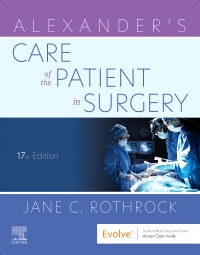

Alexander's Care of the Patient in Surgery - Elsevier eBook on VitalSource, 17th Edition
Elsevier eBook on VitalSource
Now $117.03
**Selected for Doody’s Core Titles® 2024 in Perioperative**
Gain the knowledge and skills you need to provide safe, effective perioperative nursing care! Alexander’s Care of the Patient in Surgery, 17th Edition is the definitive resource for nurses and surgical technologists training for a career in the operating room. Illustrated, step-by-step instructions cover patient care in more than 400 surgical interventions, including patient positioning, instrumentation, and postoperative care. Along with the latest on robotic surgery and a review of evidence-based guidelines, this edition includes new coverage of COVID-19 and gender affirmation surgery. From well-known educator Jane C. Rothrock — and with every chapter authored by an expert nurse — Alexander’s gives you the tools you need to pass the CNOR© certification exam and succeed in the surgical setting.
-
- Comprehensive coverage includes basic perioperative nursing principles, such as patient and environmental safety, infection prevention, patient positioning, anesthesia and pain management, and the unique needs of special populations such as pediatric and geriatric patients
- Coverage of more than 400 general and specialty surgical interventions includes minimally invasive and robotic-assisted surgical procedures, whether performed in a hospital, ambulatory surgery setting, or in a doctor's office
- Perioperative nursing considerations are presented within the nursing process framework and include assessment, nursing diagnosis, outcome identification, planning, implementation, evaluation, discharge planning, and patient and family education
- More than 1,000 full-color photos and illustrations show surgical anatomy, procedures, methods, and equipment
- Sample plans of care include nursing diagnoses, outcomes, and interventions
- Research Highlight and Evidence for Practice boxes discuss recommendations for applying current scientific research to patient care
- Robotic-Assisted Surgery boxes highlight a rapidly expanding surgical modality.
- Enhanced Recovery After Surgery boxes promote protocols to improve outcomes, reduce the length of stay, and reduce the patient’s cost of care
- Patient Engagement Exemplar boxes optimize surgical outcomes by addressing AORN guidelines on the issues of patient care and involvement of the patient’s family
- Patient Safety boxes highlight practices and initiatives for patient safety in the surgical setting
- Patient, Family, and Caregiver Education boxes include specific guidelines for preprocedural and/or postprocedural care, potential complications, home care, discharge instructions, and psychosocial care
- Ambulatory Surgery Considerations boxes highlight patient selection criteria, special anesthesia considerations, and patient assessment implications for outpatient surgical procedures
- Surgical Pharmacology tables summarize the drugs most commonly used for each surgical specialty, including generic and trade names, indications, and pharmacokinetics
- Critical Thinking questions at the end of each chapter let you assess your understanding of important material
- Exam-style practice questions on the Evolve website include answers and rationales
- References to AORN Guidelines and toolkits are discussed as relevant to the topic
-
- NEW! Additional content on infection prevention includes coverage of Severe Acute Respiratory Syndrome Coronavirus 2 (SARS-CoV-2), Candida auris
- NEW! Coverage of discharge planning and gender affirmation surgery is added to this edition
-
UNIT I Foundations for Practice
1. Concepts Basic to Perioperative Nursing
2. Patient Safety and Risk Management
3. Workplace Issues and Staff Safety
4. Infection Prevention and Control
5. Anesthesia
6. Positioning the Patient for Surgery
7. Sutures, Sharps, and Instruments
8. Surgical Modalities
9. Wound Healing, Dressings, and Drains
10. Postoperative Patient Care and Pain Management
UNIT II Surgical Interventions
11. Gastrointestinal Surgery
12. Surgery of the Biliary Tract, Pancreas, Liver, and Spleen
13. Hernia Repair
14. Gynecologic and Obstetric Surgery
15. Genitourinary Surgery
16. Thyroid and Parathyroid Surgery
17. Breast Surgery
18. Ophthalmic Surgery
19. Otorhinolaryngologic Surgery
20. Orthopedic Surgery
21. Neurosurgery
22. Reconstructive and Aesthetic Plastic Surgery
23. Thoracic Surgery
24. Vascular Surgery
25. Cardiac Surgery
UNIT III Special Considerations
26. Pediatric Surgery
27. Geriatric Surgery
28. Trauma Surgery
29. Integrative Health Practices -
-
Ways of Reading
- The appearance of the text and page layout can be modified according to the capabilities of the reading system (font family and font size, spaces between paragraphs, sentences, words, and letters, as well as color of background and text)
- This e-publication is accessible to the full extent that the file format and types of content allow, on a specific reading device, by default, without necessarily including any additions such as textual descriptions of images or enhanced navigation
- No information about nonvisual reading is available
-
Conformance
- For detailed accessibility information, see Elsevier's website at https://www.elsevier.com/about/accessibility
- For queries regarding accessibility information, contact [email protected]
- The publication was certified on 18-11-2025
-
Navigation
- Table of contents to all chapters of the text via links
-
Rich Content
- No information is available
-
Hazards
- No information is available
-
Product Content
- No information is available
-
Legal Considerations
- No information is available
-
Additional Accessibility Information
- For readers with color vision deficiency, use of color (e.g., in diagrams, graphics and charts, in prompts, or on buttons inviting a response) is not the sole means of graphical distinction or of conveying information
- E-publication includes basic navigation (usually less detailed than TOC-based navigation)
- Where links, controls or buttons are included in the content, the purpose or functionality of each link, control or button is apparent from the associated text alone - or where it is unclear, separate link, control or button descriptions are provided
- All (or substantially all) textual matter is arranged in a single logical reading order (including text that is visually presented as separate from the main text flow, e.g., in boxouts, captions, tables, footnotes, endnotes, citations, etc.). Non-textual content is also linked from within this logical reading order. (Purely decorative non-text content can be ignored).
- The language of the text has been specified (e.g., via the HTML or XML lang attribute) to optimise text-to-speech (and other alternative renderings), both at the whole document level and, where appropriate, for individual words, phrases or passages in a different language.
-
Ways of Reading


 as described in our