
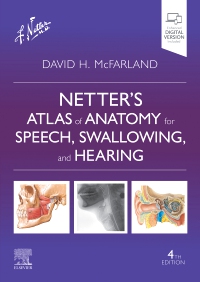

Netter’s Atlas of Anatomy for Speech, Swallowing, and Hearing - Elsevier E-Book on VitalSource, 4th Edition
Elsevier eBook on VitalSource
Now $74.79
Both an outstanding text for undergraduate and graduate courses in speech, language, and hearing (SLH), as well as an excellent resource for those in clinical practice, Netter’s Atlas of Anatomy for Speech, Swallowing, and Hearing, 4th Edition, is an affordable, brilliantly illustrated volume covering the complex anatomical functions relevant to SLH. World-renowned Netter anatomy illustrations are accompanied by concise text and tables, providing a unique "read it, see it" approach that helps you easily connect anatomy and physiology concepts to detailed illustrations. This full-color, SLH-specific atlas contains a basic overview of anatomical organization systems; coverage of the respiratory, phonatory, articulatory, and auditory systems, as well as neuroanatomy; and updated content throughout—all designed to give you a solid foundation in learning how to diagnose and treat SLH disorders.
-
- Features Dr. Frank Netter’s unique medical illustrations and straightforward descriptions that clearly present the anatomy and physiology of speech, language, swallowing and hearing
- Incorporates newly created figures to help you understand some key anatomical concepts and to orient you to the anatomical structures typically visualized in speech and swallowing instrumental examinations
- Contains more integrated physiology throughout, plus expanded coverage of the anatomy of the oropharyngeal-articulatory system (and of the procedures that make it possible to visualize the structures of this system), key information on the anatomy of the vestibular system, and the addition of fundamental neuroanatomical concepts for speech production and swallowing
- Includes system musculature summary tables for each section that present vital information in a quick, easy, and consistent format for study and reference
- Enhanced eBook includes self-test questions, and exercises to enhance your understanding of SLSH anatomy and physiology
- Evolve Instructor site with an image and test bank is available to instructors through their Elsevier sales rep or via request at https://evolve.elsevier.com
-
The Respiratory System
Skeletal Framework
Respiratory Tract
The Respiratory Muscles
Respiratory Volumes and Capacities
The Phonatory System
Larynx
Laryngeal Cartilages
Hyoid Bone
Articulations
Ligaments and Membranes
Vocal Folds
Laryngeal Muscles
Intrinsic Muscles
Extrinsic Muscles
The Articulatory System
Cranial Anatomy
Vocal Tract
Muscles of Facial Expression
Neck Muscle
Tongue Muscles
Muscles of Mastication
Muscles of the Soft Palate
Pharyngeal Muscles
Velopharyngeal Mechanism
The Auditory System
Inner Ear
Middle Ear
Outer Ear
Neuroanatomy
Telencephalon
Diencephalon
Mesencephalon
Pons
Medulla Oblongata
Spinal Cord
Cerebellum
Cranial Nerves -
-
Ways of Reading
- The appearance of the text and page layout can be modified according to the capabilities of the reading system (font family and font size, spaces between paragraphs, sentences, words, and letters, as well as color of background and text)
- This e-publication is accessible to the full extent that the file format and types of content allow, on a specific reading device, by default, without necessarily including any additions such as textual descriptions of images or enhanced navigation
- No information about nonvisual reading is available
-
Conformance
- For detailed accessibility information, see Elsevier's website at https://www.elsevier.com/about/accessibility
- For queries regarding accessibility information, contact [email protected]
- The publication was certified on 18-11-2025
-
Navigation
- Table of contents to all chapters of the text via links
-
Rich Content
- No information is available
-
Hazards
- No information is available
-
Product Content
- No information is available
-
Legal Considerations
- No information is available
-
Additional Accessibility Information
- For readers with color vision deficiency, use of color (e.g., in diagrams, graphics and charts, in prompts, or on buttons inviting a response) is not the sole means of graphical distinction or of conveying information
- E-publication includes basic navigation (usually less detailed than TOC-based navigation)
- Where links, controls or buttons are included in the content, the purpose or functionality of each link, control or button is apparent from the associated text alone - or where it is unclear, separate link, control or button descriptions are provided
- All (or substantially all) textual matter is arranged in a single logical reading order (including text that is visually presented as separate from the main text flow, e.g., in boxouts, captions, tables, footnotes, endnotes, citations, etc.). Non-textual content is also linked from within this logical reading order. (Purely decorative non-text content can be ignored).
- The language of the text has been specified (e.g., via the HTML or XML lang attribute) to optimise text-to-speech (and other alternative renderings), both at the whole document level and, where appropriate, for individual words, phrases or passages in a different language.
-
Ways of Reading


 as described in our