
ISBN:
9780323830874
Copyright:
2022
Publication Date:
02-15-2022
Page Count:
640
Imprint:
Mosby
List Price:
$84.99

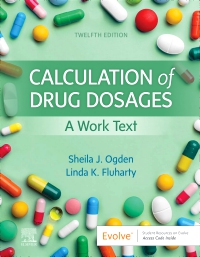
Calculation of Drug Dosages - Elsevier eBook on VitalSource, 12th Edition
by Sheila J. Ogden, MSN, RN and Linda Fluharty, RNC, MSN
Elsevier eBook on VitalSource
ISBN:
9780323830874
Copyright:
2022
Publication Date:
02-15-2022
Page Count:
640
Imprint:
Mosby
List Price:
$84.99
Was
$84.99
Now $74.79
Or $0.00 with a valid access code
Learn to calculate drug dosages accurately with this practical workbook-textbook! Calculation of Drug Dosages: A Work Text, 12th Edition makes it easy to understand and master the three major methods of dosage calculation — ratio and proportion, formula, and dimensional analysis. A basic review of mathematics refreshes your math skills, and practice problems, worksheets, and practice tests help you gain confidence in making drug calculations. New to this edition are Next Generation NCLEX® (NGN) practice problems preparing you for the critical thinking questions on the NGN exam. Written by nursing experts Sheila Ogden and Linda Fluharty, this worktext is ideal for nursing students and for nurses returning to practice!
-
-
 Book-Organized: Sherpath for Ogden Calculation of Drug DosagesSherpath Book-Organized
 -
 Elsevier Adaptive Quizzing for Calculation of Drug Dosages(eCommerce Version)Elsevier Adaptive Quizzing - Next Generation
 -

-
-
- Learning objectives keep you focused and explain what you should accomplish upon the completion of each chapter
- Logical structure organizes the material from simple to complex, making it easier to build upon and retain knowledge
- Extensive math review covers the basic math skills essential for accurate calculation of drug dosages and helps you identify your strengths and weaknesses
- Chapter worksheets allow you to practice solving realistic problems
- Post-tests at the end of each chapter allow you to assess your understanding of content
- Alert boxes highlight information crucial to math calculation and patient safety
- Comprehensive post-test at the end of the book offers additional practice and measures your overall understanding
- 40 flash cards on the Evolve website make it easy to study and review abbreviations, formulas, and conversions from the book
-
- NEW! Next Generation NCLEX® practice problems and case studies progress from simple to complex concepts and are included in chapters throughout the text
- NEW! Coverage of heparin drip calculation describes how to calculate and administer an IV weight-based heparin bolus from the IV heparin
- NEW! Added IV coverage is included in the IV Flow Rates and IV Flow Rates for Dosages Measured in Units chapters
- NEW! Updated drug information and medication labels are added to this edition
-
PART 1
Review of Mathematics
REVIEW OF MATHEMATICS PRETEST
1. Fractions
2. Decimals
3. Percents
4. Ratios
5. Proportions
REVIEW OF MATHEMATICS POSTTEST
PART 2
Units and Measurements for the Calculation of Drug Dosages
6. Metric and Household Measurements
7. Calculations Used in Patient Assessments
PART 3
Preparation for Calculation of Drug Dosages
8. Safety in Medication Administration
9. Interpretation of the Licensed Prescriber’s Orders
10. Reading Medication Labels
PART 4
Calculation of Drug Dosages
11. Oral Dosages
12. Parenteral Dosages
13. Dosages Measured in Units
14. Reconstitution of Medications
15. Intravenous Flow Rates
16. Intravenous Flow Rates for Dosages Measured in Units
17. Critical Care Intravenous Flow Rates
18. Pediatric Dosages
19. Obstetric Dosages
Comprehensive Posttest
Glossary
Appendix A: Apothecary System of Measure -
-
Ways of Reading
- The appearance of the text and page layout can be modified according to the capabilities of the reading system (font family and font size, spaces between paragraphs, sentences, words, and letters, as well as color of background and text)
- This e-publication is accessible to the full extent that the file format and types of content allow, on a specific reading device, by default, without necessarily including any additions such as textual descriptions of images or enhanced navigation
- No information about nonvisual reading is available
-
Conformance
- No information is available
-
Navigation
- Table of contents to all chapters of the text via links
- Page list to go to pages from the print source version
-
Rich Content
- No information is available
-
Hazards
- No information is available
-
Product Content
- No information is available
-
Legal Considerations
- No information is available
-
Additional Accessibility Information
- Page breaks included from the original print source
- For readers with color vision deficiency, use of color (e.g., in diagrams, graphics and charts, in prompts, or on buttons inviting a response) is not the sole means of graphical distinction or of conveying information
- E-publication includes basic navigation (usually less detailed than TOC-based navigation)
- Where links, controls or buttons are included in the content, the purpose or functionality of each link, control or button is apparent from the associated text alone - or where it is unclear, separate link, control or button descriptions are provided
- All (or substantially all) textual matter is arranged in a single logical reading order (including text that is visually presented as separate from the main text flow, e.g., in boxouts, captions, tables, footnotes, endnotes, citations, etc.). Non-textual content is also linked from within this logical reading order. (Purely decorative non-text content can be ignored).
- The language of the text has been specified (e.g., via the HTML or XML lang attribute) to optimise text-to-speech (and other alternative renderings), both at the whole document level and, where appropriate, for individual words, phrases or passages in a different language.
-
Ways of Reading
Was
$84.99
Now $74.79
Or $0.00 with a valid access code

 as described in our