ISBN:
9780323830942
Copyright:
2023
Publication Date:
10-27-2022
Page Count:
288
Imprint:
Saunders
List Price:
$44.99

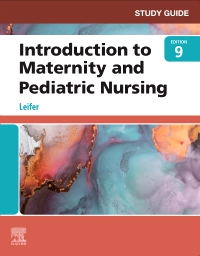
Study Guide for Introduction to Maternity and Pediatric Nursing Elsevier eBook on VitalSource, 9th Edition
by Gloria Leifer, MA, RN, CNE
Elsevier eBook on VitalSource
ISBN:
9780323830942
Copyright:
2023
Publication Date:
10-27-2022
Page Count:
288
Imprint:
Saunders
List Price:
$44.99
Was
$44.99
Now $40.49
Or $0.00 with a valid access code
Reinforce your understanding of maternity and pediatric nursing with this practical study guide! With chapters corresponding to Leifer’s Introduction to Maternity and Pediatric Nursing, 9th Edition, this workbook provides a variety of exercises and activities to help you review concepts and learn to think critically. Case studies offer opportunities to apply your knowledge to patient care. New to this edition are Next-Generation NCLEX® (NGN) exam-style questions to help you prepare for success on your licensure examination and in nursing practice.
New Edition Expected Availability: 03-21-2025

Study Guide for Leifer's Introduction to Maternity and Pediatric Nursing Elsevier eBook on VitalSource
Elsevier eBook on VitalSource
ISBN: 9780443261589
-
- NEW! Next-Generation NCLEX® exam-style questions for case studies help students develop skills in clinical judgment and prepare for the new licensure examination
- NEW! Updated exercises correspond with the textbook’s new content on methods and treatment in the care of women, families, newborns, and children
-
- Review questions cover factual information from the chapter, appropriate nursing actions, what to expect in terms of medical orders or patient care, and potential complications
- Learning activities include crossword puzzles and matching, labeling, and completion exercises to help students reinforce their understanding of basic concepts and factual knowledge
- Applying Knowledge activities provide additional opportunities for students to apply learned information to clinical care
- Thinking Critically activities require students to apply what they’ve learned in the textbook to new situations or to draw conclusions based on that knowledge
-
-
 Introduction to Maternity and Pediatric Nursing - Elsevier eBook on VitalSourceElsevier eBook on VitalSource
-
-
UNIT I. An Overview of Maternity and Pediatric Nursing
1. The Past, Present, and Future
UNIT II. Maternal-Newborn Nursing and Women’s Health
2. Human Reproductive Anatomy and Physiology
3. Fetal Development
4. Prenatal Care and Adaptations to Pregnancy
5. Nursing Care of Women with Complications during Pregnancy
6. Nursing Care of Mother and Infant During Labor and Birth
7. Nursing Management of Pain During Labor and Birth
8. Nursing Care of Women with Complications During Labor and Birth
9. The Family after Birth
10. Nursing Care of Women with Complications Following Birth
11. The Nurse’s Role in Women’s Health Care
12. The Term Newborn
13. Preterm and Post-Term Newborns
14. The Newborn with a Perinatal Injury or Congenital Malformation
UNIT III. The Growing Child and Family
15. An Overview of Growth, Development, and Nutrition
16. The Infant
17. The Toddler
18. The Preschool Child
19. The School-Age Child
20. The Adolescent
UNIT IV. Adapting Care to the Pediatric Patient
21. The Child’s Experience of Hospitalization
22. Health Care Adaptations for the Child and Family
UNIT V. The Child Needing Nursing Care
23. The Child with a Sensory or Neurological Condition
24. The Child with a Musculoskeletal Condition
25. The Child with a Respiratory Disorder
26. The Child with a Cardiovascular Disorder
27. The Child with a Condition of the Blood, Blood-Forming Organs, or Lymphatic System
28. The Child with a Gastrointestinal Condition
29. The Child with a Genitourinary Condition
30. The Child with a Skin Condition
31. The Child with a Metabolic Condition
32. Childhood Communicable Diseases, Bioterrorism, Natural Disasters and the Maternal-Child Patient
33. The Child with an Emotional or Behavioral Condition
UNIT VI. The Changing Health Care Environment
34. Complementary and Alternative Therapies in Maternity and Pediatric Nursing -
-
Ways of Reading
- The appearance of the text and page layout can be modified according to the capabilities of the reading system (font family and font size, spaces between paragraphs, sentences, words, and letters, as well as color of background and text)
- This e-publication is accessible to the full extent that the file format and types of content allow, on a specific reading device, by default, without necessarily including any additions such as textual descriptions of images or enhanced navigation
- No information about nonvisual reading is available
-
Conformance
- No information is available
-
Navigation
- Table of contents to all chapters of the text via links
- Page list to go to pages from the print source version
-
Rich Content
- No information is available
-
Hazards
- No information is available
-
Product Content
- No information is available
-
Legal Considerations
- No information is available
-
Additional Accessibility Information
- Page breaks included from the original print source
- For readers with color vision deficiency, use of color (e.g., in diagrams, graphics and charts, in prompts, or on buttons inviting a response) is not the sole means of graphical distinction or of conveying information
- E-publication includes basic navigation (usually less detailed than TOC-based navigation)
- Where links, controls or buttons are included in the content, the purpose or functionality of each link, control or button is apparent from the associated text alone - or where it is unclear, separate link, control or button descriptions are provided
- All (or substantially all) textual matter is arranged in a single logical reading order (including text that is visually presented as separate from the main text flow, e.g., in boxouts, captions, tables, footnotes, endnotes, citations, etc.). Non-textual content is also linked from within this logical reading order. (Purely decorative non-text content can be ignored).
- The language of the text has been specified (e.g., via the HTML or XML lang attribute) to optimise text-to-speech (and other alternative renderings), both at the whole document level and, where appropriate, for individual words, phrases or passages in a different language.
-
Ways of Reading
Was
$44.99
Now $40.49
Or $0.00 with a valid access code

 as described in our