
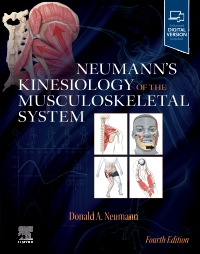

Neumann’s Kinesiology of the Musculoskeletal System - Elsevier eBook on VitalSource, 4th Edition
Elsevier eBook on VitalSource
Now $94.15
**2025 Textbook and Academic Authors Association (TAA) Textbook Excellence "Texty" Award Winner**
**Selected for Doody’s Core Titles® 2024 in Physical Therapy**
With a focus on the normal and abnormal mechanical interactions between the muscles and joints of the body, Neumann’s Kinesiology of the Musculoskeletal System, 4th Edition provides a foundation for the practice of physical rehabilitation. This comprehensive, research-based core text explores kinesiology as it relates to physical rehabilitation in a clinically relevant and accessible manner. It presents the language of human movement — and acts as a bridge between basic science and clinical management. It helps clinicians effectively address the mechanical-based changes in movement across a person’s lifespan, whether in the context of rehabilitation, recreation, or promotion of health and wellness. Full-color anatomic and kinesiologic illustrations clearly demonstrate the anatomy, functional movement, and biomechanical principles underlying movement and posture. An eBook version, included with print purchase, provides access to all the text, figures, and references, with the ability to search, customize content, make notes and highlights, and have content read aloud. The eBook included with print purchase also features multiple excellent videos of anatomic and kinesiologic principles, answers to study questions from the print book, and additional tables and figures.
-
- Evidence-based approach emphasizes the importance of research in PT decision-making
- More than 900 high-quality illustrations provide visual accompaniments to clarify the material
- Clinical Connections boxes at the end of each chapter highlight or expand upon a particular clinical concept associated with the kinesiology covered in the chapter
- Special Focus boxes throughout the text provide numerous clinical examples to demonstrate why kinesiologic information is needed
- Critical thinking questions for selected chapters reinforce the main concepts
-
- UPDATED! Current, evidence-based content closes the gap in kinesiology and anatomy science with clinical practice
- NEW! Additional Special Focus boxes and Clinical Connections boxes present kinesiology in a clinical context
- UPDATED! Modified artwork and new figures visually reinforce key concepts
- NEW! An eBook version, included with print purchase, provides access to all the text, figures, and references, with the ability to search, customize content, make notes and highlights, and have content read aloud. It also features videos, answers to study questions from the print book, and additional tables and figures
-
Section 1: Essential Topics of Kinesiology
1. Getting Started
2. Arthrology: The Study of the Structure and Function of Human Joints
3. Muscle: The Primary Stabilizer and Mover of the Skeletal System
4. Biomechanical Principles for Understanding Movement
Appendix I: Trigonometry Review and Anthropometric Data
Section II: Upper Extremity
5. Shoulder Complex
6. Elbow and Forearm
7. Wrist
8. Hand
Appendix II: Reference Materials for Muscle Attachments and Innervations, Muscle Cross-Sectional Areas, and Dermatomes of the Upper Extremity
Section III: Axial Skeleton
9. Axial Skeleton: Osteology and Arthrology
10. Axial Skeleton: Muscle and Joint Interactions
11. Kinesiology of Mastication and Ventilation
Appendix III: Reference Materials for the Cauda Equina, and Attachments, Innervations, and Selected Moment Arms of Muscles of the Axial Skeleton
Section IV: Lower Extremity
12. Hip
13. Knee
14. Ankle and Foot
15. Kinesiology of Walking
16. Kinesiology of Running
Appendix IV: Reference Materials for Muscle Attachments and Innervations, Muscle Cross-Sectional Areas, and Dermatomes of the Lower Extremity -
-
Ways of Reading
- The appearance of the text and page layout can be modified according to the capabilities of the reading system (font family and font size, spaces between paragraphs, sentences, words, and letters, as well as color of background and text)
- This e-publication is accessible to the full extent that the file format and types of content allow, on a specific reading device, by default, without necessarily including any additions such as textual descriptions of images or enhanced navigation
- No information about nonvisual reading is available
-
Conformance
- For detailed accessibility information, see Elsevier's website at https://www.elsevier.com/about/accessibility
- For queries regarding accessibility information, contact [email protected]
- The publication was certified on 18-11-2025
-
Navigation
- Table of contents to all chapters of the text via links
-
Rich Content
- No information is available
-
Hazards
- No information is available
-
Product Content
- No information is available
-
Legal Considerations
- No information is available
-
Additional Accessibility Information
- For readers with color vision deficiency, use of color (e.g., in diagrams, graphics and charts, in prompts, or on buttons inviting a response) is not the sole means of graphical distinction or of conveying information
- E-publication includes basic navigation (usually less detailed than TOC-based navigation)
- Where links, controls or buttons are included in the content, the purpose or functionality of each link, control or button is apparent from the associated text alone - or where it is unclear, separate link, control or button descriptions are provided
- All (or substantially all) textual matter is arranged in a single logical reading order (including text that is visually presented as separate from the main text flow, e.g., in boxouts, captions, tables, footnotes, endnotes, citations, etc.). Non-textual content is also linked from within this logical reading order. (Purely decorative non-text content can be ignored).
- The language of the text has been specified (e.g., via the HTML or XML lang attribute) to optimise text-to-speech (and other alternative renderings), both at the whole document level and, where appropriate, for individual words, phrases or passages in a different language.
-
Ways of Reading

 as described in our