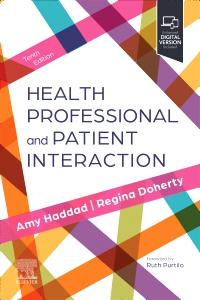

Health Professional and Patient Interaction - Elsevier eBook on VitalSource, 10th Edition
Elsevier eBook on VitalSource
Now $72.19
Learn how to navigate the complicated and challenging world of health care with Health Professional and Patient Interaction, 10th Edition. Covering strategies for effective communication and collaboration, this time-tested guide offers the tools needed to establish positive patient and interprofessional relationships that are built on respect. It not only covers respectful actions, communication standards, and good decision-making, but also demonstrates how those decisions directly shape successful patient outcomes. Practical examples and authentic scenarios highlight how to apply respect and professionalism to coworkers and patients of various ages and backgrounds across a wide spectrum of healthcare environments. It’s the strong foundation you need to communicate effectively for positive, collaborative, and compassionate patient-centered care.
-
- NEW! Revised content explores the importance of self-care, coping with moral distress, building resiliency, and workplace wellness
- NEW! Expanded coverage of justice, diversity, equity and inclusion emphasizes culturally-informed care and essential values and skill sets to minimize the impact of social and racial inequities on health outcomes
- NEW! Updated coverage of telehealth and virtual care delivery explores the evolution of communication with patients and colleagues
- NEW! Updated tools and strategies for managing difficult conversations to promote patient respect and optimize health outcomes in challenging situations
- NEW! An enhanced ebook, included only with print purchase, provides access to all the text, figures, and references, plus the ability to search, customize content, make notes and highlights, and have content read aloud
-
- UNIQUE! Integration of respect throughout the text underscores its necessity across the many different types of interactions between the health professional and patient and establishes the foundation for positive relationships with patients and interprofessional care teams
- UNIQUE! Focus on interprofessional and intraprofessional collaboration addresses issues that apply to many different healthcare disciplines to help you identify with your specific field, as well as recognize themes that apply across a variety of healthcare delivery settings
- UNIQUE! Information on developmental and lifespan changes offers insight on the challenges experienced by patients, families, and caregivers and strategies for effective age-appropriate interactions
- UPDATED! Comprehensive, evidence-based content provides the most current information and strategies for being an effective and compassionate health professional
- Authentic patient cases and scenarios drawn from contemporary practice demonstrate strategies and tools for effective communication and collaboration with patients and colleagues in a wide range of healthcare settings
- Reflections Questions throughout the text challenge you to apply critical thinking skills and personal experience to different scenarios
- Questions for Thought and Discussion at the end of the book help you apply your knowledge to a variety of situations
- Extensive, updated references ensure content is current and applicable to today’s clinical practice
-
SECTION 1 Creating a Context of Respect
1. Respect in the Professional Role
2. Professional Relationships Built on Respect
3. Respect for Self in the Professional Role
SECTION 2 Respectful Interactions in the Delivery of Care
4. Respect in a Diverse Society
5. Respect in Care Delivery Systems
SECTION 3 Respect for the Patient’s Situation
6. Respecting the Patient’s Story
7. Respect for the Patient’s Family and Significant Relationships
SECTION 4 Respect Through Collaboration and Communication
8. Respectful Interprofessional and Intraprofessional Communication and Collaboration
9. Respectful Communication in a Technology-Driven Age
SECTION 5 Respectful Interactions Across the Life Span
10. Respectful Interaction: Working With Newborns, Infants, and Children in the Early Years
11. Respectful Interaction: Working With School-Age Children and Adolescents
12. Respectful Interaction: Working With Adults
13. Respectful Interaction: Working With Older Adults
SECTION 6 Some Special Challenges: Creating a Context of Respect
14. Respectful Interaction: When the Patient Is Dying
15. Respectful Interaction in Complex Situations
APPENDIX
Questions for Thought and Discussion -
-
Ways of Reading
- The appearance of the text and page layout can be modified according to the capabilities of the reading system (font family and font size, spaces between paragraphs, sentences, words, and letters, as well as color of background and text)
- This e-publication is accessible to the full extent that the file format and types of content allow, on a specific reading device, by default, without necessarily including any additions such as textual descriptions of images or enhanced navigation
- All content can be read as read aloud speech or dynamic braille
- Has alternative text descriptions for images
-
Conformance
- The publication contains a conformance statement that it meets the EPUB Accessibility 1.1, WCAG 2.1, Level AA standard. Please see https://bornaccessible.benetech.org/certified-publishers/ for further details of our compatibility testing.
- The certifier's credential is https://bornaccessible.benetech.org/certified-publishers/
- For detailed accessibility information, see Elsevier's website at https://www.elsevier.com/about/accessibility
- For queries regarding accessibility information, contact [email protected]
- The publication was certified on 19-03-2026
-
Navigation
- Table of contents to all chapters of the text via links
- Index with links to referenced entries
- Page list to go to pages from the print source version
-
Rich Content
- Information-rich images are described by extended descriptions
-
Hazards
- The publication contains no hazards
-
Product Content
- The primary content is text.
- Content includes a significant number of actionable (clickable) web links to external content, downloadable resources, supplementary material, etc.
- Content includes a significant number of actionable (clickable) cross-references, hyperlinked notes and annotations, or with other actionable links between largely textual elements (e.g., quiz/test questions, 'choose your own ending', etc.).
- Content includes additional textual content such as an interview, feature article, essay, bibliography, quiz/test, other background material, or text that is not included in a primary or 'unenhanced' version.
- Content includes photographs, whether in a plate section / insert or not.
- Content includes figures, diagrams, charts and/or graphs, including other 'mechanical' (i.e. non-photographic) illustrations.
- Content includes animated / interactive illustrations, e.g., animated diagrams, charts, graphs or other illustrations (usually without sound).
- At least some text - including text within other images - is 'text as an image' (i.e., a picture of text).
- Product includes actionable (clickable) links to external interactive content.
-
Legal Considerations
- No information is available
-
Additional Accessibility Information
- Content is enhanced with ARIA roles to optimize organization and facilitate navigation
- Page breaks included from the original print source
- For readers with color vision deficiency, use of color (e.g., in diagrams, graphics and charts, in prompts, or on buttons inviting a response) is not the sole means of graphical distinction or of conveying information
- The body text is presented with a contrast ratio of at least 4.5:1 (or 3:1 for large/heading text)
- Ultra-high contrast between text and background
- E-publication includes basic navigation (usually less detailed than TOC-based navigation)
- Where links, controls or buttons are included in the content, the purpose or functionality of each link, control or button is apparent from the associated text alone - or where it is unclear, separate link, control or button descriptions are provided
- All (or substantially all) textual matter is arranged in a single logical reading order (including text that is visually presented as separate from the main text flow, e.g., in boxouts, captions, tables, footnotes, endnotes, citations, etc.). Non-textual content is also linked from within this logical reading order. (Purely decorative non-text content can be ignored).
- Content provides explanations for unusual words, abbreviations, acronyms, idioms, jargon in an accessible form, such as glossaries, scripted pop-ups.
- Where interactive content is included in the product, controls are provided (e.g., for speed, pause and resume, reset) and labelled to make their use clear.
- The language of the text has been specified (e.g., via the HTML or XML lang attribute) to optimise text-to-speech (and other alternative renderings), both at the whole document level and, where appropriate, for individual words, phrases or passages in a different language.
-
Ways of Reading



 as described in our