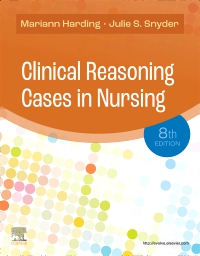

Clinical Reasoning Cases in Nursing - Elsevier eBook on VitalSource, 8th Edition
Elsevier eBook on VitalSource
Now $49.69
**Selected for Doody’s Core Titles® 2024 with "Essential Purchase" designation in Perioperative**
Learn to make sound clinical nursing judgments with the concept-based, case study approach in Harding & Snyder’s Clinical Reasoning Cases in Nursing, 8th Edition. Awarded second place in the 2019 AJN Book of the Year Awards in the Medical-Surgical category, this time-tested case study resource is highly regarded for its clinically relevant and thought-provoking cases. Approximately150 true-to-life case studies cover all four clinical practice areas — medical-surgical, pediatric, OB/maternity, and psychiatric-mental health nursing — all organized to facilitate a conceptual approach to teaching and learning. Each case covers a common patient problem drawn from actual clinical experiences and written by nurses who are clinical experts and includes a strong focus on interprofessional collaboration competencies. Cases include integrated content on pharmacology, nutrition, and diagnostic/laboratory tests to encourage you to think critically about all aspects of patient care. The 8th edition has been updated throughout to reflect the most current standards of clinical practice, including readiness for practice in the COVID-19 era. Also new to this edition, concepts and terminology related to the Next Generation NCLEX® Exam (NGN) are introduced in the Preface and integrated throughout to help you prepare for the new exam.
New Edition Expected Availability: 04-12-2027

Clinical Reasoning Cases in Nursing - Elsevier E-Book on VitalSource
-
- UNIQUE! Concepts and terminology related to the Next Generation NCLEX® Exam (NGN) are introduced in the Preface and integrated throughout to help you prepare for the new exam. All questions for the NGN are highlighted with a special icon for quick reference
- UPDATED! Content reflects the latest evidence-based clinical practice, including national and international treatment guidelines and the latest guidelines for COVID-19 and other infectious diseases
- NEW! Additional case studies and expanded content in key areas includes breastfeeding, obstetric emergency (umbilical cord prolapse or abruptio placentae) with emergency C-section, sickle cell pain crisis, and head/neck trauma with tracheostomy
- Expanded pharmacology content reflects the importance of a clear understanding of drug therapy on patient safety
- Additional illustrations and expanded use of image-related question types visually reinforce the material, while also promoting clinical utility and patient diversity in a sensitive and clinically relevant way
- Enhanced interprofessional collaboration content emphasizes the importance of identifying opportunities for collaboration with other health professions
-
- NEW! Nora AI - an AI-powered learning assistant exclusive to Elsevier ebooks on VitalSource's Bookshelf® platform - offers built-in AI learning support that provides personalized answers based on content from the Elsevier ebook
- Approximately 150 case studies draw from actual clinical experiences in medical-surgical, pediatric, OB/maternity, and psychiatric-mental health clinical areas to help you learn to think clinically, prioritize, and deliver proactive nursing care
- UNIQUE! Concept-based organization mirrors the growing popularity of concept-based curricula and conceptual approaches to teaching and learning in nursing education
- Clinical judgment approach helps you learn to identify changes, anticipate possible complications, and initiate therapeutic interventions
- Progressive case complexity builds on previous learning to help you gradually develop clinical judgment skills
- Strong QSEN safety emphasis is highlighted with an icon to communicate "caution" or "safety"
- Icons identify questions that resemble new NCLEX-RN® item types
- Strong emphasis on sepsis and antibiotic resistance addresses the growing problem of sepsis (a recent Joint Commission "core measure") and antibiotic resistance, where appropriate
-
-
 Clinical Reasoning Cases in NursingPaperback
-
-
1. Perfusion
2. Gas Exchange
3. Mobility
4. Digestion
5. Urinary Elimination
6. Intracranial Regulation
7. Metabolism and Glucose Regulation
8. Immunity
9. Cellular Regulation
10. Tissue Integrity
11. Cognition
12. Infection and Inflammation
13. Development
14. Reproduction
15. Mood, Stress, and Addiction -
-
Ways of Reading
- The appearance of the text and page layout can be modified according to the capabilities of the reading system (font family and font size, spaces between paragraphs, sentences, words, and letters, as well as color of background and text)
- This e-publication is accessible to the full extent that the file format and types of content allow, on a specific reading device, by default, without necessarily including any additions such as textual descriptions of images or enhanced navigation
- No information about nonvisual reading is available
-
Conformance
- For detailed accessibility information, see Elsevier's website at https://www.elsevier.com/about/accessibility
- For queries regarding accessibility information, contact [email protected]
- The publication was certified on 18-11-2025
-
Navigation
- Table of contents to all chapters of the text via links
-
Rich Content
- No information is available
-
Hazards
- No information is available
-
Product Content
- No information is available
-
Legal Considerations
- No information is available
-
Additional Accessibility Information
- For readers with color vision deficiency, use of color (e.g., in diagrams, graphics and charts, in prompts, or on buttons inviting a response) is not the sole means of graphical distinction or of conveying information
- E-publication includes basic navigation (usually less detailed than TOC-based navigation)
- Where links, controls or buttons are included in the content, the purpose or functionality of each link, control or button is apparent from the associated text alone - or where it is unclear, separate link, control or button descriptions are provided
- All (or substantially all) textual matter is arranged in a single logical reading order (including text that is visually presented as separate from the main text flow, e.g., in boxouts, captions, tables, footnotes, endnotes, citations, etc.). Non-textual content is also linked from within this logical reading order. (Purely decorative non-text content can be ignored).
- The language of the text has been specified (e.g., via the HTML or XML lang attribute) to optimise text-to-speech (and other alternative renderings), both at the whole document level and, where appropriate, for individual words, phrases or passages in a different language.
-
Ways of Reading

 as described in our