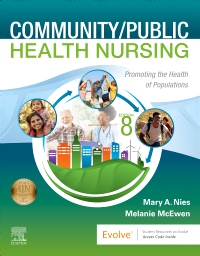

Community/Public Health Nursing - Elsevier eBook on VitalSource, 8th Edition
Elsevier eBook on VitalSource
Now $107.09
**American Journal of Nursing (AJN) Book of the Year Awards, 3rd Place in Community/Home Health Care, 2023**
Master the knowledge and skills you need to succeed in community health nursing! Community/Public Health Nursing, 8th Edition discusses the nurse’s role in population health promotion with a unique "upstream" preventive focus and a strong social justice approach, all in a concise, easy-to-read text. It shows how nurses can take an active role in social action and health policy — especially in caring for diverse and vulnerable population groups. This edition integrates the NCSBN Clinical Judgment Measurement Model to help you prepare for the Next Generation NCLEX®. Clinical examples and photo novellas show how nursing concepts apply to the real world.
-
- NEW! Online case studies for the Next Generation NCLEX® Examination (NGN) provide you with the necessary tools to prepare for the NGN
- NEW! Overview of the NCSBN Clinical Judgment Measurement Model provides information on the latest recommendations to promote evidence-based client decisions
- NEW! Healthy People 2030 boxes highlight the most current national health care goals and objectives throughout the text
-
- NEW! Nora AI - an AI-powered learning assistant exclusive to Elsevier ebooks on VitalSource's Bookshelf® platform - offers built-in AI learning support that provides personalized answers based on content from the Elsevier ebook
- Active Learning boxes test your knowledge of the content you’ve just read, helping provide clinical application and knowledge retention
- UNIQUE! Social justice approach promotes health for all people, emphasizing society’s responsibility to protect all human life and ensure that all people have their basic needs met, such as adequate health protection
- UNIQUE! Veterans’ Health chapter presents situations and considerations unique to the care of military veterans
- Genetics in Public Health boxes reflect increasing scientific evidence supporting the health benefits of using genetic tests and family health history to guide public health interventions
- UNIQUE! "Upstream" focus addresses contributing factors of poor health and promotes community efforts to address potential health problems before they occur
- Case studies present the theory, concepts, and application of the nursing process in practical and manageable examples
- UNIQUE! Photo novellas — stories in photograph form — show real-life clinical scenarios and highlight the application of important community/public health nursing roles
- Consistent pedagogy at the beginning of each chapter includes learning objectives, key terms and chapter outlines to help you locate important information and focus your study time
- Clinical Examples present snippets of real-life client situations
- Theoretical frameworks common to nursing and public health aid in the application of familiar and new theory bases to problems and challenges in the community
- Research Highlights introduce you to the growing amount of community/public health nursing research literature
- Ethical Insights boxes present situations of ethical dilemmas or considerations pertinent to select chapter topics
-
-
 Sherpath for Nies Community/Public Health NursingSherpath Book-Organized
 -
 Sherpath Vantage for Nies Community/Public Health NursingSherpath Vantage
 -
 Elsevier Adaptive Quizzing for Community and Public Health NursingElsevier Adaptive Quizzing - Next Generation
 -

-
 Community/Public Health NursingPaperback
-
-
Unit 1: Introduction to Community Health Nursing
1. Health: A Community View
2. Historical Factors: Public Health Nursing in Context
3. Thinking Upstream: Nursing Theories and Population-Focused Nursing Practice
4. Health Promotion and Risk Reduction
Unit 2: The Art and Science of Community Health Nursing
5. Epidemiology
6. Community Assessment
7. Community Health Planning, Implementation, and Evaluation
8. Community Health Education and Engagement
9. Case Management
Unit 3: Factors that Influence the Health of the Community
10. Policy, Politics, Legislation, and Community Health Nursing
11. The Healthcare System
12. Economics of Health Care
13. Cultural Diversity and Community Health Nursing
14. Environmental Health
15. Health in the Global Community
Unit 4: Aggregates in the Community
16. Child and Adolescent Health
17. Women’s Health
18. Men’s Health
19. Senior Health
20. Family Health
Unit 5: Vulnerable Populations
21. Populations Affected by Disabilities
22. Veterans’ Health
23. Homeless Populations
24. Rural and Migrant Health
25. Populations Affected by Mental Illness
Unit 6: Population Health Problems
26. Communicable Disease
27. Substance Abuse
28. Violence
29. Natural and Man-Made Disasters
Unit 7: Community Health Settings
30. School Health
31. Occupational Health
32. Forensic and Correctional Nursing
33. Faith Community Nursing
34. Home Health and Hospice -
-
Ways of Reading
- The appearance of the text and page layout can be modified according to the capabilities of the reading system (font family and font size, spaces between paragraphs, sentences, words, and letters, as well as color of background and text)
- This e-publication is accessible to the full extent that the file format and types of content allow, on a specific reading device, by default, without necessarily including any additions such as textual descriptions of images or enhanced navigation
- No information about nonvisual reading is available
-
Conformance
- For detailed accessibility information, see Elsevier's website at https://www.elsevier.com/about/accessibility
- For queries regarding accessibility information, contact [email protected]
- The publication was certified on 18-11-2025
-
Navigation
- Table of contents to all chapters of the text via links
-
Rich Content
- No information is available
-
Hazards
- No information is available
-
Product Content
- No information is available
-
Legal Considerations
- No information is available
-
Additional Accessibility Information
- For readers with color vision deficiency, use of color (e.g., in diagrams, graphics and charts, in prompts, or on buttons inviting a response) is not the sole means of graphical distinction or of conveying information
- E-publication includes basic navigation (usually less detailed than TOC-based navigation)
- Where links, controls or buttons are included in the content, the purpose or functionality of each link, control or button is apparent from the associated text alone - or where it is unclear, separate link, control or button descriptions are provided
- All (or substantially all) textual matter is arranged in a single logical reading order (including text that is visually presented as separate from the main text flow, e.g., in boxouts, captions, tables, footnotes, endnotes, citations, etc.). Non-textual content is also linked from within this logical reading order. (Purely decorative non-text content can be ignored).
- The language of the text has been specified (e.g., via the HTML or XML lang attribute) to optimise text-to-speech (and other alternative renderings), both at the whole document level and, where appropriate, for individual words, phrases or passages in a different language.
-
Ways of Reading

 as described in our