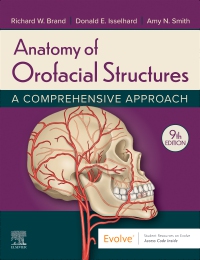

Anatomy of Orofacial Structures - Elsevier eBook on VitalSource, 9th Edition
Elsevier eBook on VitalSource
Now $98.79
**Selected for 2026 Doody's Core Titles in Dentistry**
Gain the knowledge of dental anatomy you need as a dental assistant or hygienist! Anatomy of Orofacial Structures: A Comprehensive Approach, 9th Edition provides an all-in-one resource for learning oral histology and embryology, dental anatomy, and head and neck anatomy. It offers all the benefits of a combined textbook and workbook, reinforcing your understanding with review questions in each chapter and tests in each unit. The book also includes flashcards for convenient, on-the-go study and reference. Supported with engaging activities on the Evolve website, this book provides a complete learning package!
-
- NEW! Thoroughly revised embryology and histology section features new illustrations
- NEW! Updated art program includes new illustrations and clinical images
-
- NEW! Nora AI - an AI-powered learning assistant exclusive to Elsevier ebooks on VitalSource's Bookshelf® platform - offers built-in AI learning support that provides personalized answers based on content from the Elsevier ebook
- UNIQUE! Comprehensive coverage includes orofacial development, landmarks, veins, arteries, nerves, bones, and muscles of the head and neck region
- UNIQUE! More than 600 anatomical illustrations include labeled line drawings, radiographs, and clinical photographs
- Textbook/Workbook format includes chapter review quizzes, unit tests, and a perforated workbook section
- Clinical Considerations boxes describe the real-world application of anatomical concepts
- Flashcards provide a convenient study tool for tooth morphology and major head and neck structures, featuring an image of a tooth on one side and that tooth’s identifying/important information on the other side
- Learning resources on the Evolve website include chapter quizzes and the Body Spectrum anatomy coloring book
-
-

-
 Anatomy of Orofacial StructuresPaperback
-
-
UNIT I: INTRODUCTION
1. Oral Cavity
Unit I Test
Unit I Suggested Readings
UNIT II: DENTAL ANATOMY
2. The Tooth: Functions and Terms
3. Fundamental and Preventative Curvatures
4. Dentition
5. Development, Form, and Eruption
6. Occlusion
7. Dental Anomalies
8. Supporting Structures
9. Clinical Considerations
10. Tooth Identification
11. Root Morphology
12. Incisors
13. Canines
14. Premolars
15. Molars
16. Deciduous Dentition
Unit II Test
Unit II Suggested Readings
UNIT III: ORAL HISTOLOGY AND EMBRYOLOGY
17. Basic Tissues
18. Development of Orofacial Complex
19. Dental Lamina and Enamel Organ
20. Enamel, Dentin, and Pulp
21. Root Formation and Attachment Apparatus
22. Eruption and Shedding of Teeth
23. Oral Mucous Membrane
24. The Tongue
25. Histology of the Salivary Glands
Unit III Test
Unit III Suggested Readings
UNIT IV: HEAD AND NECK ANATOMY
26. Osteology of the Skull
27. Nose, Nasal Cavity, and Paranasal Sinuses
28. Muscles of Mastication, Hyoid Muscles, and Sternocleidomastoid and Trapezius Muscles
29. Temporomandibular Joint
30. Muscles of Facial Expression
31. Soft Palate and Pharynx
32. Arterial Supply and Venous Drainage
33. Salivary Glands
34. Nervous System
35. Lymphatics and Spread of Dental Infection
36. Anatomical Considerations in Local Anesthesia
Unit IV Test
Unit IV Suggested Readings -
-
Ways of Reading
- The appearance of the text and page layout can be modified according to the capabilities of the reading system (font family and font size, spaces between paragraphs, sentences, words, and letters, as well as color of background and text)
- This e-publication is accessible to the full extent that the file format and types of content allow, on a specific reading device, by default, without necessarily including any additions such as textual descriptions of images or enhanced navigation
- All content can be read as read aloud speech or dynamic braille
- Has alternative text descriptions for images
-
Conformance
- The publication contains a conformance statement that it meets the EPUB Accessibility 1.1, WCAG 2.1, Level AA standard. Please see https://bornaccessible.benetech.org/certified-publishers/ for further details of our compatibility testing.
- The certifier's credential is https://bornaccessible.benetech.org/certified-publishers/
- For detailed accessibility information, see Elsevier's website at https://www.elsevier.com/about/accessibility
- For queries regarding accessibility information, contact [email protected]
- The publication was certified on 11-02-2026
-
Navigation
- Table of contents to all chapters of the text via links
- Index with links to referenced entries
- Elements such as headings, tables, etc. for structured navigation
- Page list to go to pages from the print source version
-
Rich Content
- Information-rich images are described by extended descriptions
-
Hazards
- The publication contains no hazards
-
Product Content
- Content includes any type of illustrations.
- The primary content is text.
- Content includes a significant number of actionable (clickable) web links to external content, downloadable resources, supplementary material, etc.
- Content includes a significant number of actionable (clickable) cross-references, hyperlinked notes and annotations, or with other actionable links between largely textual elements (e.g., quiz/test questions, 'choose your own ending', etc.).
- Content includes figures, diagrams, charts and/or graphs, including other 'mechanical' (i.e. non-photographic) illustrations.
- Content includes a significant number of web links (printed URLs, QR codes etc.).
- Content includes text within images, including text-as-text embedded in diagrams, charts, or within images containing speech balloons, thought bubbles, captions, etc.
- Content includes visual content that is purely decorative and is not necessary to understanding of the content.
-
Legal Considerations
- No information is available
-
Additional Accessibility Information
- Content is enhanced with ARIA roles to optimize organization and facilitate navigation
- Page breaks included from the original print source
- For readers with color vision deficiency, use of color (e.g., in diagrams, graphics and charts, in prompts, or on buttons inviting a response) is not the sole means of graphical distinction or of conveying information
- The body text is presented with a contrast ratio of at least 4.5:1 (or 3:1 for large/heading text)
- Ultra-high contrast between text and background
- E-publication includes basic navigation (usually less detailed than TOC-based navigation)
- Where links, controls or buttons are included in the content, the purpose or functionality of each link, control or button is apparent from the associated text alone - or where it is unclear, separate link, control or button descriptions are provided
- All (or substantially all) textual matter is arranged in a single logical reading order (including text that is visually presented as separate from the main text flow, e.g., in boxouts, captions, tables, footnotes, endnotes, citations, etc.). Non-textual content is also linked from within this logical reading order. (Purely decorative non-text content can be ignored).
- Content provides explanations for unusual words, abbreviations, acronyms, idioms, jargon in an accessible form, such as glossaries, scripted pop-ups.
- Where interactive content is included in the product, controls are provided (e.g., for speed, pause and resume, reset) and labelled to make their use clear.
- The language of the text has been specified (e.g., via the HTML or XML lang attribute) to optimise text-to-speech (and other alternative renderings), both at the whole document level and, where appropriate, for individual words, phrases or passages in a different language.
-
Ways of Reading

 as described in our