
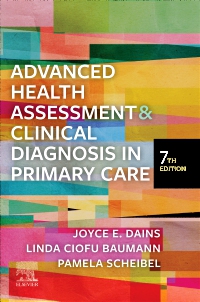

Advanced Health Assessment & Clinical Diagnosis in Primary Care - Elsevier E-Book on VitalSource, 7th Edition
Elsevier eBook on VitalSource
Now $80.95
**Selected for Doody’s Core Titles® 2024 in Diagnosis/Assessment**
Take the next step in health assessment by building your skills in diagnostic and clinical reasoning! Advanced Health Assessment and Clinical Diagnosis in Primary Care, 7th Edition goes beyond the basic physical examination to help you learn to accurately evaluate common conditions. Organized by patient symptoms or complaints, the book follows a systematic approach beginning with a chief concern rather than a specific diagnosis or disease entity, then guides you step-by-step through a diagnostic reasoning process to lead to a clinical diagnosis. This edition includes new chapters on veterans’ health and on contemporary approaches in primary care settings, as well as updated content on issues such as race, ethnicity, and gender identity. Written by a team of advanced practitioners led by Joyce E. Dains, this AJN award-winning text helps you learn to think like an expert clinician.
-
- Clear, consistent diagnostic reasoning process takes you to the next step of health assessment — beyond basic history and physical examination to diagnostic reasoning and clinical diagnosis
- Diagnostic Reasoning: Focused History sections use "self-questions" to walk you through the thinking process involved in obtaining a pertinent, relevant, problem-specific history that will assist in differential diagnosis
- Diagnostic Reasoning: Focused Physical Examination sections explain how to perform more advanced diagnostic techniques and interpret the findings
- Key Questions guide you through assessment and toward an accurate diagnosis by listing questions to ask the patient, followed by explanations of what the patient's responses might signify
- Laboratory and Diagnostic Studies sections outline the types of tests that might be appropriate based on the focused history and focused physical examination
- Differential Diagnosis sections offer the most common diagnoses for each patient problem and summarize the history and physical examination findings, along with recommended laboratory and diagnostic studies
- Differential Diagnosis tables provide a quick-reference summary of possible diagnoses for each patient problem
- UNIQUE! Care of Transgender and Gender-Diverse (TGD) Patients chapter equips you with the necessary knowledge to properly assess and care for this underserved patient population
- Content on pediatrics is integrated throughout to give a true lifespan focus
- Information on screening for abuse and sexual assault helps you identify patients who might need additional support or intervention
- Evidence-Based Clinical Practice Guidelines chapter helps you to screen for common asymptomatic conditions and promote wellness
- Information on screening for abuse and sexual assault helps identify patients who might need additional support or intervention
- List of Chapters by Body System inside the front cover provides an alternate means of accessing book content
- Compact, convenient size makes it easy to carry this reference in a lab-coat pocket, and colored thumb tabs make it easier to find the information you need
- Advanced Practice Nursing (APN) content on advanced assessment serves as a perfect complement to Ball et al.: Seidel’s Guide to Physical Examination and other health assessment textbooks
-
- NEW! Updated content throughout reflects the latest evidence-based approaches to clinical diagnosis and diagnostic reasoning
- NEW and UNIQUE! Contemporary Approaches in Primary Care Settings chapter applies public health principles to primary care in the era of COVID-19, and also includes coverage of telehealth/telemedicine, screenings, immunizations, epidemics and pandemics, health promotion, basic epidemiological terminology, and the cultural-spiritual-holistic context of primary care
- NEW! Updated content on race, ethnicity, sexual orientation, and gender identity includes special sensitivity to healthcare inequality related to social determinants of health
- NEW and UNIQUE! Veterans' Health chapter covers the health concerns of veterans, such as military sexual trauma (MST) and hazardous exposures
- NEW and UNIQUE! Scrotal Pain and Masses chapter addresses this common problem seen in primary care settings
- NEW! Updated Evidence-Based Practice boxes summarize the latest scientific literature related to the diagnosis of patient problems
-
PART I AN INTRODUCTION TO CLINICAL REASONING
1. Clinical Reasoning, Evidence-Based Practice, and Symptom Analysis
2. Evidence-Based Clinical Practice Guidelines
3. Contemporary Approaches in Primary Care Settings
PART II COMMON SYMPTOMS IN PRIMARY CARE
4. Abdominal Pain
5. Affective Changes
6. Amenorrhea
7. Breast Lumps and Nipple Discharge
8. Breast Pain
9. Chest Pain
10. Confusion in Older Adults
11. Constipation
12. Cough
13. Diarrhea
14. Dizziness
15. Dyspnea
16. Earache
17. Fatigue
18. Fever
19. Genitourinary Problems in Patients With a Penis or Prostate Gland
20. Headache
21. Heartburn and Indigestion
22. Hoarseness
23. Limb Pain: Lower Extremity
24. Limb Pain: Upper Extremity
25. Low Back Pain
26. Nasal Symptoms and Sinus Congestion
27. Palpitations
28. Penile Discharge
29. Rashes and Skin Lesions
30. Rectal Pain, Itching, and Bleeding
31. Red Eye
32. Scrotal Pain and Masses
33. Sleep Problems
34. Sore Throat
35. Syncope
36. Urinary Incontinence
37. Urinary Problems in Patients With a Vagina and Associated Anatomical Structures
38. Vaginal Bleeding
39. Vaginal Discharge and Itching
40. Vision Loss
41. Unintentional Weight Loss or Gain
PART III POPULATION-CENTERED CARE
42. Care of Transgender and Gender-Diverse Patients
43. Veterans’ Health
PART IV DIAGNOSTIC IMAGING
44. Abdominal X-Ray
45. Chest X-Ray -
-
Ways of Reading
- The appearance of the text and page layout can be modified according to the capabilities of the reading system (font family and font size, spaces between paragraphs, sentences, words, and letters, as well as color of background and text)
- This e-publication is accessible to the full extent that the file format and types of content allow, on a specific reading device, by default, without necessarily including any additions such as textual descriptions of images or enhanced navigation
- No information about nonvisual reading is available
-
Conformance
- For detailed accessibility information, see Elsevier's website at https://www.elsevier.com/about/accessibility
- For queries regarding accessibility information, contact [email protected]
- The publication was certified on 18-11-2025
-
Navigation
- Table of contents to all chapters of the text via links
-
Rich Content
- No information is available
-
Hazards
- No information is available
-
Product Content
- No information is available
-
Legal Considerations
- No information is available
-
Additional Accessibility Information
- For readers with color vision deficiency, use of color (e.g., in diagrams, graphics and charts, in prompts, or on buttons inviting a response) is not the sole means of graphical distinction or of conveying information
- E-publication includes basic navigation (usually less detailed than TOC-based navigation)
- Where links, controls or buttons are included in the content, the purpose or functionality of each link, control or button is apparent from the associated text alone - or where it is unclear, separate link, control or button descriptions are provided
- All (or substantially all) textual matter is arranged in a single logical reading order (including text that is visually presented as separate from the main text flow, e.g., in boxouts, captions, tables, footnotes, endnotes, citations, etc.). Non-textual content is also linked from within this logical reading order. (Purely decorative non-text content can be ignored).
- The language of the text has been specified (e.g., via the HTML or XML lang attribute) to optimise text-to-speech (and other alternative renderings), both at the whole document level and, where appropriate, for individual words, phrases or passages in a different language.
-
Ways of Reading


 as described in our