ISBN:
9780323832724
Copyright:
2023
Publication Date:
11-03-2022
Page Count:
1088
Imprint:
Elsevier
List Price:
$134.99

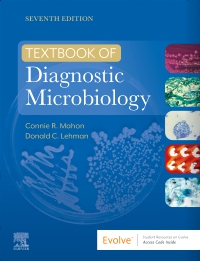
Textbook of Diagnostic Microbiology - Elsevier eBook on VitalSource, 7th Edition
by Connie R. Mahon, M.S.MT(ASCP) and Donald C. Lehman, EdD, MLS(ASCP)cm, SM(NRCM)
Elsevier eBook on VitalSource
ISBN:
9780323832724
Copyright:
2023
Publication Date:
11-03-2022
Page Count:
1088
Imprint:
Elsevier
List Price:
$134.99
Was
$134.99
Now $94.49
Or $0.00 with a valid access code
**Selected for 2026 Doody's Core Titles in Laboratory Technology**
Gain the knowledge and skills you need to succeed in the clinical lab! Textbook of Diagnostic Microbiology, 7th Edition uses a reader-friendly "building-block" approach to help you learn the essentials of diagnostic microbiology. Featuring full-color drawings and photos, this text helps you learn to develop the critical thinking and problem-solving skills necessary to the accurate diagnosis of infectious diseases and the identification of infectious agents. Written by noted educators Connie R. Mahon and Donald C. Lehman, this edition adds new content on SARS-CoV-2 and COVID-19, along with the latest information on prevention, treatment modalities, and CDC guidelines.
New Edition Expected Availability: 03-25-2027

Mahon and Lehman's Textbook of Diagnostic Microbiology - Elsevier E-Book on VitalSource
Elsevier eBook on VitalSource
ISBN: 9780443384066
-
- NEW! Information about SARS-CoV-2 and COVID-19 is added to this edition
- NEW! Updated content is included throughout the book, and several chapters are reorganized and refocused
- NEW! Enterobacteriaceae chapter is updated
-
- NEW! Nora AI - an AI-powered learning assistant exclusive to Elsevier ebooks on VitalSource's Bookshelf® platform - offers built-in AI learning support that provides personalized answers based on content from the Elsevier ebook
- Building-block approach encourages you to use previously learned information in mastering new material
- Full-color photographs and photomicrographs make it easier to understand and apply diagnostic microbiology concepts
- Case studies describe clinical and laboratory findings, offering opportunities to correlate observations with possible etiologic agents and to build critical thinking and problem-solving skills
- Hands-on procedures in the appendices describe techniques used in the lab setting
- Issues to Consider boxes list important points to think about while reading the chapter
- Case Checks in each chapter highlight specific points in the text and show how they connect to case studies
- Bolded key terms with abbreviations are listed at the beginning of each chapter, showing the most important and relevant terms in each chapter
- Learning Objectives at the beginning of each chapter supply you with a measurable learning outcome to achieve by completing the material
- Points to Remember sections at the end of each chapter provide a bulleted list of key concepts
- Learning Assessment Questions at the conclusion of each chapter help you to think critically and to evaluate how well you have mastered the material
- Agents of Bioterror and Forensic Microbiology chapter provides the most current information about these important topics
- Glossary at the end of the book supplies you with a quick reference for looking up definitions of key terms
-
Part 1: Introduction to clinical microbiology
1. Bacterial cell structure, physiology, metabolism, and genetics
2. Host-parasite interaction
3. The laboratory role in infection control
4. Control of microorganisms: disinfection, sterilization, and microbiology safety
5. Performance improvement in the microbiology laboratory
6. Specimen collection and processing
7. Microscopic examination of materials from infected sites
8. Use of colony morphology for the presumptive identification of microorganisms
9. Biochemical identification of gram-negative bacteria
10. Immunodiagnosis of infectious diseases
11. Applications of molecular diagnostics
12. Antibacterial mechanisms of action and bacterial resistance mechanisms
13. Antimicrobial susceptibility testing
Part 2: Laboratory identification of significant isolates
14. Staphylococcus and similar organisms
15. Streptococcus, Enterococcus, and other catalase-negative, gram-positive cocci
16. Aerobic gram-positive bacilli
17. Neisseria species and Moraxella catarrhalis
18. Haemophilus, HACEK group, Legionella, and other fastidious gram-negative bacilli
19. Enterobacterales
20. Vibrio, Aeromonas, Campylobacter, and Campylobacter-like species
21. Nonfermenting and miscellaneous gram-negative bacilli
22. Anaerobes of clinical importance
23. The spirochetes
24. Chlamydia, Rickettsia, and similar organisms
25. Mycoplasma and Ureaplasma
26. Mycobacterium tuberculosis and nontuberculous mycobacteria
27. Medically significant fungi
28. Diagnostic parasitology
29. Clinical virology
30. Agents of bioterror and forensic microbiology
31. Biofilms: architects of disease
Part 3: Laboratory diagnosis of infectious diseases: an organ system approach to diagnostic microbiology
32. Upper and lower respiratory tract infections
33. Skin and soft tissue infections
34. Gastrointestinal infections and food poisoning
35. Infections of the central nervous system
36. Bacteremia and sepsis
37. Urinary tract infections
38. Genital infections and sexually transmitted infections
39. Infections in special populations
40. Zoonotic diseases
41. Ocular infections
Appendix A Answers to learning assessmentquestions
Appendix B Selected bacteriologic culture media
Appendix C Selected mycology culture media and stains
Appendix D Selected procedures -
-
Ways of Reading
- The appearance of the text and page layout can be modified according to the capabilities of the reading system (font family and font size, spaces between paragraphs, sentences, words, and letters, as well as color of background and text)
- This e-publication is accessible to the full extent that the file format and types of content allow, on a specific reading device, by default, without necessarily including any additions such as textual descriptions of images or enhanced navigation
- All content can be read as read aloud speech or dynamic braille
- Has alternative text descriptions for images
-
Conformance
- The publication contains a conformance statement that it meets the EPUB Accessibility 1.1, WCAG 2.1, Level AA standard. Please see https://bornaccessible.benetech.org/certified-publishers/ for further details of our compatibility testing.
- The certifier's credential is https://bornaccessible.benetech.org/certified-publishers/
- For detailed accessibility information, see Elsevier's website at https://www.elsevier.com/about/accessibility
- For queries regarding accessibility information, contact [email protected]
- The publication was certified on 11-02-2026
-
Navigation
- Table of contents to all chapters of the text via links
- Index with links to referenced entries
- Elements such as headings, tables, etc. for structured navigation
- Page list to go to pages from the print source version
-
Rich Content
- Information-rich images are described by extended descriptions
-
Hazards
- The publication contains no hazards
-
Product Content
- Content includes any type of illustrations.
- The primary content is text.
- Content includes a significant number of actionable (clickable) web links to external content, downloadable resources, supplementary material, etc.
- Content includes a significant number of actionable (clickable) cross-references, hyperlinked notes and annotations, or with other actionable links between largely textual elements (e.g., quiz/test questions, 'choose your own ending', etc.).
- Content includes figures, diagrams, charts and/or graphs, including other 'mechanical' (i.e. non-photographic) illustrations.
- Content includes a significant number of web links (printed URLs, QR codes etc.).
- Content includes text within images, including text-as-text embedded in diagrams, charts, or within images containing speech balloons, thought bubbles, captions, etc.
- Content includes chemical notations, formulae.
- Content includes mathematical notations, formulae.
-
Legal Considerations
- No information is available
-
Additional Accessibility Information
- Content is enhanced with ARIA roles to optimize organization and facilitate navigation
- Page breaks included from the original print source
- For readers with color vision deficiency, use of color (e.g., in diagrams, graphics and charts, in prompts, or on buttons inviting a response) is not the sole means of graphical distinction or of conveying information
- The body text is presented with a contrast ratio of at least 4.5:1 (or 3:1 for large/heading text)
- Ultra-high contrast between text and background
- E-publication includes basic navigation (usually less detailed than TOC-based navigation)
- Where links, controls or buttons are included in the content, the purpose or functionality of each link, control or button is apparent from the associated text alone - or where it is unclear, separate link, control or button descriptions are provided
- All (or substantially all) textual matter is arranged in a single logical reading order (including text that is visually presented as separate from the main text flow, e.g., in boxouts, captions, tables, footnotes, endnotes, citations, etc.). Non-textual content is also linked from within this logical reading order. (Purely decorative non-text content can be ignored).
- Content provides explanations for unusual words, abbreviations, acronyms, idioms, jargon in an accessible form, such as glossaries, scripted pop-ups.
- Where interactive content is included in the product, controls are provided (e.g., for speed, pause and resume, reset) and labelled to make their use clear.
- The language of the text has been specified (e.g., via the HTML or XML lang attribute) to optimise text-to-speech (and other alternative renderings), both at the whole document level and, where appropriate, for individual words, phrases or passages in a different language.
-
Ways of Reading


Was
$134.99
Now $94.49
Or $0.00 with a valid access code

 as described in our