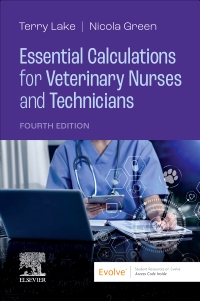

Essential Calculations for Veterinary Nurses and Technicians – Elsevier eBook on VitalSource, 4th Edition
Elsevier eBook on VitalSource
Now $48.99
**Selected for 2026 Doody's Core Titles in Veterinary Nursing & Technology**
Learn to easily master the types of veterinary nursing calculations you will face on the job with Essential Calculations for Veterinary Nurses and Technicians, 4th Edition. From basic arithmetic to dilutions and statistics, this useful text covers all aspects of calculations as applied to veterinary nursing. Readers will benefit from the text’s common-sense approach to clinical situations and complete the book knowing how to use calculations to determine dosage rates, anesthetic flow rates, radiography exposure rates, parenteral nutrition, and more. User-friendly features include simple language, detailed explanations, ample examples, and special author guidance so that content is easy to follow and understand. Plus, the text’s abundance of learning features — such as self-assessment questions, clinical hints, and tips — help clarify important concepts and ensure that you have mastered everything you need to make calculations in the day-to-day clinical environment.
-
- NEW! Reviewed and updated drugs throughout the book provide dosage calculations that coincide with drugs currently used in the field for the most clinical relevance
- NEW! Additional math problems both in the text and on the Evolve companion website offer substantial additional practice. Self-test sections with clinical hints and tips ensure retention of core concepts
-
- NEW! Nora AI - an AI-powered learning assistant exclusive to Elsevier ebooks on VitalSource's Bookshelf® platform - offers built-in AI learning support that provides personalized answers based on content from the Elsevier ebook
- Mathematical explanations using veterinary terms present all principles in a manner that directly pertains to the veterinary field
- Comprehensive content covers everything from basic arithmetic to dilutions and statistics, so users have everything needed to succeed in calculations for veterinary nursing and technology
- Dimensional analysis bridge method removes the necessity of memorizing formulae and takes advantage of simplifying equations so that calculators are often unnecessary
-
1. Calculations Involving Fractions
2. Decimals and Percentages
3. Scientific Notation
4. Ratio and Proportion
5. Dimensional Analysis
6. Clinical Applications of Basic Principles
7. Measurement Systems
8. Oral Medication
9. Parenteral Medication
10. Clinical Problems Using Dosage Calculations
11. Solutions
12. Clinical Problems Using Solutions
13. Intravenous Fluids
14. Constant Rate Infusions
15. Dilutions
16. Clinical Problems Using Dilutions
17. Anaesthesia, Radiology and Nutrition Applications
18. Statistics and Quality Control -
-
Ways of Reading
- The appearance of the text and page layout can be modified according to the capabilities of the reading system (font family and font size, spaces between paragraphs, sentences, words, and letters, as well as color of background and text)
- This e-publication is accessible to the full extent that the file format and types of content allow, on a specific reading device, by default, without necessarily including any additions such as textual descriptions of images or enhanced navigation
- No information about nonvisual reading is available
-
Conformance
- For detailed accessibility information, see Elsevier's website at https://www.elsevier.com/about/accessibility
- For queries regarding accessibility information, contact [email protected]
- The publication was certified on 03-11-2025
-
Navigation
- Table of contents to all chapters of the text via links
-
Rich Content
- No information is available
-
Hazards
- No information is available
-
Product Content
- No information is available
-
Legal Considerations
- No information is available
-
Additional Accessibility Information
- For readers with color vision deficiency, use of color (e.g., in diagrams, graphics and charts, in prompts, or on buttons inviting a response) is not the sole means of graphical distinction or of conveying information
- E-publication includes basic navigation (usually less detailed than TOC-based navigation)
- Where links, controls or buttons are included in the content, the purpose or functionality of each link, control or button is apparent from the associated text alone - or where it is unclear, separate link, control or button descriptions are provided
- All (or substantially all) textual matter is arranged in a single logical reading order (including text that is visually presented as separate from the main text flow, e.g., in boxouts, captions, tables, footnotes, endnotes, citations, etc.). Non-textual content is also linked from within this logical reading order. (Purely decorative non-text content can be ignored).
- The language of the text has been specified (e.g., via the HTML or XML lang attribute) to optimise text-to-speech (and other alternative renderings), both at the whole document level and, where appropriate, for individual words, phrases or passages in a different language.
-
Ways of Reading



 as described in our