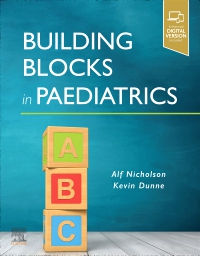

Building Blocks in Paediatrics - Elsevier eBook on VitalSource, 1st Edition
Elsevier eBook on VitalSource
Now $44.09
This book from experienced paediatricians Professor Alf Nicholson and Professor Kevin Dunne covers the essential elements needed throughout the career of those who treat children and adolescents.
Based on the current paediatric training curriculum, this book includes the core basics (section 1), the various symptom-based presentations (section 2) all with input from renowned sub-specialists in Paediatrics, the common presentations relating to age that are seen in primary care (section 3) and the skills you need to have to be a successful trainee or consultant in Paediatrics (section 4). All of the chapters have high quality clinical and radiology images as appropriate and have additional typical case scenarios to highlight the learning points.
This book is unique in that it caters for undergraduate students through to postgraduate trainees in paediatrics or general practice, and the working GP or consultant.
-
- Clinical vignettes to highlight key learning points
- Over 90 case scenarios sprinkled throughout the book with clinical pearls, interpretation of investigations and pitfalls to avoid for each scenario
- List of key points to be obtained from a consultation to support doctors in the clinic
- All key procedures in neonatology and paediatrics are covered
- Problem-solving practice to test knowledge
- Section 4 hosts unique chapters not least safe practice, dealing with uncertainty, the avoidance of errors, ethical dilemmas, ECG and laboratory interpretation of results, neonatal and paediatric procedures and critical journal reading
- High-quality clinical pictures, cardiac pictures, ECGs and radiology images to support learning
- Content suitable for students, GPs and specialists
- Includes 20 podcasts
-
-
 Building Blocks in PaediatricsPaperback
-
-
SECTION 1 The Core Essentials
1. The Big Picture in Child Health
2. Taking a History
3. The Paediatric Examination
4. The Newborn and the Six-Week Examination
5. Feeding Issues and Faltering Growth
6. Growth and Puberty
7. Understanding Childhood and Adolescent Obesity
SECTION 2 A Symptom-Based Approach
8. Common Problems in Newborns
9. Evaluating the Dysmorphic Child
10. Anaemia – The Pale Child
11. Congenital Heart Disease
12. The Child With a Cough
13. The Child With Diarrhoea
14. Diabetes Mellitus in Childhood and Adolescence
15. The Child With a Fever
16. Food Allergies in Children
17. The Child With Frequent Infections
18. The Child With Headaches
19. Inborn Errors of Metabolism
20. Joint Pains in Childhood
21. Problems Relating to the Kidneys
22. Neurodisability
23. The Child With a Rash
24. Safeguarding Infants and Children
25. The Child With a Seizure
26. Severe Illness in Infancy and Childhood
27. Surgical Problems in Infancy and Childhood
SECTION 3 Paediatrics in Everyday Practice
28. Common Presentations in Infancy
29. Frequent Flyers in the Toddler Years
30. Issues in School-Going Children
31. Adolescent Health
SECTION 4 The Skills Required to Be a Successful Paediatrician
32. Clinical Reasoning and the Clinical Consultation
33. Learning From Clinical Events
34. Illness Without Disease
35. Professionalism, Advocacy and Ethics in Child Health
36. Interpretation of Laboratory Results
37. ECG Interpretation
38. Critical Appraisal of the Literature
39. Practical Procedures in Neonatology and Paediatrics -
-
Ways of Reading
- The appearance of the text and page layout can be modified according to the capabilities of the reading system (font family and font size, spaces between paragraphs, sentences, words, and letters, as well as color of background and text)
- This e-publication is accessible to the full extent that the file format and types of content allow, on a specific reading device, by default, without necessarily including any additions such as textual descriptions of images or enhanced navigation
- No information about nonvisual reading is available
-
Conformance
- No information is available
-
Navigation
- Table of contents to all chapters of the text via links
- Page list to go to pages from the print source version
-
Rich Content
- No information is available
-
Hazards
- No information is available
-
Product Content
- No information is available
-
Legal Considerations
- No information is available
-
Additional Accessibility Information
- Page breaks included from the original print source
- For readers with color vision deficiency, use of color (e.g., in diagrams, graphics and charts, in prompts, or on buttons inviting a response) is not the sole means of graphical distinction or of conveying information
- E-publication includes basic navigation (usually less detailed than TOC-based navigation)
- Where links, controls or buttons are included in the content, the purpose or functionality of each link, control or button is apparent from the associated text alone - or where it is unclear, separate link, control or button descriptions are provided
- All (or substantially all) textual matter is arranged in a single logical reading order (including text that is visually presented as separate from the main text flow, e.g., in boxouts, captions, tables, footnotes, endnotes, citations, etc.). Non-textual content is also linked from within this logical reading order. (Purely decorative non-text content can be ignored).
- The language of the text has been specified (e.g., via the HTML or XML lang attribute) to optimise text-to-speech (and other alternative renderings), both at the whole document level and, where appropriate, for individual words, phrases or passages in a different language.
-
Ways of Reading

 as described in our