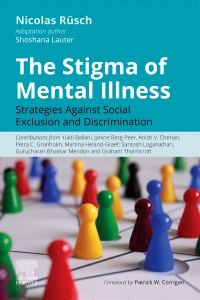

The Stigma of Mental Illness - Elsevier E-Book on VitalSource, 1st Edition
Elsevier eBook on VitalSource
Now $32.39
People with mental illness are often painfully familiar with overt prejudice or more subtle forms of mistreatment. The stigma and discrimination associated with their disorders can have effects in several areas of life: in social interactions, in work and healthcare settings, in the legal system and the media. Many withdraw due to shame and do not seek help. In turn, stigma can prove to be a more serious problem than the disorder itself. Yet too little is done to reduce stigma and its impact.
The Stigma of Mental Illness: Strategies Against Discrimination and Social Exclusion offers up the knowledge necessary to understand and fight against stigma and discrimination. It will be invaluable to all health professionals, social workers, healthcare managers and policy makers with an involvement or interest in mental illness.
-
- Broad coverage of the forms and consequences of stigma
- Specific treatment of stigma in relation to diagnoses such as dementia and autism
- Perspectives and strategies of a service user and a relative
- Up-to-date concepts regarding exclusion and discrimination
- Practical strategies for service users, relatives, healthcare professionals and policy makers
-
-
 The Stigma of Mental IllnessHardcover
-
-
1. Introduction
2. Historical and Social Contexts
3. What Is Stigma?
4. Consequences of Stigma
5. People With Various Mental Disorders and Their Relatives
6. Personal Perspectives
7. Stigma in Different Sectors of Society
8. Reduction of Public Stigma
9. Strategies Against Self-Stigma
10. Reduction of Stigma as a Barrier to Help-Seeking
11. Reducing Structural Discrimination
12. Nationwide Antistigma Campaigns
13. Stigma and Discrimination Related to Mental Illness in Low- and Middle-Income Countries
14. Looking Back and Ahead -
-
Ways of Reading
- The appearance of the text and page layout can be modified according to the capabilities of the reading system (font family and font size, spaces between paragraphs, sentences, words, and letters, as well as color of background and text)
- This e-publication is accessible to the full extent that the file format and types of content allow, on a specific reading device, by default, without necessarily including any additions such as textual descriptions of images or enhanced navigation
- No information about nonvisual reading is available
-
Conformance
- No information is available
-
Navigation
- Table of contents to all chapters of the text via links
- Page list to go to pages from the print source version
-
Rich Content
- No information is available
-
Hazards
- No information is available
-
Product Content
- No information is available
-
Legal Considerations
- No information is available
-
Additional Accessibility Information
- Page breaks included from the original print source
- For readers with color vision deficiency, use of color (e.g., in diagrams, graphics and charts, in prompts, or on buttons inviting a response) is not the sole means of graphical distinction or of conveying information
- E-publication includes basic navigation (usually less detailed than TOC-based navigation)
- Where links, controls or buttons are included in the content, the purpose or functionality of each link, control or button is apparent from the associated text alone - or where it is unclear, separate link, control or button descriptions are provided
- All (or substantially all) textual matter is arranged in a single logical reading order (including text that is visually presented as separate from the main text flow, e.g., in boxouts, captions, tables, footnotes, endnotes, citations, etc.). Non-textual content is also linked from within this logical reading order. (Purely decorative non-text content can be ignored).
- The language of the text has been specified (e.g., via the HTML or XML lang attribute) to optimise text-to-speech (and other alternative renderings), both at the whole document level and, where appropriate, for individual words, phrases or passages in a different language.
-
Ways of Reading

 as described in our