
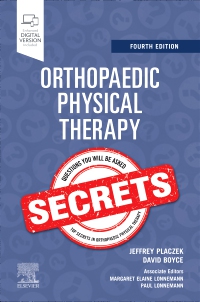

Orthopaedic Physical Therapy Secrets - Elsevier eBook on VitalSource, 4th Edition
Elsevier eBook on VitalSource
Now $48.39
Unlock the secrets to passing the Orthopaedic Certified Specialist (OCS) exam with this comprehensive Q&A review! Offering a unique question-and-answer format, Orthopaedic Physical Therapy Secrets, 4th Edition helps you build the knowledge and skills needed to pass orthopaedic and sports certification specialty exams. The book introduces basic physical therapy concepts and then covers different healing modalities, clinical specialties, and orthopedic procedures typically prescribed for common injuries such as those to the shoulder, hand, wrist, spine, and knee. From a team of PT experts led by Jeffrey D. Placzek and David A. Boyce, this review also serves as a useful reference for practitioners who wish to provide the latest in evidence-based care.
-
- Coverage of topics found on the orthopedic specialty exam makes this a valuable resource for study and review
- Wide scope of orthopedic coverage includes specialties ranging from anterior knee pain to X-ray imaging, featuring topics such as therapeutic dry needling plus functional movement screening and assessment
- Annotated references provide a useful tool for further reading and research
- Review questions are consistent with the level of difficulty encountered on the orthopedic or sports specialty examinations
- Evidence-based content is based on the latest orthopedic research
- Clinical tips provide guidance for a variety of physical therapy tasks and situations
- Charts, tables, and algorithms summarize information in logical, quick-reference frameworks
-
- NEW! Updated content reflects contemporary practice standards and provides the current information you need to pass the Orthopaedic Certified Specialist (OCS) examination
- NEW! eBook version is included with print purchase. The eBook allows you to access all of the text, figures and references, with the ability to search, customize your content, make notes and highlights, and have content read aloud
- NEW! Updated references ensure that information is based on the latest scientific literature
-
I Basic science
1. Skeletal muscle
2. Biomechanics
3. Soft tissue injury and repair
4. Bone injury and repair
5. Exercise physiology
II Disease processes
6. Arthritis
7. Deep venous thrombosis
III Electrotherapy and modalities
8. Electrotherapy
9. Iontophoresis, ultrasound, phonophoresis, and photobiomodulation therapy
IV Special topics
10. Stretching
11. Manual therapy
12. Massage and myofascial mobilization
13. Spinal traction
14. Normal and pathologic gait
15. Pharmacology in orthopaedic physical therapy
16. Evaluation of medical laboratory tests
17. Electrodiagnostic tests: nerve conduction studies and needle electromyography
18. Orthopaedic neurology
19. Clinical research and data analysis
20. Concussion management
21. Differential diagnosis and clinical reasoning
22. Special tests for medical screening
23. Pediatric orthopaedic physical therapy
24. Pelvic health physical therapy
25. Interventional pain management
26. Cervicogenic headache
27. The neuroscience of pain and treatment
28. Anatomy mnemonics
29. Nutrition
30. Dry needling
31. Exercise in aging and disease
32. Orthopaedic radiology
33. Blood flow restriction training
34. Running
35. Diagnostic ultrasound
V The shoulder
36. Functional anatomy of the shoulder
37. Shoulder impingement and rotator cuff tears
38. Shoulder instability
39. Adhesive capsulitis
40. Total shoulder arthroplasty
41. Acromioclavicular and sternoclavicular injuries: evaluation and treatment
42. Scapulothoracic dysfunction and impairments
43. Fractures of the clavicle, proximal humerus, and humeral shaft
44. Nerve entrapments of the shoulder region
VI The elbow and forearm
45. Functional anatomy of the elbow
46. Common orthopedic elbow dysfunction
47. Elbow fractures and dislocation: patterns, classifications, and management
48. Nerve entrapments of the elbow and forearm
VII The wrist and hand
49. Functional anatomy of the wrist and hand
50. Common orthopedic dysfunction of the wrist and hand
51. Fractures and dislocations of the wrist and hand
52. Nerve entrapments of the wrist and hand
VIII The spine
53. Functional anatomy of the spine
54. Cervical spine
55. Temporomandibular joint
56. Thoracic spine and rib cage dysfunction
57. Scoliosis
58. Classifications of low back pain
59. Mechanical and discogenic back pain
60. Lumbar spinal stenosis
61. Spondylolysis and spondylolisthesis
62. Spine fractures and dislocations: patterns, classifications, and management
IX The sacroiliac joint
63. Functional anatomy of the sacroiliac joint
64. Sacroiliac dysfunction
X The hip and pelvis
65. Functional anatomy of the hip and pelvis
66. Common orthopedic hip dysfunction
67. Fractures and dislocations of the hip and pelvis
68. Total hip arthroplasty
XI The knee
69. Functional anatomy of the knee
70. Patellofemoral disorders
71. Meniscal injuries
72. Ligamentous injuries of the knee
73. Total knee arthroplasty
74. Knee fractures and dislocations
75. Nerve entrapments of the lower extremity
XII The foot and ankle
76. Functional anatomy of the foot and ankle
77. Common orthopaedic foot and ankle dysfunctions
78. Fractures and dislocations of the foot and ankle
79. Foot biomechanics, orthoses, and shoe design -
-
Ways of Reading
- The appearance of the text and page layout can be modified according to the capabilities of the reading system (font family and font size, spaces between paragraphs, sentences, words, and letters, as well as color of background and text)
- This e-publication is accessible to the full extent that the file format and types of content allow, on a specific reading device, by default, without necessarily including any additions such as textual descriptions of images or enhanced navigation
- All content can be read as read aloud speech or dynamic braille
- Has alternative text descriptions for images
-
Conformance
- The publication contains a conformance statement that it meets the EPUB Accessibility 1.1, WCAG 2.1, Level AA standard. Please see https://bornaccessible.benetech.org/certified-publishers/ for further details of our compatibility testing.
- The certifier's credential is https://bornaccessible.benetech.org/certified-publishers/
- For detailed accessibility information, see Elsevier's website at https://www.elsevier.com/about/accessibility
- For queries regarding accessibility information, contact [email protected]
- The publication was certified on 19-03-2026
-
Navigation
- Table of contents to all chapters of the text via links
- Index with links to referenced entries
- Page list to go to pages from the print source version
-
Rich Content
- Math formulas in accessible format (MathML)
- Information-rich images are described by extended descriptions
-
Hazards
- The publication contains no hazards
-
Product Content
- The primary content is text.
- Content includes a significant number of actionable (clickable) web links to external content, downloadable resources, supplementary material, etc.
- Content includes a significant number of actionable (clickable) cross-references, hyperlinked notes and annotations, or with other actionable links between largely textual elements (e.g., quiz/test questions, 'choose your own ending', etc.).
- Content includes additional textual content such as an interview, feature article, essay, bibliography, quiz/test, other background material, or text that is not included in a primary or 'unenhanced' version.
- Content includes photographs, whether in a plate section / insert or not.
- Content includes figures, diagrams, charts and/or graphs, including other 'mechanical' (i.e. non-photographic) illustrations.
- Content includes animated / interactive illustrations, e.g., animated diagrams, charts, graphs or other illustrations (usually without sound).
- Content includes narrative animation, e.g., cartoon, animatic or CGI animation (usually includes sound).
- Content includes images displayed in a specific order for the purpose of graphic storytelling or giving information (e.g. graphic novels, comics and manga). May include text integrated into the image (as speech and thought bubbles, textual 'sound' effects, captions etc.).
- At least some text - including text within other images - is 'text as an image' (i.e., a picture of text).
- Product includes actionable (clickable) links to external interactive content.
-
Legal Considerations
- No information is available
-
Additional Accessibility Information
- Content is enhanced with ARIA roles to optimize organization and facilitate navigation
- Page breaks included from the original print source
- For readers with color vision deficiency, use of color (e.g., in diagrams, graphics and charts, in prompts, or on buttons inviting a response) is not the sole means of graphical distinction or of conveying information
- The body text is presented with a contrast ratio of at least 4.5:1 (or 3:1 for large/heading text)
- Ultra-high contrast between text and background
- E-publication includes basic navigation (usually less detailed than TOC-based navigation)
- Where links, controls or buttons are included in the content, the purpose or functionality of each link, control or button is apparent from the associated text alone - or where it is unclear, separate link, control or button descriptions are provided
- All (or substantially all) textual matter is arranged in a single logical reading order (including text that is visually presented as separate from the main text flow, e.g., in boxouts, captions, tables, footnotes, endnotes, citations, etc.). Non-textual content is also linked from within this logical reading order. (Purely decorative non-text content can be ignored).
- Where interactive content is included in the product, controls are provided (e.g., for speed, pause and resume, reset) and labelled to make their use clear.
- The language of the text has been specified (e.g., via the HTML or XML lang attribute) to optimise text-to-speech (and other alternative renderings), both at the whole document level and, where appropriate, for individual words, phrases or passages in a different language.
-
Ways of Reading

 as described in our