
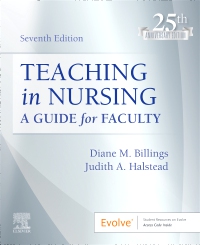

Teaching in Nursing - Elsevier eBook on VitalSource, 7th Edition
Elsevier eBook on VitalSource
Now $84.47
**American Journal of Nursing (AJN) Book of the Year Awards, 1st Place in Nursing Education/Professional Development, 2024**
**Selected for Doody’s Core Titles® 2024 in Education**
Now in its 25th-anniversary edition, Billings and Halstead’s Teaching in Nursing: A Guide for Faculty, 7th Edition prepares you for the day-to-day challenges of teaching future nurses for practice in today's rapidly evolving healthcare system. This comprehensive resource covers all four components of nursing education: teaching and learning, curriculum, evaluation, and technology-empowered learning. You’ll benefit from the expert guidance on such key issues as curriculum and test development, diverse learning styles, the redesign of healthcare systems, advances in technology and information, global health and curricular experiences, the flipped classroom, interprofessional education, and interprofessional collaborative practice. New to the 7th edition is a full-color design for improved learning and reference; increased use of illustrations, tables, and boxes to promote learning through enhanced usability; updated content throughout to reflect the latest trends in nursing education, including up-to-date content on the Next-Generation NCLEX® Exam; expanded use of high-quality case studies throughout the book; chapter-ending key points; new practice questions for nurse educator certification on a companion Evolve website; and much more!

-
-
 Evolve Resources for Teaching in NursingResources
-
-
- UNIQUE! Chapter on Global Health and Curricular Experiences focuses on internationalization of the nursing curriculum, with an emphasis on leading international learning experiences; policies, procedures, and guidelines for overseas study; and global and health competencies for health professions programs
- Coverage of concept-based curricula includes strategies on how to approach and implement concept-based instruction
- Pedagogical aids include Reflecting on the Evidence boxes, covering such issues as how to do evidence-based teaching; applications of evidence-based teaching; implications for faculty development, administration, and the institution; and how to use the open-ended application questions at the end of each chapter for faculty-guided discussion
- Strategies to promote clinical judgment and active learning are incorporated throughout the text, highlighting various evaluation techniques, lesson planning insights, and tips for developing examinations
- Guidance on teaching in diverse settings addresses such topics as the models of clinical teaching, teaching in interdisciplinary settings, how to evaluate students in the clinical setting, and how to adapt teaching for community-based practice
- Strong emphasis on teaching clinical judgment, new models of clinical education, and responding to needs for creating inclusive multicultural teaching-learning environments
-
- NEW! Updated content throughout reflects the latest evidence-based guidelines for best practices in teaching and learning.
- NEW! Expanded use of high-quality case studies (two per chapter on average) serves to model sound judgment for beginning nurse educators.
- UNIQUE! Full-color design and expanded use of illustrations, tables, and boxes improves accessibility and promotes learning through improved visual appeal.
- NEW! Updated content reflects changes in nursing education related to the global COVID-19 pandemic, including the shift to online learning, increased reliance on virtual experiences in lieu of face-to-face clinical experiences, and more.
- NEW! Updated content includes guidance on preparing students for the Next-Generation NCLEX® Examination, which represents the most significant revision in the licensure exam since the rollout of alternate-format questions.
- NEW! Chapter-ending key points serve as a helpful review and nurse education certification study aid.
- NEW and UNIQUE! Practice questions for nurse educator certification on the Evolve companion website expand the book’s utility as a nurse educator certification review resource.
-
Unit I: Faculty and Students
1. Teaching in Nursing: The Faculty Role
2. Strategies to Support Diverse Learning Needs of Students
3. The Academic Performance of Students: Legal and Ethical Issues
4. Teaching Students With Disabilities
Unit II: Curriculum as a Process
5. Forces and Issues Influencing Curriculum Development
6. An Introduction to Curriculum Development
7. Philosophical Foundations of the Curriculum
8. Curriculum Models for Undergraduate Programs
9. Curriculum Models for Graduate Programs
10. Designing Courses and Learning Experiences
11. Interprofessional Education and Collaborative Practice
12. Fostering Social Responsibility Through Service-Learning
13. Global Health and Curricular Experiences
Unit III: Teaching and Learning
14. Theoretical Approaches to Teaching and Learning in Nursing
15. Managing Student Incivility and Misconduct in the Learning Environment
16. Evidence-Based Teaching Strategies to Promote Learning
17. Multicultural Education in Nursing
18. Teaching in the Clinical Learning Environment
Unit IV: Technology-Empowered Learning
19. Teaching and Learning Using Simulations
20. Using Technology to Facilitate Learning in the Classroom
21. Teaching and Learning at a Distance
Unit V: Evaluation
22. Introduction to the Evaluation Process
23. Strategies for Evaluating Learning Outcomes
24. Using Classroom Tests to Evaluate Student Attainment of Learning Outcomes
25. Clinical Performance Evaluation
26. Systematic Program Evaluation
27. The Accreditation Process -
-
Ways of Reading
- The appearance of the text and page layout can be modified according to the capabilities of the reading system (font family and font size, spaces between paragraphs, sentences, words, and letters, as well as color of background and text)
- This e-publication is accessible to the full extent that the file format and types of content allow, on a specific reading device, by default, without necessarily including any additions such as textual descriptions of images or enhanced navigation
- All content can be read as read aloud speech or dynamic braille
- Has alternative text descriptions for images
-
Conformance
- The publication contains a conformance statement that it meets the EPUB Accessibility 1.1, WCAG 2.1, Level AA standard. Please see https://bornaccessible.benetech.org/certified-publishers/ for further details of our compatibility testing.
- The certifier's credential is https://bornaccessible.benetech.org/certified-publishers/
- For detailed accessibility information, see Elsevier's website at https://www.elsevier.com/about/accessibility
- For queries regarding accessibility information, contact [email protected]
- The publication was certified on 09-02-2026
-
Navigation
- Table of contents to all chapters of the text via links
- Index with links to referenced entries
- Elements such as headings, tables, etc. for structured navigation
- Page list to go to pages from the print source version
-
Rich Content
- Information-rich images are described by extended descriptions
-
Hazards
- The publication contains no hazards
-
Product Content
- Content includes any type of illustrations.
- The primary content is text.
- Content includes a significant number of actionable (clickable) web links to external content, downloadable resources, supplementary material, etc.
- Content includes a significant number of actionable (clickable) cross-references, hyperlinked notes and annotations, or with other actionable links between largely textual elements (e.g., quiz/test questions, 'choose your own ending', etc.).
- Content includes figures, diagrams, charts and/or graphs, including other 'mechanical' (i.e. non-photographic) illustrations.
- Content includes a significant number of web links (printed URLs, QR codes etc.).
- Content includes text within images, including text-as-text embedded in diagrams, charts, or within images containing speech balloons, thought bubbles, captions, etc.
-
Legal Considerations
- No information is available
-
Additional Accessibility Information
- Content is enhanced with ARIA roles to optimize organization and facilitate navigation
- Page breaks included from the original print source
- For readers with color vision deficiency, use of color (e.g., in diagrams, graphics and charts, in prompts, or on buttons inviting a response) is not the sole means of graphical distinction or of conveying information
- The body text is presented with a contrast ratio of at least 4.5:1 (or 3:1 for large/heading text)
- Ultra-high contrast between text and background
- E-publication includes basic navigation (usually less detailed than TOC-based navigation)
- Where links, controls or buttons are included in the content, the purpose or functionality of each link, control or button is apparent from the associated text alone - or where it is unclear, separate link, control or button descriptions are provided
- All (or substantially all) textual matter is arranged in a single logical reading order (including text that is visually presented as separate from the main text flow, e.g., in boxouts, captions, tables, footnotes, endnotes, citations, etc.). Non-textual content is also linked from within this logical reading order. (Purely decorative non-text content can be ignored).
- Where interactive content is included in the product, controls are provided (e.g., for speed, pause and resume, reset) and labelled to make their use clear.
- The language of the text has been specified (e.g., via the HTML or XML lang attribute) to optimise text-to-speech (and other alternative renderings), both at the whole document level and, where appropriate, for individual words, phrases or passages in a different language.
-
Ways of Reading

 as described in our