ISBN:
9780323846868
Copyright:
2024
Publication Date:
06-06-2023
Page Count:
648
Imprint:
Elsevier
List Price:
$66.99

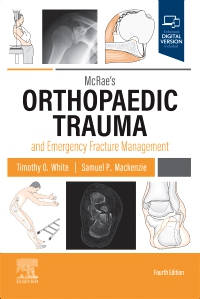
McRae's Orthopaedic Trauma and Emergency Fracture Management - Elsevier E-Book on VitalSource, 4th Edition
by Timothy O. White, BMedSci, MBChB, FRCSEd (Tr & Orth), MD and Samuel P. Mackenzie, BMed Sci, MBChB, MRCSEd
Elsevier eBook on VitalSource
ISBN:
9780323846868
Copyright:
2024
Publication Date:
06-06-2023
Page Count:
648
Imprint:
Elsevier
List Price:
$66.99
Was
$66.99
Now $60.29
Or $0.00 with a valid access code
McRae’s Orthopaedic Trauma and Emergency Fracture Management is the essential, best-selling ‘survival guide’ for the orthopaedic surgeon, trainee, resident or practitioner treating injured patients in the Emergency or Orthopaedic Department.
This fourth edition has been extensively updated and rewritten, retaining the essence and underlying principles of McRae’s original book, but with new text and illustrations to ensure it remains at the cutting edge.
This highly regarded book is a companion to McRae’s Elective Orthopaedics, and together these titles provide complete coverage of orthopaedic surgery as relevant to contemporary practice.
-
- Comprehensive coverage of the full range of orthopaedic trauma presentations in the Emergency Department, operating theatre, and outpatient clinic
- Clear step-by-step illustrations and text guide you through the relevant anatomy, examination, and investigations before you see the patient
- More than 500 illustrations and 250 x-rays
- Practical procedures, including fracture and joint reduction and immobilisation, explained step-by-step
- Careful descriptions of the principals of trauma surgery and individual surgical procedures provide excellent preparation for the trauma meeting and operating theatre
- Covers postoperative care, complications and follow-up, providing a framework for your fracture clinic
-
Part 1: General Principles
1. Fractures and fracture management
2. Management of the injured patient
3. Limb-threatening injuries
4. Closed management of fractures
5. Operative management of fractures
6. Musculoskeletal infection and joint aspiration
7. Complications
Part 2 Specific Injuries by Region
8. Shoulder girdle
9. Humerus
10. Elbow
11. Forearm
12. Wrist and carpus
13. Hand
14. Spine
15. Pelvis
16. Acetabulum
17. Hip
18. Femur
19. Knee
20. Tibia
21. Ankle
22. Foot
23. Principles of paediatric trauma
24. Upper limb paediatric trauma Shoulder girdle
25. Lower limb paediatric trauma Pelvis and acetabulum
Part 3 Training in Orthopaedic Trauma Surgery
26. Getting the most from your orthopaedic training -
-
Ways of Reading
- The appearance of the text and page layout can be modified according to the capabilities of the reading system (font family and font size, spaces between paragraphs, sentences, words, and letters, as well as color of background and text)
- This e-publication is accessible to the full extent that the file format and types of content allow, on a specific reading device, by default, without necessarily including any additions such as textual descriptions of images or enhanced navigation
- No information about nonvisual reading is available
-
Conformance
- No information is available
-
Navigation
- Table of contents to all chapters of the text via links
- Page list to go to pages from the print source version
-
Rich Content
- No information is available
-
Hazards
- No information is available
-
Product Content
- No information is available
-
Legal Considerations
- No information is available
-
Additional Accessibility Information
- Content is enhanced with ARIA roles to optimize organization and facilitate navigation
- Page breaks included from the original print source
- For readers with color vision deficiency, use of color (e.g., in diagrams, graphics and charts, in prompts, or on buttons inviting a response) is not the sole means of graphical distinction or of conveying information
- E-publication includes basic navigation (usually less detailed than TOC-based navigation)
- Where links, controls or buttons are included in the content, the purpose or functionality of each link, control or button is apparent from the associated text alone - or where it is unclear, separate link, control or button descriptions are provided
- All (or substantially all) textual matter is arranged in a single logical reading order (including text that is visually presented as separate from the main text flow, e.g., in boxouts, captions, tables, footnotes, endnotes, citations, etc.). Non-textual content is also linked from within this logical reading order. (Purely decorative non-text content can be ignored).
- The language of the text has been specified (e.g., via the HTML or XML lang attribute) to optimise text-to-speech (and other alternative renderings), both at the whole document level and, where appropriate, for individual words, phrases or passages in a different language.
-
Ways of Reading

Was
$66.99
Now $60.29
Or $0.00 with a valid access code

 as described in our