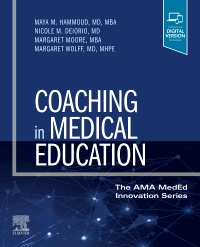

Coaching in Medical Education - Elsevier E-Book on VitalSource, 1st Edition
Elsevier eBook on VitalSource
Now $45.89
-
- Summarizes a set of robust theories, which form a scientific foundation for coaching competencies
- Gives clear guidance on coaching, as well as how to design, implement, and evaluate a coaching program in today’s institutions
- Explains the difference between coaching and traditional advising and mentoring.
- Discusses how to use coaching to develop the Master Adaptive Learner
- Provides various approaches for different levels of learners—remedial to advanced, UME through GME
- Offers practical frameworks for individual, team, and peer coaching
- Discusses how to use coaching to enhance wellbeing, strengthen leadership skills, foster personalized academic and career development, and increase resilience during change and acute uncertainty
- Contains tools for creating an ethical, equitable, and inclusive coaching program.
- Includes a chapter focused on Assessment and Program Outcomes
One of the American Medical Association’s ChangeMedEd initiatives and innovations, written and edited by members of the Accelerating Change in Medical Education Consortium – a unique, innovative collaborative that allows for the sharing and dissemination of groundbreaking ideas and projects.
Enhanced eBook version included with purchase. Your enhanced eBook allows you to access all of the text, figures, and references from the book on a variety of devices.
-
-
 Coaching in Medical EducationPaperback
-
-
1. Coaching in the Academic Environment
2. Coaching and the Master Adaptive Learner Model
3. Coaching Theories: A Scientific Foundation for Coaching Competencies in Medical Education
4. Competencies for Academic Coaches
5. Overview of Individual, Team, and Peer-Coaching
6. Applications of Coaching
7. Coaching for Performance Improvement
8. Coaching and Ethics, Diversity, Equity, and Inclusion
9. Examples of Successful Coaching Programs
10. Developing Coaches for Learners Across the Medical Education Continuum
11. Coaching Assessment and Program Outcomes
12. The Current and Future State of Coaching in Medical Education -
-
Ways of Reading
- The appearance of the text and page layout can be modified according to the capabilities of the reading system (font family and font size, spaces between paragraphs, sentences, words, and letters, as well as color of background and text)
- This e-publication is accessible to the full extent that the file format and types of content allow, on a specific reading device, by default, without necessarily including any additions such as textual descriptions of images or enhanced navigation
- No information about nonvisual reading is available
-
Conformance
- No information is available
-
Navigation
- Table of contents to all chapters of the text via links
- Page list to go to pages from the print source version
-
Rich Content
- No information is available
-
Hazards
- No information is available
-
Product Content
- No information is available
-
Legal Considerations
- No information is available
-
Additional Accessibility Information
- Page breaks included from the original print source
- For readers with color vision deficiency, use of color (e.g., in diagrams, graphics and charts, in prompts, or on buttons inviting a response) is not the sole means of graphical distinction or of conveying information
- E-publication includes basic navigation (usually less detailed than TOC-based navigation)
- Where links, controls or buttons are included in the content, the purpose or functionality of each link, control or button is apparent from the associated text alone - or where it is unclear, separate link, control or button descriptions are provided
- All (or substantially all) textual matter is arranged in a single logical reading order (including text that is visually presented as separate from the main text flow, e.g., in boxouts, captions, tables, footnotes, endnotes, citations, etc.). Non-textual content is also linked from within this logical reading order. (Purely decorative non-text content can be ignored).
- The language of the text has been specified (e.g., via the HTML or XML lang attribute) to optimise text-to-speech (and other alternative renderings), both at the whole document level and, where appropriate, for individual words, phrases or passages in a different language.
-
Ways of Reading

 as described in our